
[ad_1]

Rain, environmental degradation, alpine habitat, human shelter, trash: these are all themes evoked by Shifting Baselines, a new, temporary art exhibit now open at Keene Arts, and running until November 10th. Keene Arts is open each Saturday and Sunday from noon to five.
Shifting Baselines is referencing climate change and environmental degradation, and how each new generation risks perceiving what they grow up with as ‘normal’.

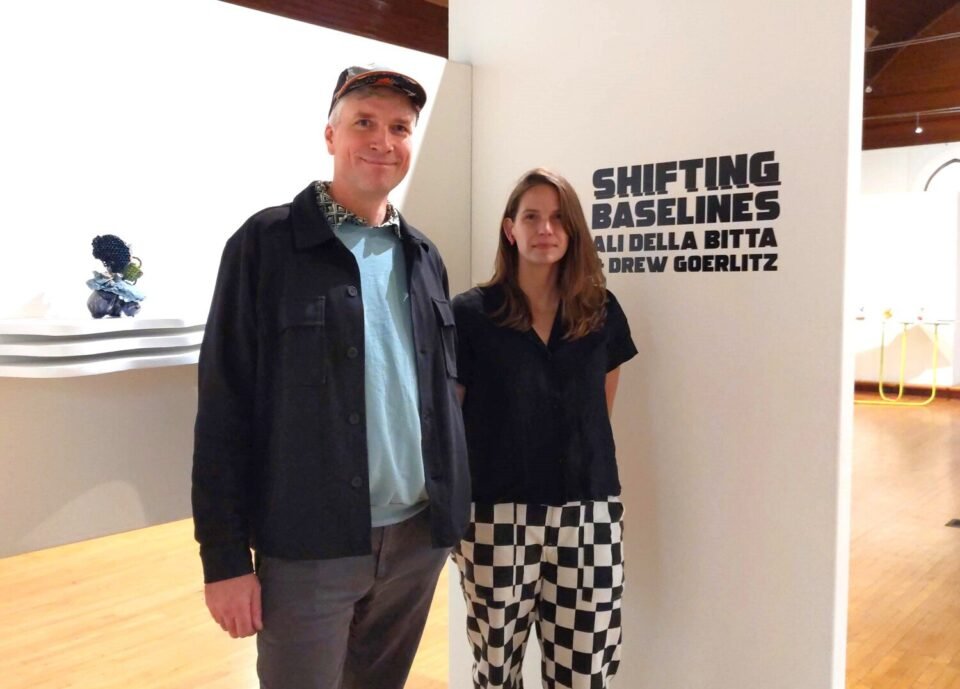
The show merges the art of sculptors and multimedia artists Ali Della Bitta and Drew Goerlitz. The two artists are married, and they both work as tenured art professors at SUNY Plattsburgh.
While the pair have collaborated on public art projects before, they’ve mostly worked independently. This new show merges their bodies of work: Della Bitta is showing ceramic and multimedia pieces, and Goerlitz is showing steel sculptures and photo-based installations.
The exhibit is a collaboration betweeb Della Bitta, Goerlitz, art curator Jason Andrew, and Keene Arts owner Malcolm MacDougall.
Keene Arts is an old church that has been turned into a gallery. It has white walls, wood ceilings, and colorful stained glass windows original to the church.
The artwork of Ali Della Bitta and Drew Goerlitz is “blended throughout the space,” said Goerlitz, “so we’re pairing our work by not only by size and volume, but also by aesthetics.”
Much of the work is colorful, which echoes the stained glass. It’s also varied in scale: huge steel sculptures, made by Goerlitz, intricate smaller multimedia pieces, made by Della Bitta, and mounted work of various sizes on the walls.
“Just having all of this range and different surfaces, different detail, I think it gives a lot for the viewers to kind of walk around and investigate,” said Della Bitta.
One of Goerlitz’s newer works is called ‘Monoculture,’ and is a digitally altered photograph on plywood. “The photograph print has been sliced along with the plywood and curved,” explained Goerlitz. “The original image is of a cornfield, or monoculture, and the landscape is digitally removed, just leaving the cornfield and the clouds.”

“An interesting fact about corn is how much more moisture corn gives off per acre than, say, a forest,” said Goerlitz. “So that’s also leading to excessive amounts of rain. I’m trying to make the viewer see the the clouds in a bit of a different way, which is why I remove the landscape out of it and fracture the image as well.”
Ali Della Bitta’s ‘Landscaping Memory’ series is one she’s been working on for several years now. She has multimedia and ceramic pieces from it displayed on a specially built table. “This series is sitting on these fractured geometric plywood forms that are different levels, resembling topography. And it rests on what I consider kind of guardrails, hand railings that you would see in construction zones.”
She says the table is temporary, unsteady, and unsafe – all themes of the work. “It’s about pairing moments in the landscape, memories of a landscape. The idea of how we’re impacting our landscape and how it’s coming out in these fractured moments.”
The pieces themselves are a startling mix of materials. “You’ll see things that are very organic and plant-like. You’ll see things that are actually debris that I picked up on a construction site. There’s lots of plastics that are reused rubber. So I’m trying to take things out of the waste and reuse them,” said Della Bitta. “And that’s all part of the dialogue of what we’re doing with our landscape and how we’re interacting with our landscape.”
The name of the show, Shifting Baselines, refers to environmental change and human reactions to it. Della Bitta says anytime artists exhibit their work they hope “that the viewer will engage. And that’s going to be on whatever terms that they want, whatever they’re bringing to the table.”
She imagines oas viewers read and think about the titles of the work, “they’ll get the idea that we’re talking about the changes in our environment, and [that] we’re very focused on what that means for this area and native plant species. And what the community is seeing.”

Goerlitz says he’s trying to communicate to viewers “that the world that we live in is is very artificial. Even though we live in this beautiful area [the Adirondacks], this whole area was clear-cut at one point, and so we – and all of its inhabitants – kind of change and move with it.”
All of the photos included in Goerlitz’s work were taken within the last year, and most of them were taken within the Adirondack Park. “There’s a lot of photos of barren ice,” he explained, referencing last winter’s constant freeze-and-thaw cycle.
That new landscape gave him a new color palette. “As an artist, looking at ice with the brown of the trees in the background, that was giving me a different color palette than I’m used to. Because I’m normally used to looking at snow in the woods and then snow on the lake and it really changes the color of what we see in the wintertime. It’s kind of me bearing witness to what is happening.”
Della Bitta says the Adirondacks play a huge role in her work, from alpine environments to bogs.
“I think for me, I am always outside,” said Della Bitta. ” There’s a couple of pieces, especially in Landscaping Memory, where you can see a bog. And that’s definitely from here [the Adirondacks], and investigating the small things.”
Della Bitta says she’s “horrible to hike with” because she moves through the landscape slowly. “I will stop and look at the smallest plant, and pick things up, and pick rocks up, and I will be way behind and have to run to catch up to everyone!”
That observation comes through in a series of photographs called ‘Have you taken your sunset today?’
Those photographs come from “the early month of lockdown of COVID, where I hadn’t been used to being stuck in this area and stuck in your house for a number of days.”
Della Bitta started looking at and photographing the sunset each night, “and it turned into this kind of record of time and record of noticing.”
She transferred some of those photos onto small ceramic tiles that hang on one of the gallery walls. “I think it gave us that kind of moment or that time, to look at things a little bit closer and find fractures and investigate things.”
Shifting Baselines is temporary art exhibit now showing at Keene Arts. It runs until November 10th. Keene Arts is open each Saturday and Sunday from noon to five.

[ad_2]
Source link