
[ad_1]
“Future Geographies: Art in the Century of Climate Change” is now on view at the VAG until November 15.
“How do artists help us understand and think through our shared future on this planet?” asks Eva Respini, Vancouver Art Gallery’s interim co-CEO and curator at large. Respini explores this question and many others in Future Geographies: Art in the Century of Climate Change, now on view at the gallery until November 15.
“This exhibition doesn’t have a lot of answers. It’s really about asking questions,” Respini said at the exhibition preview last week.
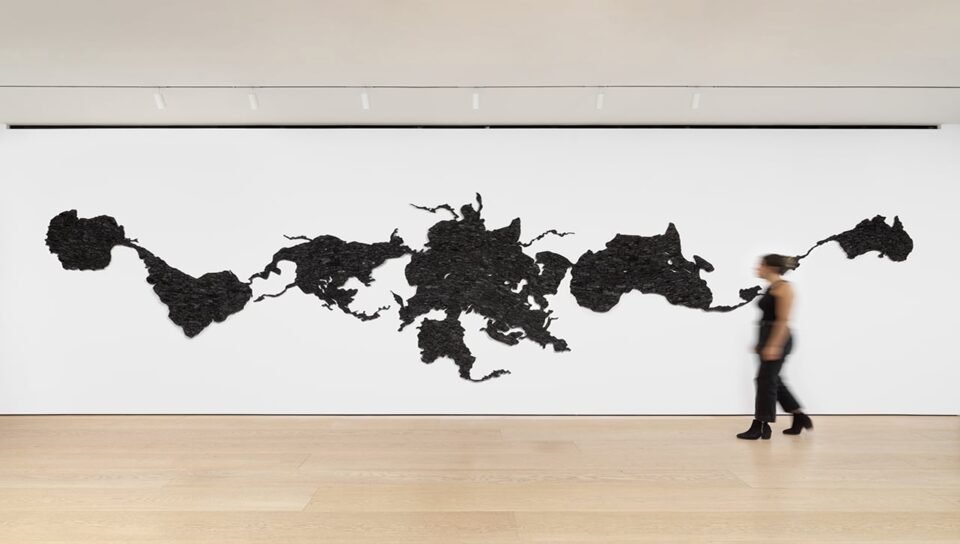
Future Geographies features more than 30 artists and over 35 works—including sculptures, paintings, video installations and photographs. Sustainability, migration, oceans and land use are only some of the lenses through which these artists view the climate crisis. Respini brings these disparate mediums and issues together under four themes: living knowledge, consumed earth, speculative worlds and material memory.
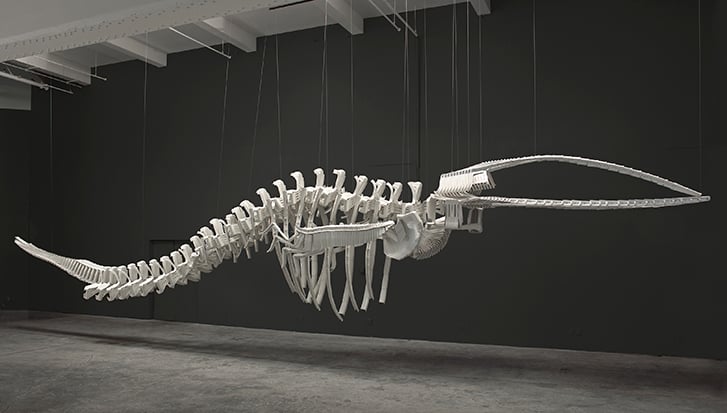
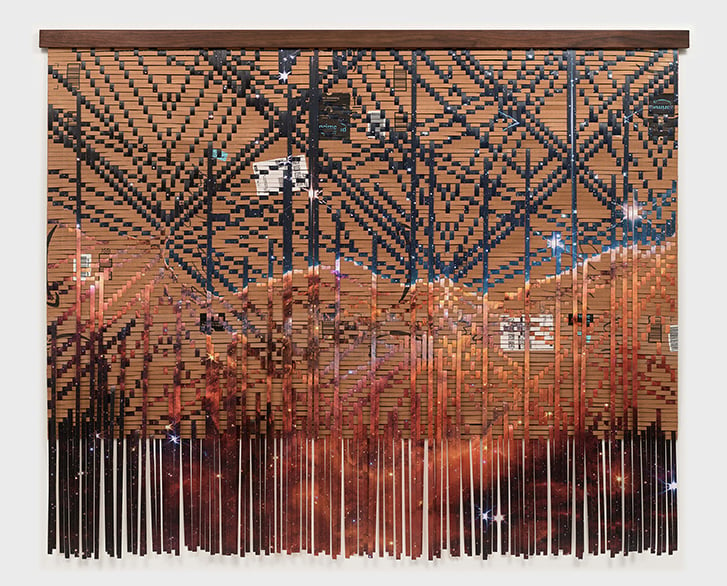
It is easy to focus on the exhibition’s show-stopping moments. For example, take Brian Jungen’s Cetology (2002), a colossal whale-skeleton sculpture created from plastic lawn chairs. Quieter pieces also deserve attention, like Brazilian artist Clarissa Tossin’s Future Geographies: Cosmic Cliffs (2023), a multimedia weaving of Amazon boxes and images of the cosmos, which also gave the exhibition its name. Explorations beyond the ground floor are also worthwhile: follow the escalator up to the satellite installation Sanctuary: The Ancient Forest Experience (2021), an immersive 360° experience set inside British Columbia’s last remaining ancient forests.
Sustainability is not only a theme of Future Geography’s curation, it’s an organizing principle. Wall labels are printed on scraps of reused cardboard rather than the standard vinyl; instead of transporting pieces by plane, all loans arrived via overland shipping. Respini also curated close to home—commissioning local artists and sourcing works already in the museum’s collection.
Of course, Respini isn’t working alone. This exhibition is the result of many collaborations, with major partners being the University of British Columbia’s Climate Action Lab and Dr. Sara Harris, department of Earth, Ocean and Atmospheric Sciences. More than 40 undergraduates created videos commenting on and providing scientific context for the artworks, even creating an emissions calculator to determine the exhibition’s environmental impact. Instead of printing a traditional catalogue, the gallery collaborated with Canada’s National Observer (an independent, digital news organization focused on climate reporting) to host the exhibition catalogue on their website.
In addressing the sometimes-difficult conversations that might arise from this subject matter, Respini focuses on the museum’s role of providing artists a platform to present challenging ideas.
“Artists are not journalists, and they’re not scientists,” Respini says, “but they do have a role to play in how we can think a little bit differently about this moment and how we can engage in dialogue that’s respectful and open.” Future Geographies is “not just provoking,” Respini says, “there’s a lot of beauty in this exhibition, too.”
Future Geographies: Art in the Century of Climate Change runs from May 14, 2026 to January 10, 2027. SANCTUARY: The Ancient Forest Experience is on view until November 15, 2026.
[ad_2]
Source link