
[ad_1]

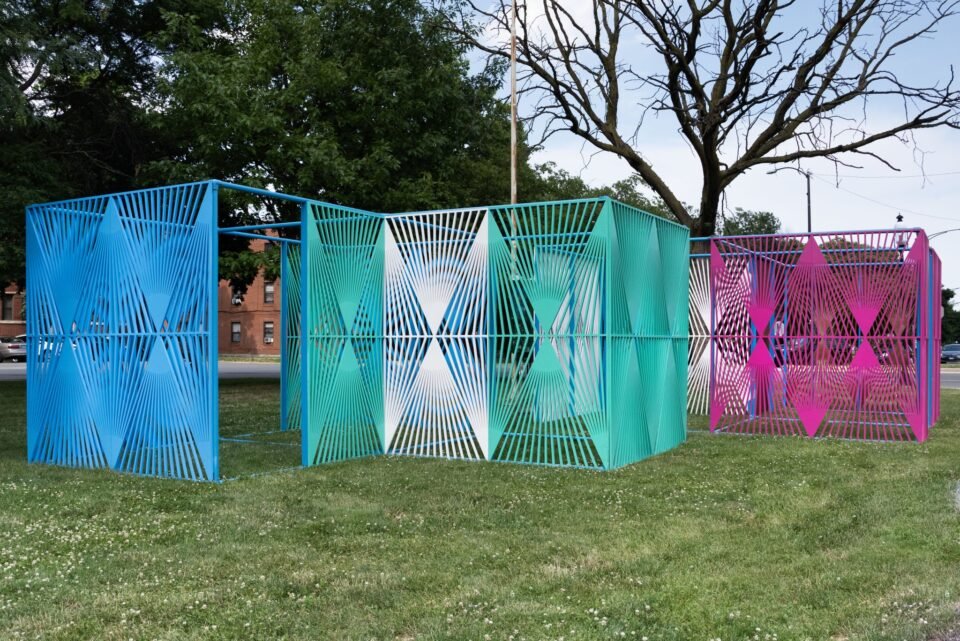
“La Casa de Todos / Everyone’s Home” by Edra Soto, 2024, pvc foam boards, aluminum, paint. At Comfort Station through November 2024/Photo: Maria Burundarena
Last year, Edra Soto had just about the best year an artist can have: in addition to solo shows at Engage Projects, Cleve Carney Museum and Hyde Park Art Center, her work was shown at New York’s LatchKey Gallery and acquired by the Whitney Museum. The coming of a new year did little to slow her momentum: she’s capping off 2024 with a large-scale installation at Pittsburgh’s Carnegie Museum of Art and solo showcases at Portland, Maine’s ICA and Chicago’s own Comfort Station.
Soto’s meteoric rise in the past decade can be attributed to the proliferation of her “Graft” series, which uses architectural motifs—wrought-iron gates called rejas and concrete fences known as quiebrasoles—that are ubiquitous in her birthplace, Puerto Rico. In “grafting” (as one might with skin) these forms of vernacular architecture from Puerto Rico to stateside art venues, Soto ignites a debate concerning the role which her island home plays in the larger culture and economy of the United States.
And now, as of September 5, an iteration of Soto’s “Graft” series will adorn the Doris C. Freedman Plaza at the southeastern entrance of Central Park in New York, one of the busiest spots in the country’s largest city. Its presentation outside of the white cube galleries and world-renowned museums which typically house her work allows it to pose a distinctly trenchant set of questions concerning the fate of Puerto Rican culture within an increasingly menacing status quo. I spoke to her on the occasion of its inauguration, discussing the new sculpture’s significance within her wider oeuvre, the evolution of her artistic practice, and what we can expect from her in the coming years.

Sketch by Edra Soto for Public Art Fund, 2023
The impetus of this interview is the inauguration of one of your sculptures at the Doris C. Freedman Plaza in Central Park, which is your public art debut in New York City. Additionally, in just the past couple years, you’ve won the Public Art Dialogue Award, had a comprehensive solo show at the Hyde Park Art Center, and even had your work acquired by the Whitney Museum. How do you feel right now, achieving milestone after milestone in your career?
I feel incredibly grateful that I get to enjoy the efforts of my labor in my lifetime. I feel inspired by my life’s journey which has allowed my ideas to evolve. Building myself was not easy. Arriving at this point feels like a combination of hard work, luck and great support. I want to add to the list of achievements you mentioned the U.S. Latinx Art Forum Artist Fellowship, the 3Arts Next Level Award, and most recently the Joyce Foundation Award with The Sculpture Center in Cleveland, to whom I will always be grateful for their trust and support.
Right now everything feels like work. I’ve been at the Arts/Industry residency at the John Michael Kohler Arts Center. At the factory in Sheboygan, Wisconsin, I’m making molds of objects that were significant during my upbringing in Puerto Rico—and subsequently casting them. It’s been a beautiful and rewarding time of making work in a studio with an expert technician and factory workers’ assistance. It is a privilege to be given the opportunity to generate work that would have cost thousands of dollars to produce independently. I’ve been commuting from Sheboygan to Chicago to continue working at my Chicago studio and spend time with my family over the weekends. I’ve been away many times to work at art residencies and being at home is very important to me at this moment of my life, but when Kohler invited me to do a residency, I just had to take it and work around it. My husband, Dan Sullivan, has been helping me manage many of my projects through his company Navillus Woodworks. Everyday I have a conversation with my husband about what is happening and what needs to happen. As he has described it many times, I’m one of his top clients. We have learned how to work together and enjoy the process. We remind ourselves daily how privileged we are to be making and doing what we love.

“La Distancia” by Edra Soto, 2023, concrete. At The Floating Museum (permanent)/Photo: Jeremiah Hulsebos-Spofford
Though you began your “Graft” series back in 2013, it’s still ongoing. Has the series changed since its inception? What about rejas and quiebrasoles prove continually intriguing for you as an artist?
As time goes by, things change—I have changed as well. The relationships that have tied me to Puerto Rico have changed. At some point Puerto Rico suffered from dramatic and tragic changes [Hurricane Maria], I can go on and on. I continued to hold on to “Graft” because as a continuous form of manifestation, I continue to see its potential and its evolution has become evident. “Graft” addresses my complex sentiments generated by migrating to Chicago while remaining connected to Puerto Rico—a feeling of dislocation compounded by Puerto Rico’s ambiguous status as an unincorporated territory of the United States.
“Graft” opens connections between Puerto Rican communities across the city and reminds us of the centrality of the Caribbean to the history of New York City and the United States. Early iterations of “Graft” were presented solely as architectural interventions complemented by literary components. Exhibiting “Graft” at conventional gallery spaces demanded a new set of considerations to engage viewers. Those challenges lead me to integrate the archive that informs the work with its architectural components. The archive consists of photo documentation of my journeys to Puerto Rico, documentation of the advertising that impacts the tourist sector, political propaganda, television and media, military colonial architecture as well as residential architecture, life inside the home and memorabilia. I started using and have continued to use viewfinders to incorporate my photo documentation. All the photos are taken with my phone as it is immediate and the most accurate and pragmatic way to represent a fast-paced journey. The iteration titled “Manual Graft” added a performative component to shed light on the making process. I think of my painting series titled “Dos Cuerpos” in 2022 and a series of wall sculptures titled “por la señal” in 2023 as a part of a more personal expression that happens for the most part in my studio. It varies in scale—could be large but also very small—and demands close attention from the viewer. From the physical journeys to the religious upbringing, this form of expressing my migration has opened up my ways of representing residential architectural motifs. Last year I started to visualize parallels between the rejas design motifs and a tabernacle—a devotional centerpiece also known as “the place of dwelling”—a vision that impacted my upbringing while attending Catholic school. In questioning methods of indoctrination by colonial traditions, I reclaim the tabernacle as a space for personal memories. This series is complemented by photo documentation of my family memorabilia—home life.

Edra Soto with her piece “El Destino / Destination,” 2024. At the Carnegie Museum of Art exhibition, “Widening the Lens: Photography, Ecology, and the Contemporary Landscape,” through January 12, 2025
While you’re no stranger to public art (as anyone who’s seen your installation at Western on the Blue Line knows), most of your work is experienced in the setting of a gallery or art museum. How do you hope a public setting will affect the perception of your work?
Art in a public setting has a greater chance of becoming culturally influential and accessible by the masses. Growing up in mainstream Puerto Rico makes me a bit sensitive to the general public’s cultural consumption. I take care to advocate for the lower- and middle-class communities of Puerto Rico when I craft my work. The cacophony of Puerto Rican, American and other cultures is easier to visualize as you acquire a certain perspective. Being away from home has allowed me to arrive at a genuine voice, the expression that captures the moments and details that have shaped my thoughts and ideas. I can’t imagine making this work without enough physical distance from Puerto Rico. I hope that my work echoes genuine aspects of Puerto Rican culture that are not present in the current cultural narrative, which is an amalgamation of tropical tropes, commerce and its colonial history.
What sort of relationship do you think your new sculpture will take on with the city’s architecture? Will it be assimilated or remain distinct?
“Graft,” the title of my work at Central Park, will be located at the Doris C. Freedman Plaza, which is at the most prominent and busiest entrance to Central Park in New York City. Central Park is not only the oldest park in the United States, but comprises fifty-eight miles of pedestrian routes merged into one single line. Another well-known fact is the difficult history of affluent people pushing away marginalized communities to build the park.
A representation of Puerto Rican residential architecture will be a great contrast at various levels and recognizable to many, especially the Latinx communities living in New York City. The location brings people together from all over the world who are either passing by or who go there to visit or work. There are vendors, food trucks, hustlers, indigents, artists, you name it. An entrance location contributes to the overall identity of the built environment and plays an important role in the impressions and experiences formed by its visitors. Instead of making a type of gate, “Graft” will read as a house façade. Made from Corten steel and terrazzo, “Graft” is a monument to working-class Puerto Rican communities. Three tables welcome visitors into the installation, providing an amenity for rest, connection, moments of reflection, or just a place to sit and eat lunch. The sculpture creates a threshold, with one side representing a building exterior, while the other creates the illusion of a lived-in home. Its placement prompted me to continue thinking about monumental qualities—the sculpture’s scale aligns with the scale of a common Puerto Rican house.

Edra Soto at the Arts/Industry residency at the John Michael Kohler Arts Center
You’re well-acquainted with New York as well, but you’ve shown more of your work in Chicago. Will New York City’s historical status as the stateside hub of the Puerto Rican population impact the effect of your work?
It is a well-earned status! I greatly admire and respect Nuyoricans and Latinx communities’ commitment to culture in New York City. It is palpable and like no other… Like a perpetual celebration. The Clemente, El Museo del Barrio, El Centro and the Latinx Project are just a few of the arts organizations that are constantly reaching out to artists to engage in cultural conversations and develop their educational programs. Their common mission is to highlight and make visible the arts and culture of Latinx communities. Then there are people like Marcela Guerrero, curator at the Whitney Museum of American Art, who went above and beyond to make sure Puerto Rican artists were collected at the Whitney, carving a space for Latinx communities in its collection.
You received your MFA in painting from the School of the Art Institute, and in a conversation last year with Mana Taylor at Newcity, expressed a desire to return to that medium. Can we expect a resurgence of painting in your artistic practice anytime soon?
My process is quite intuitive. It’s very hard for me to predict what is going to happen. I love taking risks and experimenting with new materials. I also have ideas that sometimes have taken me years to make. I convince myself that the time is not right, until it is. I think I’m very much driven by providing creative solutions using any type of material. The material is considered but it is very much a response to the place or type of space where the work will be displayed. I made a series of paintings a year ago that I titled “Dos Cuerpos.” Using abstractions sourced from the residential motifs I represent in “Graft,” I created over seventy compositions using leftover materials, as stencils, and decorative house paint. I continue to incorporate paint and textures in my latest sculptural work,“por la señal.” A grouping of this series is on view at Mariane Ibrahim in Chicago. I will be presenting a few more of these works at Morgan Lehman Gallery and at the Armory Show with Embajada in New York this fall.
What are you hoping viewers will take away from this installation?
Immersive moments, learning experiences and nostalgic feelings. I’m also hoping that the domino-game activations [to be facilitated at the sculpture’s tables by The Clemente] provide excitement and new connections among the commwunities involved. Perhaps my biggest hope is that “Graft” heightens the cultural value of the lower- and middle-class homes of Puerto Rico. Pushing and shifting the paradigm, challenging the current narratives, providing awareness and offering alternatives is what we can do as artists—understanding that what we already have is valuable and that appreciating its value could potentially ignite a great sense of pride and care.
[ad_2]
Source link