
[ad_1]
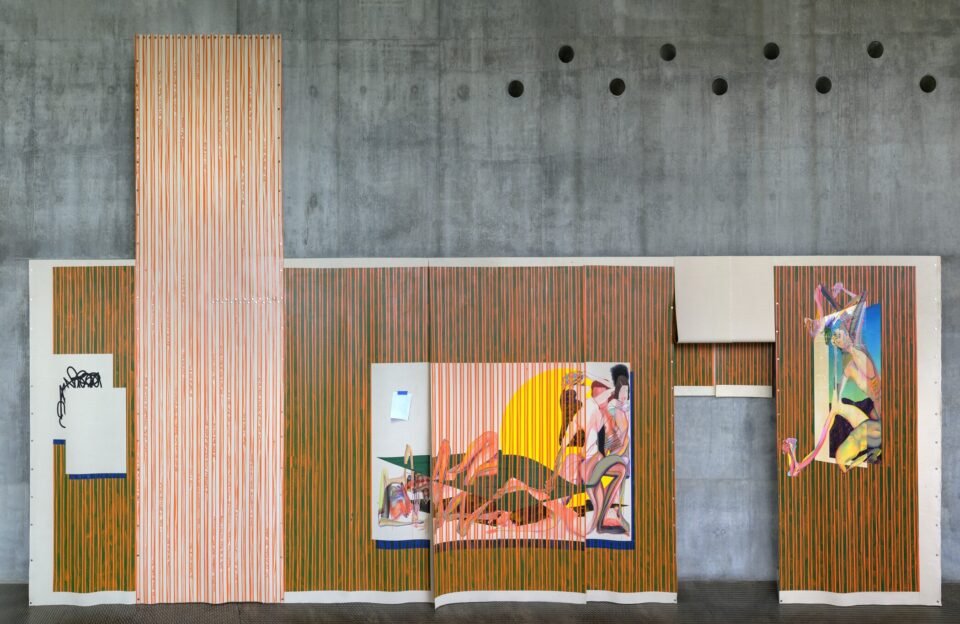
Los Angeles–based artist Christina Quarles is known for large-scale canvases that explore what it feels like to inhabit a body shaped by identity and lived experience. Now We’re There (And We’ Only Just Begun), recently acquired by LACMA, features luminous, shape-shifting figures that invite visitors to consider how we understand ourselves and how we are perceived by others.
Now on view in the W.M. Keck Foundation Gallery, it is the inaugural exhibition of a series devoted to working contemporary artists presented in the new space. We recently had the opportunity to talk to Quarles about the ideas behind the work, the themes of her larger practice, and her memories of the museum.
Is it true you grew up nearby?
Christina Quarles: I grew up on Wilshire and Mansfield, which is just about a mile away from LACMA. I would come to the free jazz nights on Fridays. I took art classes here as a kid. I really got to know the museum as my sort of home away from home.
How does it feel to have a piece here now?
CQ: It’s amazing. I remember when I was in third grade, we did this art project where we looked at all of the tea cups on display, and then we got to make our own paper tea cup that was displayed, so you could say this is my second showing at LACMA. As a little kid, I could never have dreamed of having something above the basement floor, which I think is where they displayed the third-grade artworks.
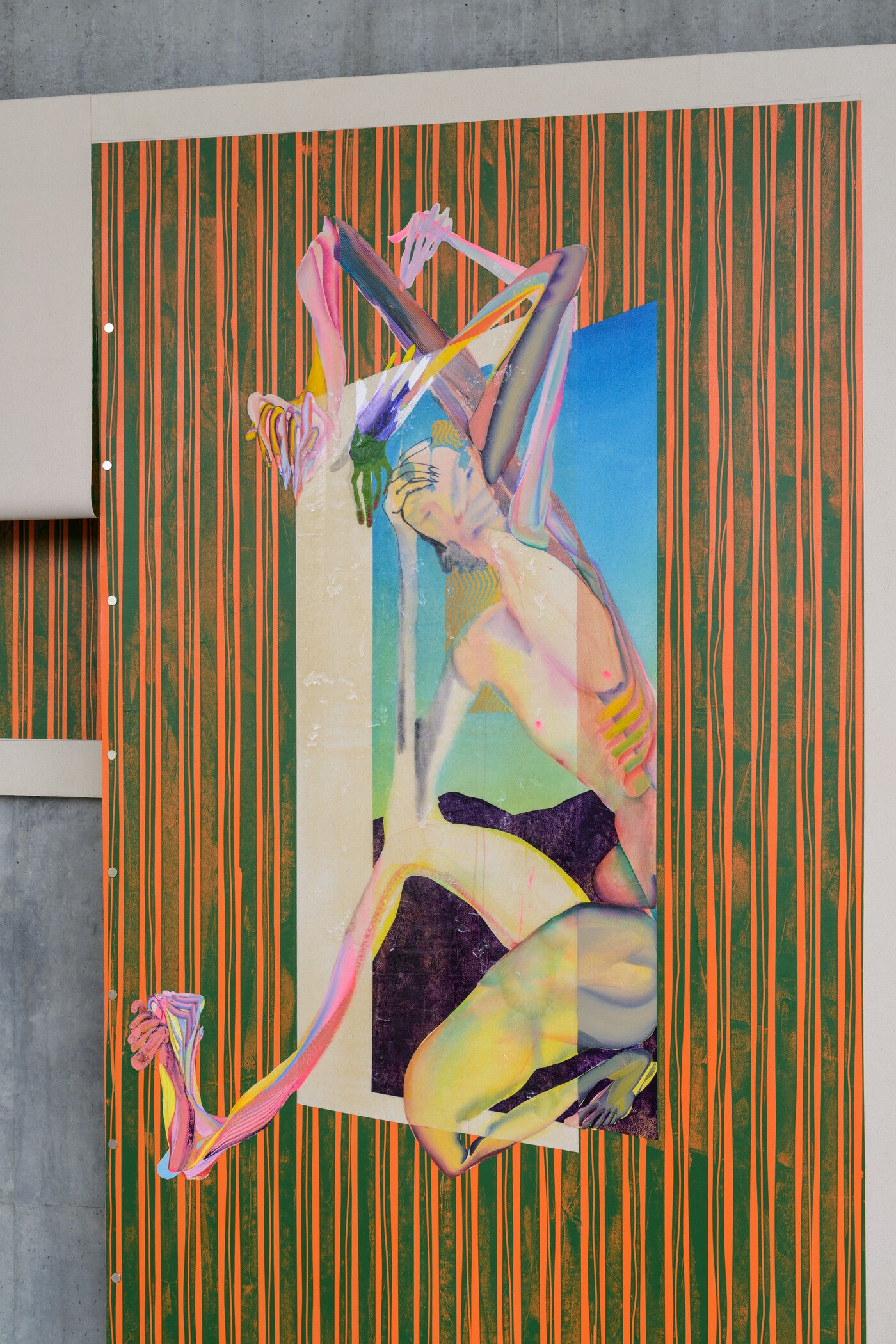
Christina Quarles, Now We’re There (And We’ Only Just Begun) (detail), 2023, Los Angeles County Museum of Art, purchased with funds provided by Shari Behnke and Paul Britton, © Christina Quarles, photo © Museum Associates/LACMA, by Jonathan J. Urban
Tell us about your work on view.
CQ: This piece is a large-scale installation called Now We’re There (And We’ Only Just Begun). Like many of my pieces, the title comes from a misremembered song lyric, and I was thinking a lot about confusion of place. Some of my installations are a way of expanding beyond the painted frame. Typically, my work exists as paintings on canvas, but when I do these large-scale installations, suddenly the edge of the canvas is not the edge of the picture plane—the piece expands beyond and encapsulates the entire room. The figures are able to exceed the frame and exceed the edge of the canvas, because it’s all trompe-l’œil.
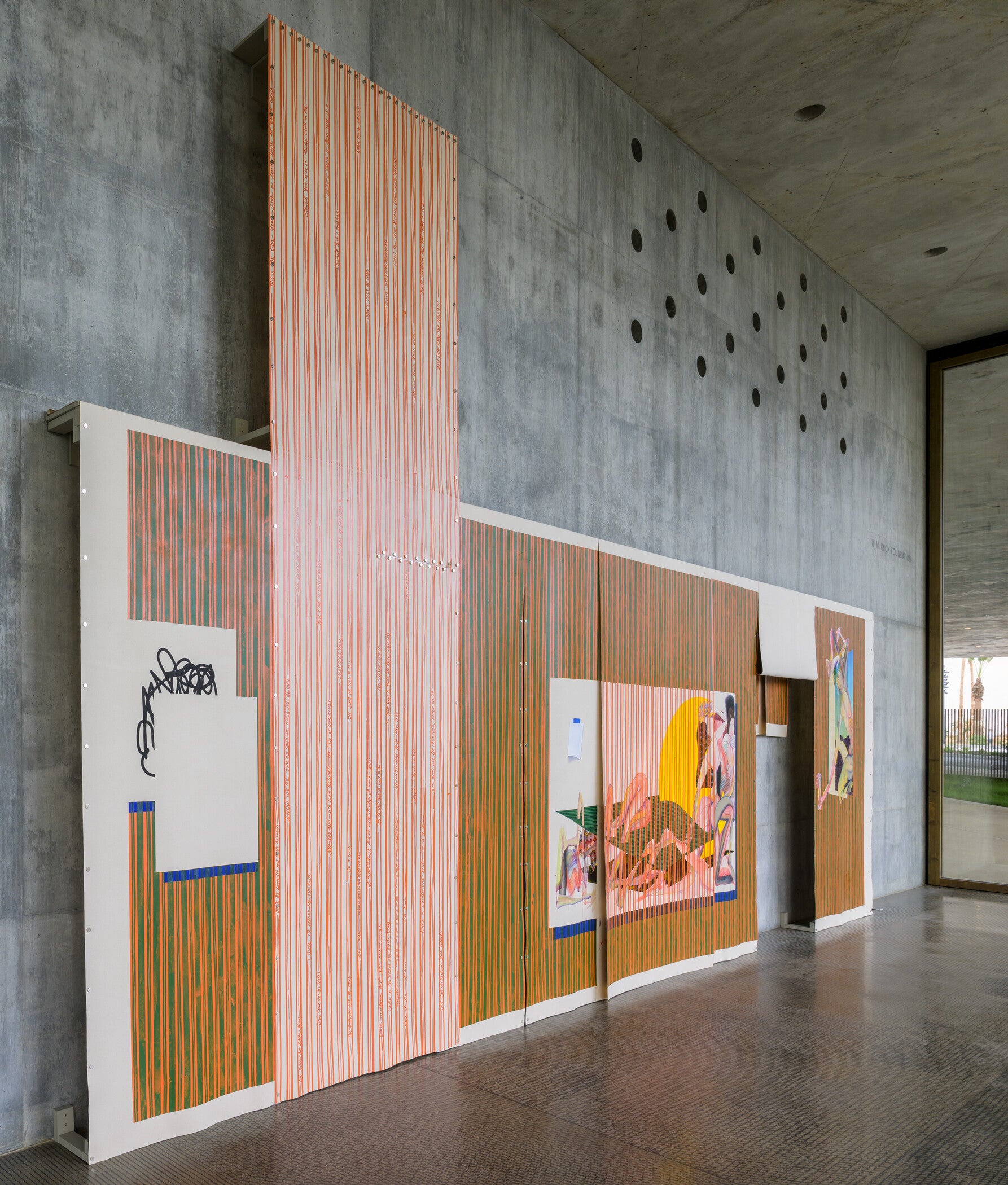
Christina Quarles, Now We’re There (And We’ Only Just Begun), 2023, Los Angeles County Museum of Art, purchased with funds provided by Shari Behnke and Paul Britton, © Christina Quarles, photo © Museum Associates/LACMA, by Jonathan J. Urban
Can you talk more about that aspect of trompe-l’œil, or illusion, in your artwork?
CQ: I try to build compositions that contend with the materiality and the edge of the frame. If you look at this painting on your phone or in a reproduction, it’s going to look very graphic, and you might think that these are just canvases on top of a striped wall. But the more you look at it, the more you might begin to ask: how is this possible? And the only way that that’s possible is for the entire thing to be made of paint. I’m really interested in having this be something that constantly reminds viewers that this is just an illusion, that these are constructed images. Maybe when we spend a bit longer looking, we can begin to question the assumptions behind how we’re trained to see.
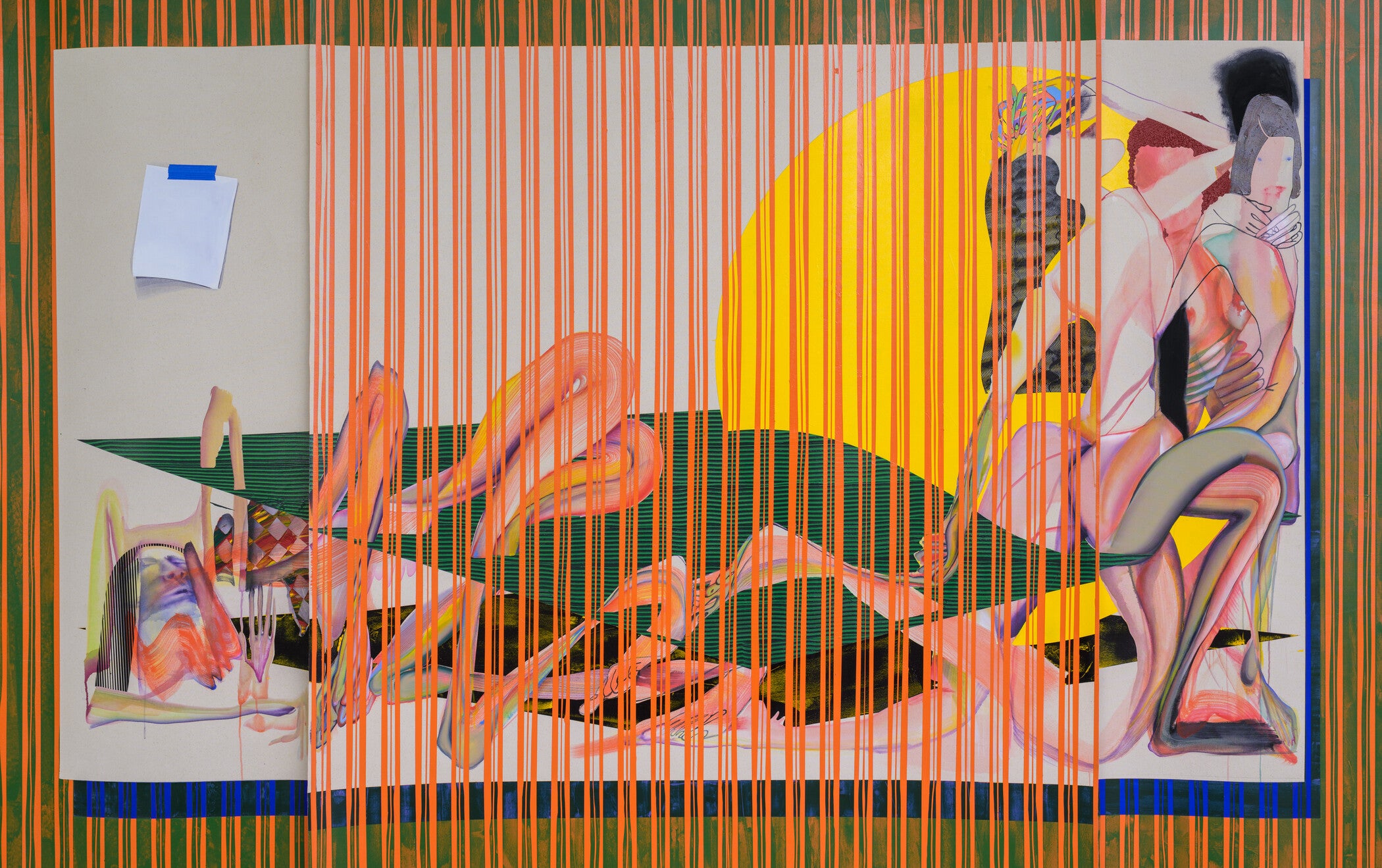
Christina Quarles, Now We’re There (And We’ Only Just Begun) (detail), 2023, Los Angeles County Museum of Art, purchased with funds provided by Shari Behnke and Paul Britton, © Christina Quarles, photo © Museum Associates/LACMA, by Jonathan J. Urban
What motivates your practice?
CQ: The reason I started painting was to describe and understand aspects of myself that I felt were not represented in the world or pictorially. If people have been existing in a body, for example, that feels like it hasn’t quite been able to fit into the norms of the society that we’re living within, I hope that the work is a place where people can feel seen, or a place where people can find respite. And if you’re somebody that moves through the world effortlessly and doesn’t have to question aspects of your identity, I hope that the work is a place where you can begin to ask some of those questions.
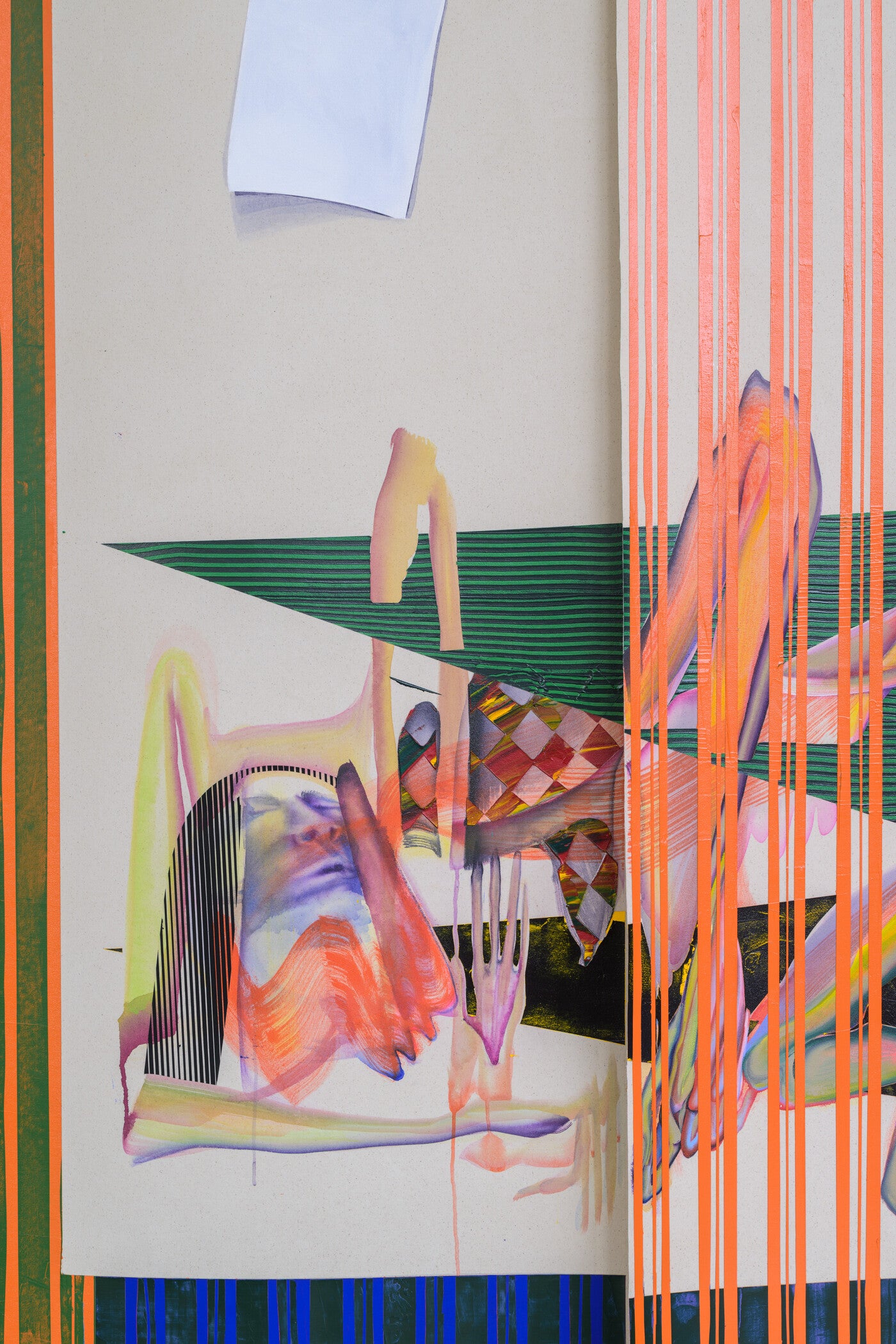
Christina Quarles, Now We’re There (And We’ Only Just Begun) (detail), 2023, Los Angeles County Museum of Art, purchased with funds provided by Shari Behnke and Paul Britton, © Christina Quarles, photo © Museum Associates/LACMA, by Jonathan J. Urban
What aspects of your identity inform your work?
CQ: I think we are often most aware of the parts of our identity that stray furthest from the norms of society. For me, something that was a constant question growing up was how to describe my racial identity. And it wasn’t that I had a problem with how I would describe it—it was more that when I would tell kids on the playground, “I’m half Black, I’m half white. My dad’s Black, my mom’s white,” it would be met with resistance. So from an early age, I had this disconnect between how I saw myself and how others saw me. That’s something that has really motivated me to make work. It’s a way of working with representation and working with these pictorial norms to undo the assumptions of what we see and hopefully find a place of questioning and self-making.
[ad_2]
Source link