
[ad_1]
Plato’s Republic is often remembered for its vision of justice, philosopher-kings, and hierarchy of souls, yet one of its most misunderstood passages remains the call to ban imitative art from the ideal city. Many modern writers, readers, and even philosophers find this shocking. Nietzsche, for example, imagines Plato as an enemy of art, while Karl Popper sees him as a censor, even a proto-totalitarian. But this is inaccurate.
Greek philosopher Plato did not hate art. He loved it too deeply to let it become a drug. His purpose in banishing imitative poetry was not to silence the imagination but to protect the soul from disunity. He saw that imitation, when separated from truth, breaks the harmony of both the citizen and the city.
The polis as a living organism, art, and the fragmented soul in the Republic by Plato
In the Republic, the polis (city) is a living organism. Each part has its own function, nature, and measure. Justice arises when every part performs its proper role without trespassing on another. When reason rules, spirit defends, and appetite obeys, the soul is just. When the rulers, warriors, and craftsmen each fulfill their work efficiently, the city mirrors that same inner harmony.
However, imitation, Plato warned, threatens that harmony. In Book X, he calls the poet “an imitator of appearances.” The craftsman makes a bed that imitates the Form of the Bed. The painter then copies that bed, producing an image twice removed from truth. The same is true of poetry. The poet imitates human emotions and actions, not in their rational order but in their passionate confusion. He invites his listeners to live through borrowed feelings.
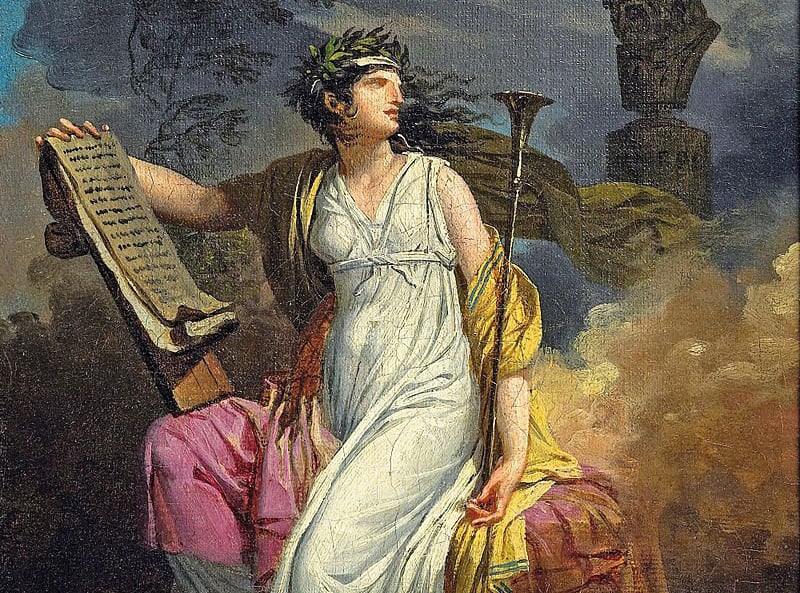
In Book III, Plato illustrates this through Homer. Homer does not speak in one voice; he becomes everyone at once. At one moment, he is Achilles raging in battle, while the next moment, he is Nestor giving counsel, and then Agamemnon grieving or rejoicing, shifting endlessly among roles. To Plato, this fluidity was dangerous. It trains the listener to do the same—to identify with the hero, then with the coward, and later on with the weeper or flatterer.
The result is a fragmented soul. The citizen learns to imitate every passion and personality. He no longer knows which one is truly his own. Moreover, the child listening to such poetry might love Achilles one day for his fury and Nestor the next for his prudence. In time, he becomes an imitator of imitators—a self built from borrowed moods.
How Plato aimed to prevent the destruction of his Republic through art and imitation
Plato aimed to prevent this disintegration. He wished to raise citizens who would not envy the heroes of story but honor their own measure. He feared that those who fill their imagination with other people’s lives would neglect the shaping of their own. The guardians of his city could not be actors; they had to be themselves—unified, steadfast, and free from inner contradiction.
Imitation, in his eyes, leads to envy and instability. It awakens the lower parts of the soul—the appetite for spectacle, grief, and admiration. It makes the emotions dominate reason. The more a man imitates, the less he becomes. The more he copies, the less he knows himself.
This, Plato believed, was not merely a personal weakness but a civic danger. When citizens imitate everything they see, the city loses its structure. The craftsman wants to rule, the ruler chases luxury, and the soldier becomes soft. The city collapses because its souls have lost their nature. Justice, which is harmony, fades in the noise of imitation.
His solution was not censorship for political control but purification for spiritual health. Plato wanted poetry that guides the soul upward rather than outward. He also wanted art that reflects the divine pattern rather than multiplying distortions of it and wished for education that tunes the emotions to truth so that each soul could live in harmony with itself and the whole.
Modern readers often miss this point. They treat Plato’s Republic as a treatise on politics rather than a map of the soul. His “ban” on poets was not an act of tyranny but a call for inner coherence. He wanted citizens whose imaginations serve their reason and doesn’t dominate it.
The modern cave: Social media and pop culture
If Plato could see the world today, he would recognize the very disease he feared. We live surrounded by imitation. The poet’s stage has become the screen of every device. The multitude of shifting voices that once spoke through Homer now speaks through movies, series, games, and social media. Every image invites imitation, and every life becomes a mask we wish to wear.
The modern self, like the soul in Plato’s Book X, stands before a mirror of shadows. We no longer live—we perform. The line between being and acting has vanished, and people switch roles as easily as Homer switched voices. They curate their personalities the way poets compose scenes. The result is anxiety, envy, and exhaustion.
Plato foresaw this centuries ago. He knew that a soul scattered among images grows weak, unable to love one thing purely. Such a soul cannot find its own measure. The flood of imitation drowns out the voice of the daemon—that inner guide whispering what each of us was born to be.
His “censorship” was meant to heal this. He wanted stories that taught self-knowledge, not self-forgetting. Plato wanted citizens to admire virtue in their own form rather than chase the illusions of others. His ban on Homeric imitation was a warning: do not become divided within yourself. Love your own rhythm and let your being speak in its natural voice.

Art education and Plato
When modern writers accuse Plato of suppressing art, they expose their own misunderstanding. They no longer see art as revelation but as entertainment, confusing freedom of consumption with freedom of the soul. Plato’s question still cuts through time: what kind of art shapes the soul toward the Good, and what kind shapes it toward chaos?
Plato asked for musical education—the training of the soul to love order, proportion, and simplicity. We must learn to admire without envying and to see without imitating. True education begins in stillness when the soul hears its own harmony again.
Socrates lived this truth. Barefoot, ascetic, and free, he needed no possessions or roles. He loved wisdom, not wealth or power. He was the opposite of the imitative man. His life showed that happiness comes when the soul aligns with its nature and loves the Good for its own sake.
Plato’s Republic is not a manual for censorship but a mirror for the modern soul. It teaches that imitation, left unchecked, breeds alienation. To live surrounded by images is to forget being. To envy every hero is to lose one’s own. The cure lies in simplicity—in learning once more to love the form that lives within us.
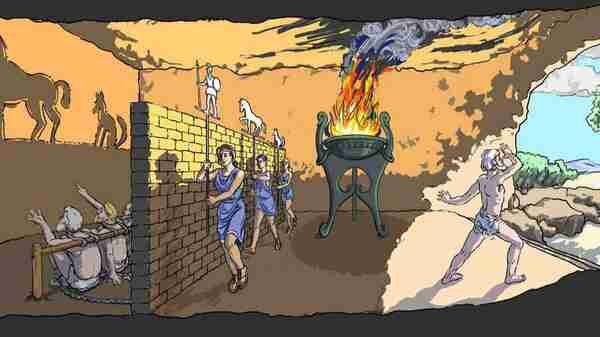
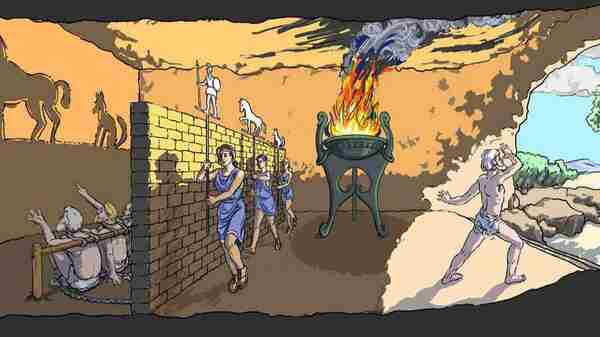
Today, our cave glows with the light of screens instead of fire. Yet the shadows are the same, and the way out, as Plato said so very long ago, begins the moment we turn around—not toward more images but toward the light of our own truth.
[ad_2]
Source link