
[ad_1]
The skeletal remains of a gigantic former ironworks have been resurrected as a colossal canvas, with dozens of urban artists descending upon a UNESCO World Heritage site to orchestrate a breathtaking collision of industrial decay and modern creativity. The Urban Art Biennale 2026 at the Völklinger Hütte in Germany has transformed the rust-stained monuments of a bygone industrial era into one of Europe’s most vital and anarchic contemporary art exhibitions.
This massive convergence of global talent challenges traditional curatorial boundaries, forcing art out of the sterile confines of the conventional white cube and thrusting it into the raw, unforgiving architecture of heavy industry. By reclaiming spaces originally designed for the brutal extraction of raw materials, these artists are authoring a profound narrative on memory, obsolescence, and the regenerative power of street art on a monumental scale.
The Architecture of an Industrial Behemoth
Located in the Saarland region of Germany, the Völklinger Hütte ceased its massive iron production operations in 1986, leaving behind a sprawling, apocalyptic labyrinth of blast furnaces, burden sheds, and towering smokestacks. Designated a UNESCO World Heritage Site in 1994, it stands as the only intact example of an integrated ironworks from the golden age of the iron and steel industry. For the sixth iteration of the Urban Art Biennale, 50 premier artists representing 17 different nations have converged on the site to create works specifically tailored—in situ—for the complex spatial dynamics of the complex. The general director of the site, Ralf Beil, noted that the location represents the absolute core of street art and graffiti culture, which historically gestated in the abandoned industrial sectors of declining urban centers. The artists are not merely hanging canvases; they are engaging in a visceral dialogue with the rust, the vast dimensions, and the lingering ghosts of the thousands of laborers who once toiled in the extreme heat of the furnaces.
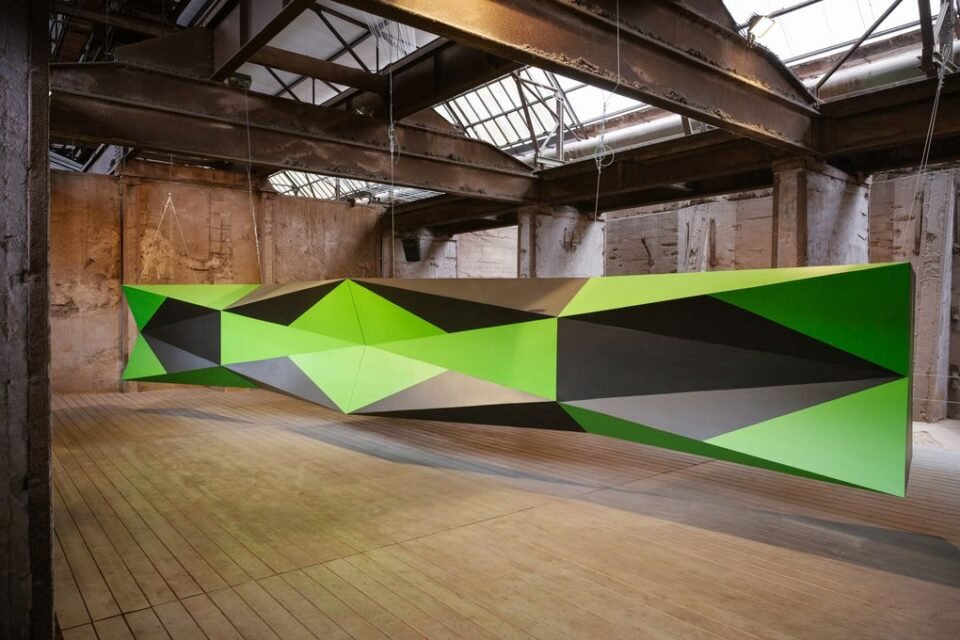
The sheer scale of the installations demands structural engineering as much as artistic vision. Graffiti pioneer Boris Tellegen, operating under the renowned moniker DELTA, has translated his signature three-dimensional typographical style into a gigantic, two-tone wooden sculpture named “One Beam,” which dramatically illuminates the dark interior of the ironworks. Meanwhile, the French-based collective Vortex-X has executed a striking intervention titled “Memory in Transit,” stretching brilliant rays of white industrial fabric across the cavernous expanse of one of the main production halls, creating a stark, ethereal contrast against the corroded machinery.
Provocative Commentary on Modernity and Decay
The thematic undercurrent of the 2026 Biennale is heavily steeped in socio-political critique. Spanish artist Ampparito executed a massive typographical piece on the roof of one of the massive sheds, painting the phrase “no hay nada de valor” (roughly translating to “There is nothing of value here”) in gigantic white letters. The cynical message, best viewed from a towering 45-meter observation platform, operates as a sharp satirical jab at capitalist valuations of property and history. In another haunting installation, France-based artist Tomas Lacque created a tableau featuring a small van, discarded tires, and debris buried under a uniform coat of ashen paint. Positioned directly within a hall where furnaces once burned at staggering temperatures, the piece evokes the petrified ruins of Pompeii, offering a chilling commentary on fossil-fueled mobility and the eventual, inevitable collapse of the hyper-industrialized age.
Global Parallels: Reclaiming the Urban Landscape
The philosophical drive behind the Völklinger Hütte exhibition resonates profoundly on a global scale, mirroring the artistic reclamation of discarded spaces across the African continent. In Nairobi, the transformation of abandoned warehouses in the industrial area and the vibrant mural culture exploding across urban transit corridors share the same genetic code as the German biennale. African street artists, much like their European counterparts, utilize the scarred architecture of their cities to reclaim public narratives, challenge institutional authority, and inject humanity into spaces designed purely for commerce. The Biennale serves as a powerful testament to the universal language of urban art, proving that graffiti has permanently evolved from a marginalized act of vandalism into a highly sophisticated, globally recognized mechanism for architectural and historical preservation.
Key Highlights of the 2026 Biennale
- A monumental in situ installation by Baptiste Debombourg featuring industrial clothing heavily studded with dangerous shards of mirror glass.
- A delicate, expansive spider’s web crafted from crocheted doilies by Polish artist NeSpoon, suspended between the sintering plant and the burden shed.
- Performative art by Igor Ponosov, who translates the historic, rhythmic physical movements of the former ironworkers into a striking physical choreography.
- A sprawling urban art book fair hosting over 80 specialized publishers from 22 countries, accompanied by documentary screenings and workshops.
As visitors navigate the perilous catwalks and cavernous halls of the Völklinger Hütte, they are forced to confront the transient nature of human ambition. The Urban Art Biennale does not attempt to hide the decay of the ironworks; instead, it aggressively amplifies it, proving that the most profound artistic statements are often found in the places society has chosen to abandon.
[ad_2]
Source link