
[ad_1]
When we talk about feminist art, performance, or body art today, it is almost impossible to avoid VALIE EXPORT. The Austrian artist, born Waltraud Lehner, radically changed the way we think about the body, the gaze, women in public space, and the relationship between art and politics from the late 1960s onward. Her performances were never created as provocation, but as a direct response to a society that viewed the female body as an object rather than an autonomous subject. Today, she is considered one of the key figures of the feminist avant-garde and a pioneer of media and performance art.
Related: Vesna Perunović on her new exhibition, home and gestures of repair
One of her most famous statements was: “The female body has always been a construct.” That idea runs through almost her entire body of work. Through performances, films, and photographic works, she sought to dismantle the notion of the female body as something that naturally belongs to the gaze of others, pointing to how deeply our ideas of femininity are shaped by social expectations, popular culture, advertising, film, and the historically dominant male gaze. For VALIE EXPORT, the body was never just a body, but a political space where questions of power, control, identity, and freedom collide.
Related: How the female orgasm became a powerful tool of resistance
The artist passed away in Vienna on May 15, 2026, just three days before her 86th birthday. News of her death was announced by her foundation, and she leaves behind a body of work that permanently changed the way we perceive the relationship between the body, art, and society. Below, we bring you a few things you may not have known about VALIE EXPORT.
1. Her artistic name was a political act

She was born as Waltraud Lehner and later carried the surname of her former husband, Höllinger, which she also rejected. In the late 1960s, she decided to completely change the identity under which she would create, wanting to break with the practice by which women carry the surnames of their fathers or husbands throughout their lives, identities defined through men. Her new name was not chosen by chance. “EXPORT” was taken from the popular Austrian cigarette brand Smart Export, while “VALIE” was a shortened version of her own name. She wrote it entirely in capital letters so that it would function like an artistic signature, logo, or political slogan.
That act was not merely a change of pseudonym, but one of her first performative and feminist gestures. Through her new name, she wanted to construct her own identity outside the family and social structures that traditionally assign women their place. In a way, VALIE EXPORT became her first work of art.
2. She created one of the most controversial performances in art history

Valie Export, Tapp und Tastkino 1968. Photo: Werner Schulz.
In the 1968 work Tapp und Tastkino, VALIE EXPORT walked through the streets of Vienna and Munich with a small box attached to the upper part of her body, resembling a miniature cinema. The front of the box was covered with a curtain, and passersby were invited to slip their hands inside and touch her breasts without being able to see them. The performance lasted only a few seconds per person, while the artist herself maintained direct eye contact with the audience throughout.
The work emerged as a reaction to the way film, advertising, and the media turn the female body into an object of gaze and consumption. EXPORT wanted to reverse the logic of cinema and voyeurism. Instead of passively observing the female body on screen, the audience was forced to become aware of its own role in that process. Touch, which is usually considered intimate and private, was transformed here into a public act, an almost uncomfortable social experiment that exposed the boundaries between desire, control, and power.
What is particularly interesting is that the artist maintained complete control over the situation during the performance. Although the audience physically touched her body, she determined the rules, duration, and context of the entire encounter. That is precisely why Tapp und Tastkino is today considered one of the key works of feminist and performance art of the 20th century, as well as one of the first works to address the “male gaze” so directly long before the term became part of broader film and cultural theory.
3. Austria once regarded her as a scandal

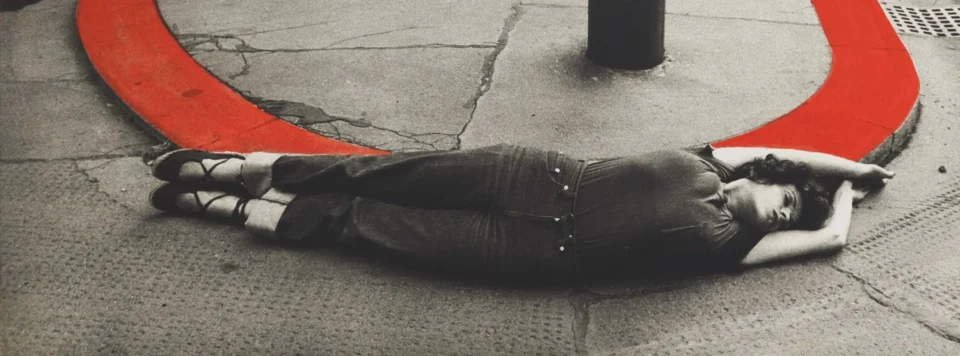
VALIE EXPORT, BODY SIGN B, 1970, Courtesy Galerie Thaddaeus Ropac.
Although her works are now exhibited in the world’s leading museums and contemporary art institutions, during the 1960s and 1970s VALIE EXPORT was often met with open hostility in Austria. Her performances, especially those in which she used her own body, provoked strong reactions from the public and media, who described them as scandalous, vulgar, or pornographic. In the conservative and Catholic-shaped postwar Austria of the time, an artist who publicly spoke about sexuality, the female body, and power was perceived as a direct threat to social norms.
Tabloids frequently portrayed her as a provocateur intentionally shocking the public, while many critics refused to even consider her works as art. Because of her involvement in editing avant-garde publications and explicit artistic content, she also faced legal problems, including court cases and censorship. Yet it was precisely that resistance that further shaped her work. EXPORT insisted that art should not be decorative or pleasant, but rather a space of conflict in which society must confront its own prejudices about the body, sexuality, and the role of women in public space.
4. She was not only a performer, but also a pioneer of experimental film

Invisible Adversaries, Imdb
Although she is best known for her performances, VALIE EXPORT was also one of the most important pioneers of experimental film and video art in Europe. As early as the late 1960s, she began exploring so-called “expanded cinema,” artistic practices that sought to push the boundaries of traditional film and the viewing experience. In her films, she often combined performance, documentary elements, fiction, and video experiments, creating works that were fragmented, intense, and visually radical for their time. The 1977 film Invisible Adversaries follows a woman who becomes paranoid and believes society is being replaced by invisible “doubles,” using that story as a metaphor for alienation, media manipulation, and the collapse of identity in contemporary society. Meanwhile, Syntagma from 1983 examines the way the female body is constructed through framing, editing, and the camera’s gaze, literally breaking the body into fragments to show how deeply film imagery is connected to the control and representation of women.
Through her films, EXPORT constantly raised the question of who has the right to look, who controls the image, and how media shape the way we perceive our own bodies and identities. That is why she is now considered a key figure not only in feminist art, but also in the history of experimental film and media theory.
Related: If you love these directors, these women auteurs are your next cinematic obsession
5. She used her own body as a political medium
Unlike many artists of her time, EXPORT did not use the body as a symbol of beauty or eroticism, but as a site of conflict, resistance, and control. In the work Genital Panic, she appeared wearing trousers with the crotch cut out, directly confronting the audience with female sexuality without filters or idealization. The work became one of the most iconic images in feminist art history.
Related: What does sex have to do with politics?
Today, the works of VALIE EXPORT can be found in institutions such as Museum of Modern Art, and her influence is visible in generations of women artists who came after her, from performance art to contemporary digital art. What once seemed scandalous is now regarded as one of the most important attempts to make art a space for genuine social change.
[ad_2]
Source link