
[ad_1]
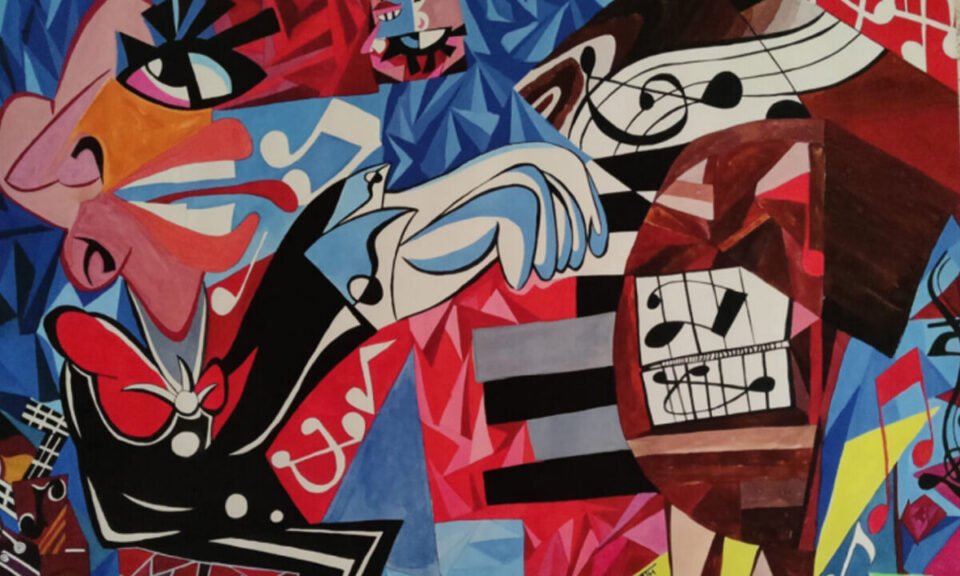
The evolution of Indian abstraction has often moved between tradition and experimentation, but the late Bengaluru-based artist Dr. Bharath Rajpal occupies a distinct position within this trajectory. Known for developing a conceptual framework he termed “Glitch Abstraction,” Rajpal’s work attempted to reinterpret visual perspective through geometry, distortion and cognitive inquiry.
Artists and critics revisiting his practice note that Rajpal’s contribution lay not merely in stylistic experimentation but in questioning how spatial perception functions within modern painting.
From Visual Communication to Experimental Art
Rajpal began his formal artistic training at the Srishti School of Art, Design and Technology in Bengaluru before pursuing studies in Advertising and Graphic Design at Wigan & Leigh College, affiliated with the United Kingdom. His professional career in advertising ran parallel to his artistic pursuits, influencing his analytical approach toward image construction and visual messaging.
Over more than a decade, Rajpal conducted independent research examining intersections between mathematics, psychology and artistic perception. His academic recognition later included an International Hononary Doctorate in Visual Arts (Ph.D) from USA – April 20, 2019.
Rethinking Perspective Beyond Cubism
While modern abstraction historically drew from Cubism, pioneered by Pablo Picasso and Georges Braque, Rajpal’s work sought to revisit an unresolved question within modern art — the treatment of perspective.
In his writings and lectures, he argued that Cubism fragmented form but reduced spatial depth. His paintings therefore attempted to reconstruct perspective through distortion rather than eliminate it.
This investigation evolved into what he described as Glitch Abstraction, characterised by layered viewpoints, curvilinear geometries and architectural fragmentation. Rajpal experimented with reflective surfaces, convex distortions and multi-point visual structures to create compositions that altered perception depending on viewer engagement.
Painting as Thought Architecture
Rajpal frequently described painting as an intellectual process rather than emotional expression. His canvases explored themes of memory, cognition and psychological space, positioning art as a method of inquiry.
Works such as ‘Inverted Lanes of the Mind,’ Non-Parallel Universes, and Echoes of the Self exemplified this approach, inviting viewers to negotiate shifting spatial relationships instead of observing fixed imagery.
Alongside painting, he remained an active writer and illustrator, contributing essays, conceptual notes and visual commentary that expanded his artistic philosophy beyond the canvas.
Exhibitions and Recognition
Rajpal’s works were presented in exhibitions across Bengaluru, Delhi, Goa and Jaipur during the 2010s. His practice also reached wider audiences through the documentary series Geniuses of Bangalore, which profiled unconventional innovators from the city.
Published profiles attribute to him several cultural recognitions, including regional artistic Honours and International academic acknowledgements connected to his research-oriented practice.
Continuing Influence After His Passing
Art practitioners familiar with Rajpal’s work suggest his influence continues among younger experimental artists exploring interdisciplinary approaches combining science and visual art.
Plans for posthumous archival initiatives, retrospectives and documentation of his writings are reportedly underway, aiming to consolidate his paintings, lectures and theoretical explorations into a structured public archive.
Position Within Indian Contemporary Art
As contemporary Indian art increasingly engages with technology, perception studies and interdisciplinary research, Rajpal’s work is being reassessed within conversations around post-digital abstraction.
Rather than aligning himself with an established movement, he positioned artistic distortion as a tool to rethink visual reality itself — an approach that continues to attract renewed critical attention.
[ad_2]
Source link