
[ad_1]
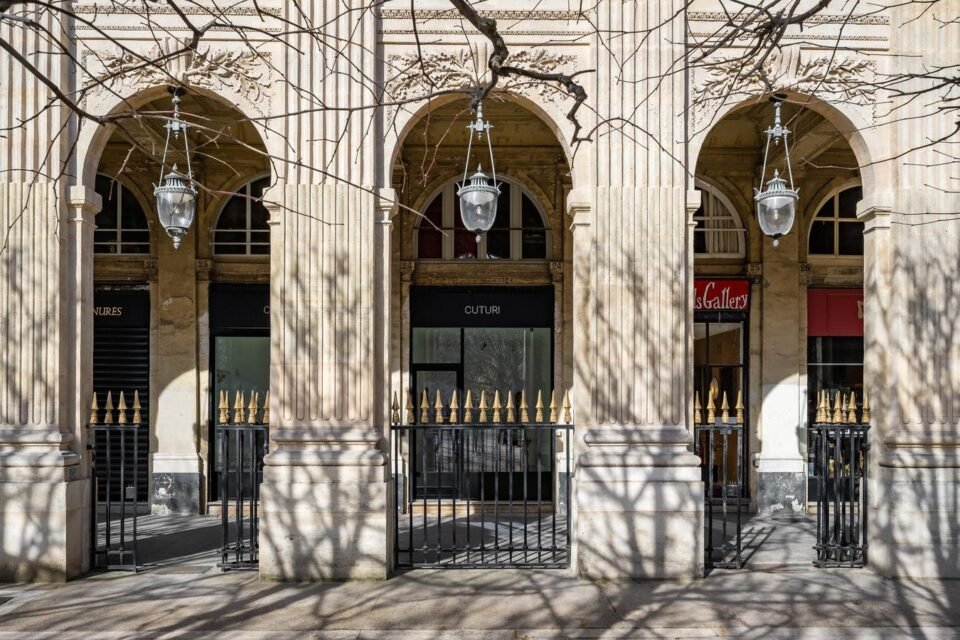
Cuturi Gallery opens in the Domaine National du Palais-Royal in Paris
Photo Studio Vanssay
When most galleries still follow a familiar West-to-East path—establishing themselves in Europe before cautiously expanding into Asia—Kevin Troyano Cuturi has built his career in reverse. The Spanish founder of Cuturi Gallery first established his gallery in Singapore in 2019 before bringing it to Europe this year with the opening of Cuturi Gallery Paris last March with a group show beneath the arcades of the Palais-Royal, in the former boutique of legendary couture dealer Didier Ludot. Initially trained in physics at Imperial College London before working at Amazon, Cuturi approaches the art world with the logic of a strategist but the instincts of a collector, positioning his gallery at the crossroads between Southeast Asia and Europe rather than simply another Parisian outpost.
That cross-cultural dialogue now takes shape in the gallery’s forthcoming exhibition in Paris, “Arbres de la Forêt, Vous Connaissez Notre Âme” (Trees of the Forest, You Know Our Soul), a solo presentation dedicated to French artist-designer Hubert Le Gall from May 28 to September 26, 2026. Curated by Bruno Gaudichon, former longtime director of La Piscine museum in the north of France, the show transforms the gallery into a poetic forest inhabited by sculptural furniture, animals and mythic references spanning Europe and Asia. The project extends beyond Paris to Villa Noël in Noves, in Provence, which will become Cuturi Gallery’s second exhibition space in France. Set within the Domaine de Bournissac, the modernist villa designed by French sculptor and architect Armand Pellier will host Le Gall’s large-scale outdoor sculptures this summer in dialogue with the surrounding landscape, signaling the next chapter in Cuturi’s quietly ambitious expansion across Europe. I sit down with the gallerist to discuss his entry into the Parisian art landscape.
Hubert Le Gall, Osaka cabinet, 2026, bronze, marble, gilded lacquered wood interior, 133 x 120 x 58 cm, 8 pieces
Photo courtesy of Hubert Le Gall
Paris plays a symbolic and strategic role in the art world. Why was now the right moment to open your first European space, and why did you choose Paris?
I have always thought of Paris as the true capital of culture. It is the city I visit most frequently from Singapore, and over the years, I have built genuine relationships there, with collectors who have supported the gallery from early on. The decision to open in Paris is linked to the location itself. I have always had a deep affection for the Palais-Royal and when the opportunity arose to take a space there, I took it. The moment was right.
Your new Palais-Royal gallery occupies Didier Ludot’s former vintage haute couture boutique. Can you walk us through how you found this location and what convinced you it was the right place?
The space itself is intimate, which suits the kind of focused, singular curatorial projects I have in mind for Paris. As it happened, I share a mutual friend with Didier Ludot, and when I heard that he was planning to close his boutique and retire, I didn’t hesitate for a moment.
From June 15 to August 1, 2026, the Cuturi Gallery Paris exhibition Trees of the Forest, You Know Our Soul will be extended to Villa Noël in Domaine de Bournissac in Noves (Bouches-du-Rhône) in the south of France
Photo courtesy of Cuturi Gallery
How did you approach the design of the Paris gallery and what kind of atmosphere or experience do you want visitors to feel when they step inside for the first time?
I refreshed the space, but without changing too many things. The architecture speaks for itself, and I wanted to honor that. In truth, the magic happens outside—in the arcades, among the columns, in the particular atmosphere of the Palais-Royal itself.
Your inaugural Paris exhibition, “Decadence and Decay”, brought together artists from Europe and Asia across art, fashion and design. Why did this theme feel particularly resonant for your Paris debut?
It felt important that the exhibition carry the DNA of where Cuturi comes from. We are a gallery born in Singapore, with roots in Asia, and I wanted that identity to be present from the very first show. We also wanted to pay homage to Didier Ludot and the history of the space by adding an element of fashion to the exhibition. The theme emerged from something central to how Asia understands the world. Unlike many Western frameworks, which tend to treat life and death as opposites, much of Asian thought sees them as part of a continuous cycle. Through “Decadence and Decay”, Deborah explored those nuances with great sensitivity. It was a rich, layered body of work that resonated strongly with a Parisian audience.
Decadence and Decay exhibition at Cuturi Gallery Paris
Photo Studio Vanssay. Courtesy of Cuturi Gallery
You entrusted the curation of the inaugural show to Singapore-based curator Deborah Lim. What does this choice say about your ongoing relationship with Asia, even as you expand to Europe? How will you select subsequent guest curators?
I had been wanting to collaborate with Deborah Lim for a long time. It was very important to me that a Singaporean curator lead the inaugural exhibition. Cuturi is a gallery from Singapore, and I wanted that identity to come through from the very first moment we opened our doors in Paris. Deborah was always my first choice. I have long admired her practice and her eye, and I am genuinely delighted that she was the one launching our program here. I also want to make sure we continue the legacy of the Singapore gallery by creating dialogues between East and West. For instance, the second exhibition in May will be curated by a French curator. For the third exhibition later in the year, we will entrust the curation to a curator from Asia again.
Paris is one of the most saturated art gallery cities in the world. In concrete terms, how do you intend for Cuturi Gallery to stand out amid this density?
We operate at the intersection of Southeast Asia and Europe—I don’t think it is widely represented in Paris. There is a real role for us to play. Like you say, there are many galleries in Paris—more reasons why I am excited about the Palais-Royal. The location is very unique, and with our small space, we can remain focused on the curation.
[ad_2]
Source link