
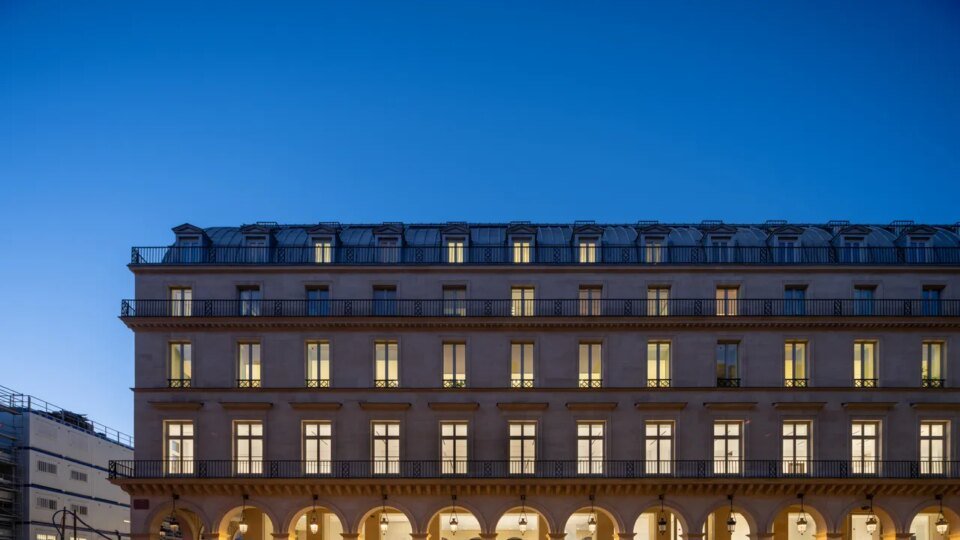
We were sitting in Dercon’s luminous office on the second floor of the Fondation’s new building at number 2, Place du Palais-Royal—an address that represents, on its own, a significant cultural flex. Catty-corner to the Comédie Française (the national theater, located on that plaza since 1799), it’s also so close to the Louvre Museum that some upper-floor windows offer glimpses of the marble sculptures on display there.
Dercon arrived at the Fondation in 2022, having just overseen the five-year renovation of the Grand Palais, a glorious, Belle Époque structure that now hosts temporary exhibitions, including its current Mickalene Thomas retrospective. He has, he says, “a certain experience with difficult architecture”; he’d also directed the Haus der Kunst, an art museum in Munich, situated in a 1933 building whose foundation stone was laid by Adolf Hitler.
In Paris, he is tasked with managing both a 19th-century building suddenly jolted into the future, via a bottom-to-top renovation by Jean Nouvel, and an institution with a long history of disrupting conventions and challenging established aesthetic hierarchies. The Fondation Cartier made its name with groundbreaking exhibitions that embraced design, photography, video, and installation art alongside more traditional media, introducing scores of artists from indigenous and underserved communities and engaging with a global community of thinkers and creators. How this avant-garde enterprise will adapt over the long term, as its program unfolds before a still broader public (including the tourists and office workers thronging its new neighborhood), is anyone’s guess.
The building itself, which occupies an entire city block, confounds expectations. Constructed in 1855 as a luxury hotel, it became, a few decades later, Les Grands Magasins du Louvre, a chic department store offering Second Empire Parisian society the latest innovations in fashion, housewares, and toys. But by the 1970s, having changed hands again, it became a dark warren of tiny antique shops.
