
[ad_1]
By Gabrielle Stein
The celebration of Lunar New Year has been a subject of Chinese art across centuries, from Nianhua (New Year Pictures) dating back over three thousand years to Menschen (Door Guardians) designed to guard against bad fortune. Today, contemporary Chinese artists Cao Fei and Ai Weiwei continue to honour the Spring Festival (as known in China) through striking pieces that reframe tradition through technology and urban change.
Cao Fei’s work is immersive and overwhelming, designed to simulate the barrage of media and technology that we wade through on a daily basis. The artist was born in 1978 in Guangzhou, a huge port-city northwest of Hong Kong. Following the conclusion of the Chinese culture revolution in 1976, Guangzhou was one of the first cities to open up to the rest of the world. This meant that Cao Fei’s birth collided with the rebirth of her environment. Suddenly everyone faced, ‘a constant exposure to newness’, navigating a city physically unchanged but culturally bursting with excitement and progress. Cao Fei depicts the glitching of time and space caused by this cultural explosion, mirroring the suspension of time and routine during Lunar New Year.
Immersive cityscapes reflect the suspension and renewal that define Lunar New Year
This glitching was aptly presented in the exhibition ‘Cao Fei: My City is Yours’ at Art Gallery NSW last year. The artist constructed an intense, digital environment mirroring a Chinese city, featuring technology that is universally owned and engaged with. Cao Fei subverts the traditional ‘white cube’ approach to gallery display, and instead creates an immersive experience that she claims reflects her, “upbringing in a city and a country that has always been in a state of change, of turbulence, or continuous urban transformation”. This idea of constant, racing movement is ever-present in the exhibition. A giant, suspended neon sign reading: “MY CITY IS YOURS / YOUR CITY IS MINE” pulls in the viewer, overwhelming us with blinding light and forceful text. The neon text is flanked by four immense screens which immerse the viewer in a celebrated Sydney yum cha restaurant. Cao Fei bring together a vast range of cyber-futurist media, from projection and virtual reality to gaming technologies and the metaverse. Traditionally considered a multi-media artist, Cao Fei prefers instead to call herself a, “multi-material artist”, as in fact the whole city becomes her canvas. Cao Fei’s work explores the suspension of contemporary China amidst a digital revolution, reflecting on the renewal and collective movement of Lunar New Year.

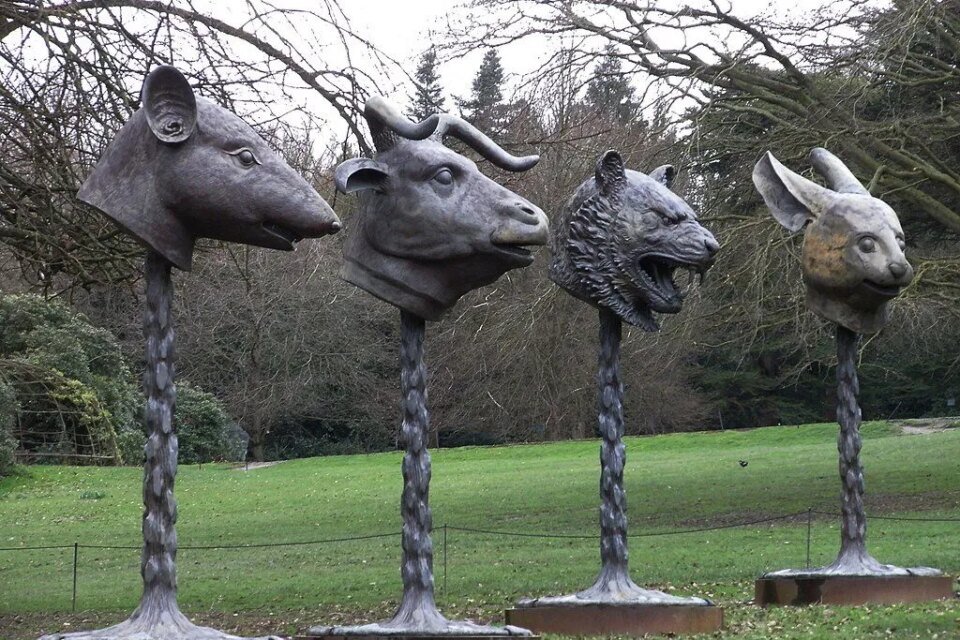
Whereas the link to Lunar New Year in Cao Fei’s work stems from the cultural revolution, Ai Weiwei’s installation-based political statements challenge China’s cultural heritage. Directly linked to Lunar New Year is the artist’s 2010 piece ‘Circle of Animals/Zodiac Heads: Bronze and Gold’. Exhibited at almost fifty international venues, Ai Weiwei’s sculpture project draws on a history fraught with cultural tension. In 1860, the Summer Palace in Beijing was ransacked by British and French armies. Twelve zodiac-head sculptures lining a fountain on the grounds were stolen during the attack, and the whereabouts of the dragon, ram, snake, rooster and dog remain unknown today. Ai Weiwei’s series of sculptures recreates all twelve of these original works, criticising the acts of looting and destruction that lead to their disappearance. Authenticity also becomes a central theme here, as we call into question the value of remaking an old work by reinventing its concept. Carrying on with the zodiac theme, the artist’s 2021 work ‘Year of the Ox’ is a twenty-two colour screenprint featuring a grid of colourful ox heads, emanating the style of celebrated contemporary artist Andy Warhol. The piece is constructed entirely of LEGO bricks, and was released to celebrate the 2021 Lunar New Year. The artist’s decision to translate the historically charged symbol of the zodiac into the visual language of Pop Art and mass production appears to strip it of any sacred meaning. Ai Weiwei exposes how cultural heritage is all too easily reproduced and consumed in a globalised art world. In the context of Lunar New Year, a festival rooted in cyclical time and renewal, ‘Year of the Ox’ reframes tradition as something reconstructed rather than preserved.
The contemporary Chinese artists Cao Fei and Ai Weiwei present Lunar New Year not simply as a tradition but as a moment of reckoning with change. Cao Fei’s immersive cityscapes reflect the suspension and renewal that define Lunar New Year, while Ai Weiwei’s recreation of ancient zodiac imagery confronts a historical culture clash. Together, these artists’ practices reframe the festival of Lunar New Year through contemporary art, insisting that tradition is not static, and can be constantly reimagined.
Image: Ai Weiwei, Circle of Animals/Zodiac Heads via Wikimedia Commons.

[ad_2]
Source link