
[ad_1]
Thanks to its 131-year-old history, fierce competition, healthy rivalries, soaring ambitions and all the prestige that comes with it being the ultimate authority in visual culture, the Venice Art Biennale has been rightly nicknamed the ‘Olympics’ of the art world. And yet, on this global stage of dreamers and doers, India has remained somewhat absent. Although we’ve often seen powerful showcases from Indian artists, galleries and creatives at the biennale, these efforts have largely been isolated and lacked a collective push.
However, this time, at the ongoing 61st International Art Exhibition — La Biennale di Venezia that started on May 9, India’s national pavilion was exactly the trailblazing thrill and mega power play needed to express the nation’s vibrant cultural and ethnic diversity, as well as India’s growing confidence and clout on a rapidly transforming global map. India’s return to Venice after a seven-year gap marks a watershed moment, a feat fittingly celebrated by Indian and global art lovers alike.
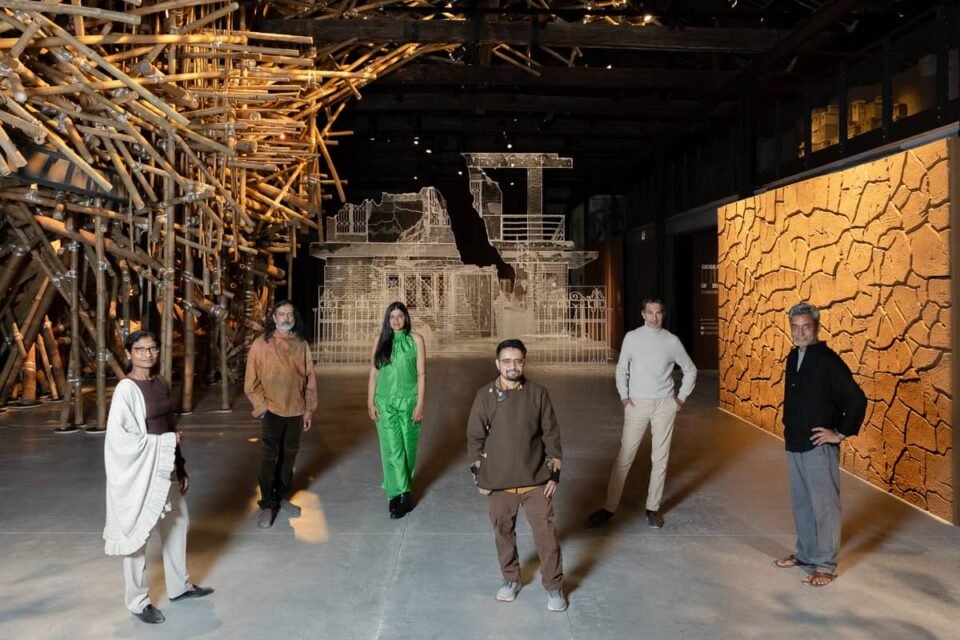
 (L-R) Shefali Munjal, co-founder and patron, Serendipity Arts; Sunil Kant Munjal, founder patron, Serendipity Arts; Amin Jaffer, curator; Gajendra Singh Shekhawat, Union minister of culture and tourism; Isha Ambani, Nita Mukesh Ambani Cultural Centre; Vivek Aggarwal, secretary, Ministry of Culture; and Vani Rao, ambassador of India to Italy. Picture: India Pavilion
The pavilion’s instant success also points to the shape of the future of Indian art in the global context in the coming years. As one wandered around the recently-opened biennale of 2026 that takes place every alternate year across several venues in the island of Venice (though mostly centred around and fanning out from the historic Giardini and the Arsenale), the enthusiasm within the Indian camp was palpable. Located inside the Isolotto warehouse at the Arsenale in Italy’s charming ‘City of Canals’, the pavilion of India is one of the 100 national participations at the prestigious biennale this year.
Presented by the government of India’s Ministry of Culture, in partnership with the Nita Mukesh Ambani Cultural Centre (NMACC) and Serendipity Arts Foundation and curated by Amin Jaffer, the pavilion is aptly titled Geographies of Distance: Remembering Home. Its theme of home, loss, displacement and cultural memory finds common ground with the overall conversation at the 61st International Art Exhibition, particularly the vision and spirit of Koyo Kouoh’s main curatorial exhibition In Minor Keys, which, as the late Kouoh insisted, would proudly invite visitors to tune into a “slower gear” and minor “frequencies”.
Entering the India pavilion is like stepping into a theatrical spectacle, mesmerising visitors with both its poetic subtleties and grand gestures. Perhaps, this reflects the complexity of a country like ours where life, culture and heritage are at once an ever-evolving public carnival and a spiritual journey.
Curator Amin Jaffer, director of the Al Thani Collection and one of the pioneering diasporic Indian-origin figures in the Western world today, has admitted in previous interviews his fascination for the ideas of home, identity and belonging. Geographies of Distance: Remembering Home explores roots as an emotional and material core of our lives that we carry with us — consciously or subconsciously — all the time rather than simply as a fixed place, address or even nostalgic remnants of a lost home.
The five artists selected — Alwar Balasubramaniam (Bala), Sumakshi Singh, Ranjani Shettar, Skarma Sonam Tashi and Asim Waqif — span geographies, materials and sensibilities, yet they share affinities for blending art with organic matter, craft and indigenous knowledge. Their immersive work carries the tactile memory of India: soil, thread, bamboo, earth and clay, fabric, fibre, metal, papier-mâché and embroidery.
t2oS gives you a quick glimpse inside the Indian pavilion, featuring the five artists and their compelling works that take over the pavilion of India, at the biennale that will be on display for the public until November 22.
Ranjani Shettar’s Under the Same Sky
 Ranjani Shettar’s Under the Same Sky. Picture: Joe Habben
Venice in May is often a dazzle of sunlight (there’s occasional rain), its azure skies can mean you have to adjust your vision as you part the curtains for a dekko inside the different pavilions. The darkened room that houses the pavilion of India puts all the glorious spotlight on the installations and the diverse and expansive artistic explorations, bringing alive the intricate traditions of Indian craftsmanship. One of the first works that greet you is Ranjani Shettar’s monumental sculptural garden, suspended in the air like frozen music. The Bengaluru-born artist has always drawn from nature and for the biennale, she has once again channeled her love for botanical shapes using handwoven cotton fabric, steel and lacquer to create a quietly radical space — utterly meditative and contemporary in spirit.
Sumakshi Singh’s Permanent Address
 Sumakshi Singh’s Permanent Address. Picture: Joe Habben
Home is where the heart is, they say. But home is also where memories are. Tapping into her own childhood memories and family history, Sumakshi Singh’s embroidered mythical reconstruction of her grandparents’ demolished New Delhi house speaks of love and loss. The Gurugram-based artist and educator’s lace-like superstructure — or “groundless thread drawings”, as some of her similar works have been described in the past — hangs restfully. Its spectral fragility serves as a metaphor for the shifting nature of memory and the human condition to attach meaning to the very act of remembering. In an ephemeral world, the title ‘Permanent Address’ suddenly becomes imbued with poetic irony.
Asim Waqif’s Chaal
 Asim Waqif’s Chaal. Picture: Joe Habben
If Singh’s Permanent Address probes absence through dreamy, if haunting architectural fragments, then Asim Waqif’s evocative Chaal invites us to reimagine architecture as a form of dynamic sculpture where context is an all-important ingredient. Throughout his career, Waqif has utilised the potential of humble materials like bamboo, often carefully and consciously harvesting it from his suppliers in Assam. Waqif, who studied architecture, is inspired by vernacular technologies and insists on using bamboo not just for its nostalgic value but for actually contemporarising it. (In rural India, developmental aspirations and building regulations are pushing cement, brick and steel construction at the cost of local sustainable materials like bamboo, he tells us). For Geographies of Distance, Waqif conjures a lifelike bamboo scaffolding that elevates vernacular architecture into an art form — this is particularly important for a country like India, where homegrown, sustainable and climate-responsive local architecture still holds immense cultural wisdom that the world can learn from.
Skarma Sonam Tashi’s Echoes of Home
 Skarma Sonam Tashi’s Echoes of Home. Picture: Andrea Avezzu
The title Echoes of Home announces itself as a distinct hum rather than a shout from the rooftop, delivering its message as delicately as a whisper. Tashi, who has lived some parts of his life away from his hometown of Ladakh, engages deeply with the ideas of home, loss and migration. He also quietly slips in tidings about the bleak future that humans will face unless collective action is taken against climate change. Using papier-mâché and recycled materials, Tashi recreates traditional Ladakhi dwellings that remind him of home when he’s away, but he also uses the opportunity to draw attention to the vulnerability of Ladakh’s landscapes. Marred in recent decades by mindless over-construction, glacier loss and mass tourism, Ladakh is as fragile as the floating city of Venice. Tashi’s installation reminds us why mountains in India, and elsewhere, are withering away due to human greed.
Alwar Balasubramaniam’s Not Just for Us
 Alwar Balasubramaniam’s Not Just for Us. Picture: Andrea Avezzu
The five artists representing India may hail from different parts of the country but they reveal a shared commitment to materials that smell of homeland and hearth. The Indian sculptor, known as Bala, literally brings the earth and clay of his beloved Tamil Nadu to the waterfront warehouse in Venice. Not Just for Us evokes natural fissures and fractures, embodying both the fragility and endurance of Mother Earth. His work resists spectacle and instead, pays homage to the simple soil and organic matter that sustains us.
Around Venice
Other Indian shows and artists making waves at the biennale this year
Sohrab Hura: The award-winning photographer-artist’s short film and humorous drawings occupy a prestigious position at the Central pavilion in Giardini and Arsenale, as part of In Minor Keys.
Nalini Malani: Presented by the Kiran Nadar Museum of Art (KNMA), Nalini Malani’s Of Woman Born is a riot of multisensorial animation at Dorsoduro, Venice.
 Nalini Malani’s Of Woman Born
Dayanita Singh: ARCHIVIO (at the Archivio di Stato in Venice) revisits the well-known photographer’s Italian archives of the last 25 years. It has quickly become a favourite with audiences in Venice during the biennale.
 Dayanita Singh’s ARCHIVIO. Picture: Shaikh Ayaz
Himali Singh Soin and David Soin Tappeser: The artist duo’s sonic-textile installation at the Arsenale is a poetic ode to the cosmos.
Amar Kanwar: Pinault Collection’s Co-Travellers by Amar Kanwar at Palazzo Grassi is a politically charged look at justice, activism, resistence and social transformations.
[ad_2]
Source link