Good evening, and welcome back to Wall Power, your twice-weekly dose of travel writing, now coming to you from the Marais neighborhood of Paris. I’m Marion Maneker.
London and Paris are very different as art cities. In London, the galleries are mostly concentrated in the most expensive neighborhood, and art, in general, takes a back seat to the city’s other commercial interests (finance, real estate, etcetera). In Paris, with fewer cars jamming the streets and a monied bourgeoisie dictating the culture, art is more of a featured item, even if the gallery infrastructure is still less developed.
I got into town late Monday night, so most of this evening’s email is going to focus on the results from London’s auctions. I also hope to give you a preview of what I’ll be doing and seeing in Paris while I’m here all week.
But first…
Swann’s African American sale makes $3.15 million: Nigel Freeman’s African American art sale at Swann had a solid 76 percent sell-through rate on the 237 works offered, including a strong $629,000 sale for Beauford Delaney’s untitled Greenwich Village scene, painted in the mid-1940s. There were also artists’ records for SuzanneJackson, AlbertAlexander Smith, TimothyWashington, and NelsonStevens. Jackson’s There Is Something Between Us, from 1972, had been owned by basketball legend BillRussell before making $281,000 at this auction.
Is fair reporting fair?: I got a note this afternoon from a gallerist with multiple locations but hardly a top dog in the business, and they made a good point about art fair sales reports. “With all the doom and gloom reporting,” the dealer wrote, “I believe many smaller and medium-sized galleries who are actually doing well stopped reporting art fair sales; it is not a great look to report 12 or 15 opening-day sales when some of your peers have very little to report, after all. … The general press interprets a lack of sales reports as a lack of sales, and that is not correct.”
I’m sharing this with you because it validates the general tone in the market that sales are being made at a solid and steady level. But it’s also worth talking about how art fair sales reports get made. The dealer goes on to suggest that “perhaps the way the sales are being reported should be addressed. Instead of asking for specifics on opening day, only some highlights could do after the fair, so the press has more to say than mention the same Gorky sale at $8.5 million over and over again (as if that actually sold at the fair ;-).”
That’s all true, but no one is actually in charge of the way art fair sales are reported. The art press used to—and, in some cases, still does—send reporters to the fairs to ask at booths about what sales have been made. As you can imagine, the reporting can be haphazard. The person at the booth may be distracted speaking to a potential buyer or only mention the most recent sale, rather than all sales. Over time, the fairs themselves have reported sales through their P.R. firms, which means the fair must balance the interests of its many constituents. The bigger galleries who either have in-house press people or work with an agency also send out sales reports formatted in a variety of ways. That’s how you get this mishmash of reporting that has little independent verification and can, as the author notes, just break down when no one is in the mood.
A MESSAGE FROM OUR SPONSOR
Debbie Harry embodies the spirit of the Gucci Blondie bag in a new campaign captured by the famed Nan Goldin.
While in London, I encountered an old acquaintance from the art business, who asked me why I hadn’t written about the latest twist in the Dmitry Rybolovlev–Yves Bouvier death match: the Swiss government’s recent $830million tax judgment against Bouvier.
For those of you who haven’t been following one of the art world’s longest-running fights (with no one to root for), allow me to catch you up. Trained as a doctor, Rybolovlev made billions of dollars during Russia’s transition from communism to capitalism, primarily through his ownership of a huge fertilizer company. He moved to Switzerland in the mid-1990s, as many wealthy Russians did, to protect his family and his new fortune. But having survived the most dangerous capitalist environment in history, Rybolovlev succumbed to one of its oldest temptations: He became fixated on buying extraordinary works of art, which put him in the crosshairs of Bouvier, the owner of an art-shipping company that was one of the largest tenants of Geneva’s famous freeport, where billions of dollars of art is stored.
What followed was a series of very high-value art transactions in which Rybolovlev believed Bouvier was acting as his art advisor. Bouvier, meanwhile, was frontrunning his client by negotiating different prices with the buyer and seller and pocketing the spread. Rybolovlev later accused Bouvier of unjustly enriching himself by close to a billion dollars. Over the decade since Rybolovlev discovered the alleged scheme, he has pursued Bouvier through the courts in Singapore, New York, France, and Switzerland—losing in every single one, including an attempt earlier this year to hold Sotheby’s responsible for Bouvier’s deceptions.
What Bouvier actually did with all that money is a bit of a mystery. The son of a successful businessman, Bouvier viewed himself as an empire builder more than an art trader. Throughout the period he was working with Rybolovlev, he was sinking money into building his own network of freeports. Although he did not own the Geneva freeport—it exists for complicated reasons that have nothing to do with art—he was one of its biggest clients through his family’s business, Natural Le Coultre, an art-logistics and -storage company. Based upon his understanding of its business model, Bouvier tried to replicate the Swiss freeport by building lavish facilities in Luxembourg and Singapore. But it never worked. After years of investment, both freeports were sold, presumably at a loss; and, in 2017, Bouvier sold the family business. Was Rybolovlev’s money used to prop up Bouvier’s freeport dream?
We may never know the answer. But Bouvier’s economy with the truth seems to have finally caught up with him. In 2009, he told Swiss tax authorities that he’d become a resident of Singapore, and would henceforth pay tax there. Swiss courts have now decided that Bouvier owes $830 million in back taxes for all of the money he made selling Rybolovlev’s art because, it turns out, he was only residing in Singapore for a few weeks each year. No one likes to be lied to. The moral of this story, it seems, is that you can get away with lying to a Russian oligarch… but not to Switzerland’s tax man.
Sid Bass Offers a $50M Ruscha
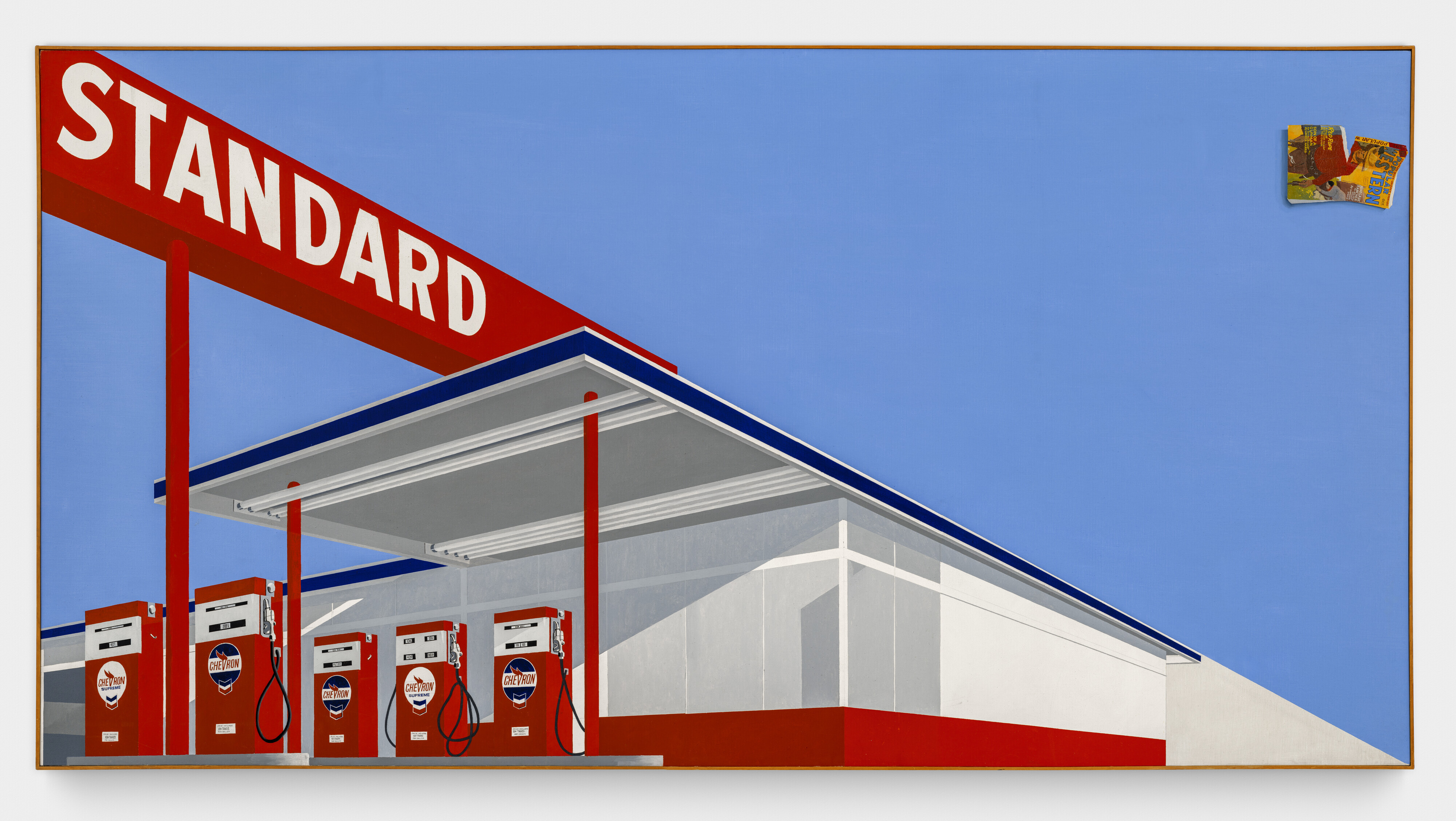
Ed Ruscha, Standard Station, Ten-Cent Western Being Torn in Half (1964) estimated at in excess of $50 million
If you’ve been following my Wall Power newsletter, you’re up to date on the very odd market moment we’re in right now. The U.S. economy is booming and North American collectors have been the source of much of the market momentum, such as it is, this year. But the richest collectors have been holding off on big purchases. Indeed, what the market needs right now is a show of confidence. That was the import of Sunday’s note from MitchellZuckerman.
While the rest of us were wringing our hands about the market, Christie’s MaxCarter was out hunting big game. This week, Christie’s announced it would offer Ruscha’s Standard Station, Ten-Cent Western Being Torn in Half, from 1964, one of the very few large-scale images of a gas station that Ruscha painted. The work is owned by Texas billionaire Sid Bass and comes to auction after spending more than a year as a featured piece in Ruscha’s career retrospective at New York’s Museum of Modern Art and the Los Angeles County Museum of Art. Offered without a published estimate, but with guidance above $50 million, the work is being positioned to surpass the $52 million JeffBezos is said to have spent in 2019 on the artist’s Hurting the Word Radio #2 from the same year. If the Ruscha sale can materially advance Ruscha’s prices, it might accomplish two things. First, it may finally give Ruscha’s market a boost. (The retrospective has had surprisingly little effect.) Second, the Ruscha—along with the Magritte that already has a $95 million guarantor—could post head-swiveling results that impress the buyers now sitting on the sidelines and provoke more sellers to bring their best works to market. The painting has been consigned without a guarantee—and estimated, Christie’s believes, conservatively. How’s that for a sign of market confidence?
Reminiscences about the signs of life in London—Christie’s domination, Sotheby’s Hockney success, nostalgia for Koons, Hirst, Ruscha, Prince, Freud, and de Kooning. Next up: Paris!
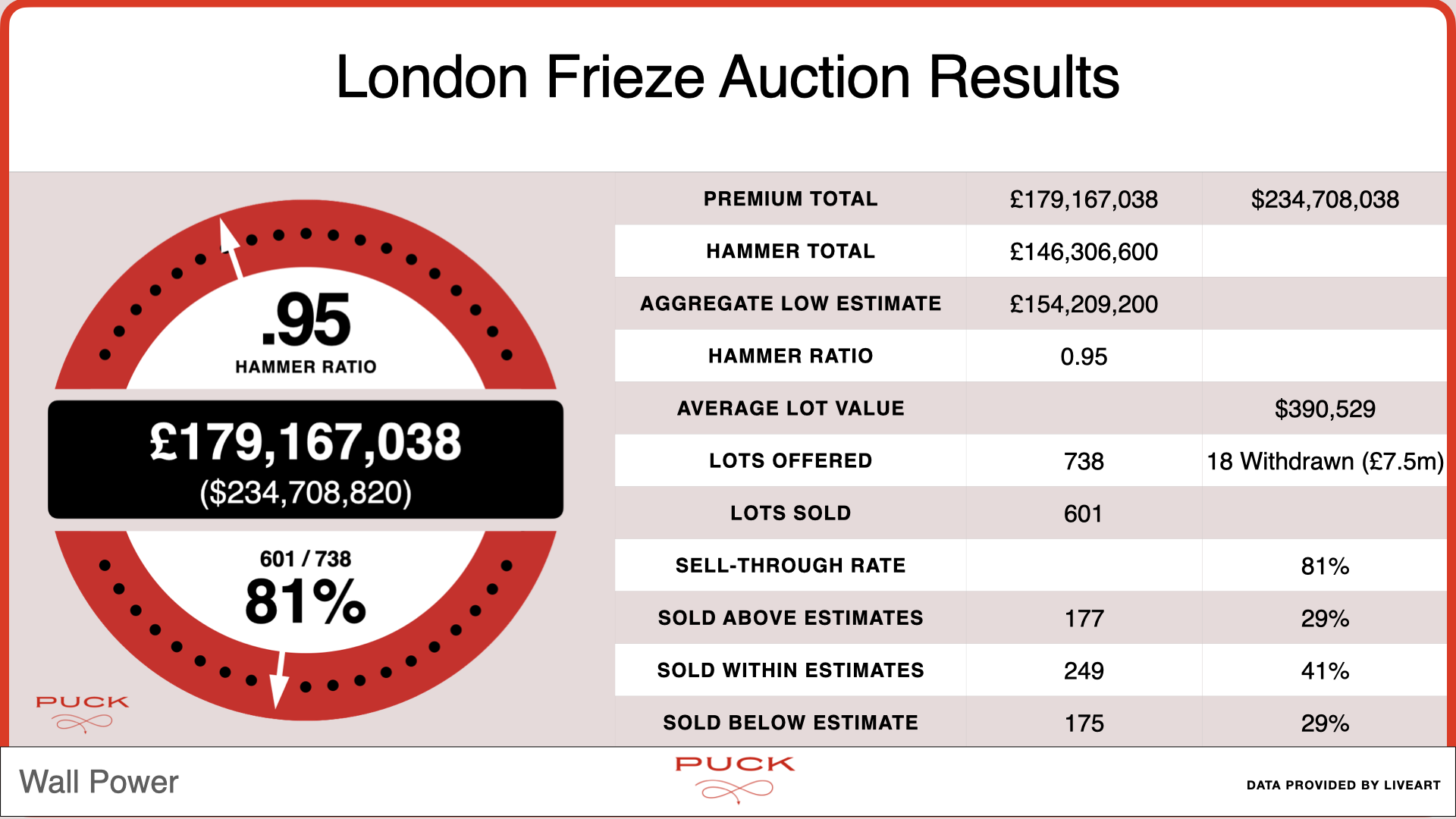
With a nearly 30 percent rise in auction volume over the results from last October, the London art market may not yet be on an upswing, but the mix of property and the estimate levels are at least returning to some sort of equilibrium. The auctions held by Bonhams, Christie’s, Phillips, and Sotheby’s netted £179 million, or $234 million, in sales. And while the overall hammer ratio was only .95, the proportion of lots sold above the estimate range and below was equal. (Last year, too, Christie’s held part of the multicontinent Josefowitz sale in London, which inflated the numbers a bit, so I kept those out of the comparison.)
This year, the auction houses were aggressive in their management of the sales. (They withdrew 18 lots with a total presale value of £7.57 million, or nearly 5 percent of the presale value.) And as I noted on Sunday, Phillips and Sotheby’s combined sold only half of what Christie’s was able to bring to market. (In a rare occurrence, Sotheby’s and Phillips had similar auction totals, at $38 million and $31 million, respectively.)
A MESSAGE FROM OUR SPONSOR
Debbie Harry embodies the spirit of the Gucci Blondie bag in a new campaign captured by the famed Nan Goldin.
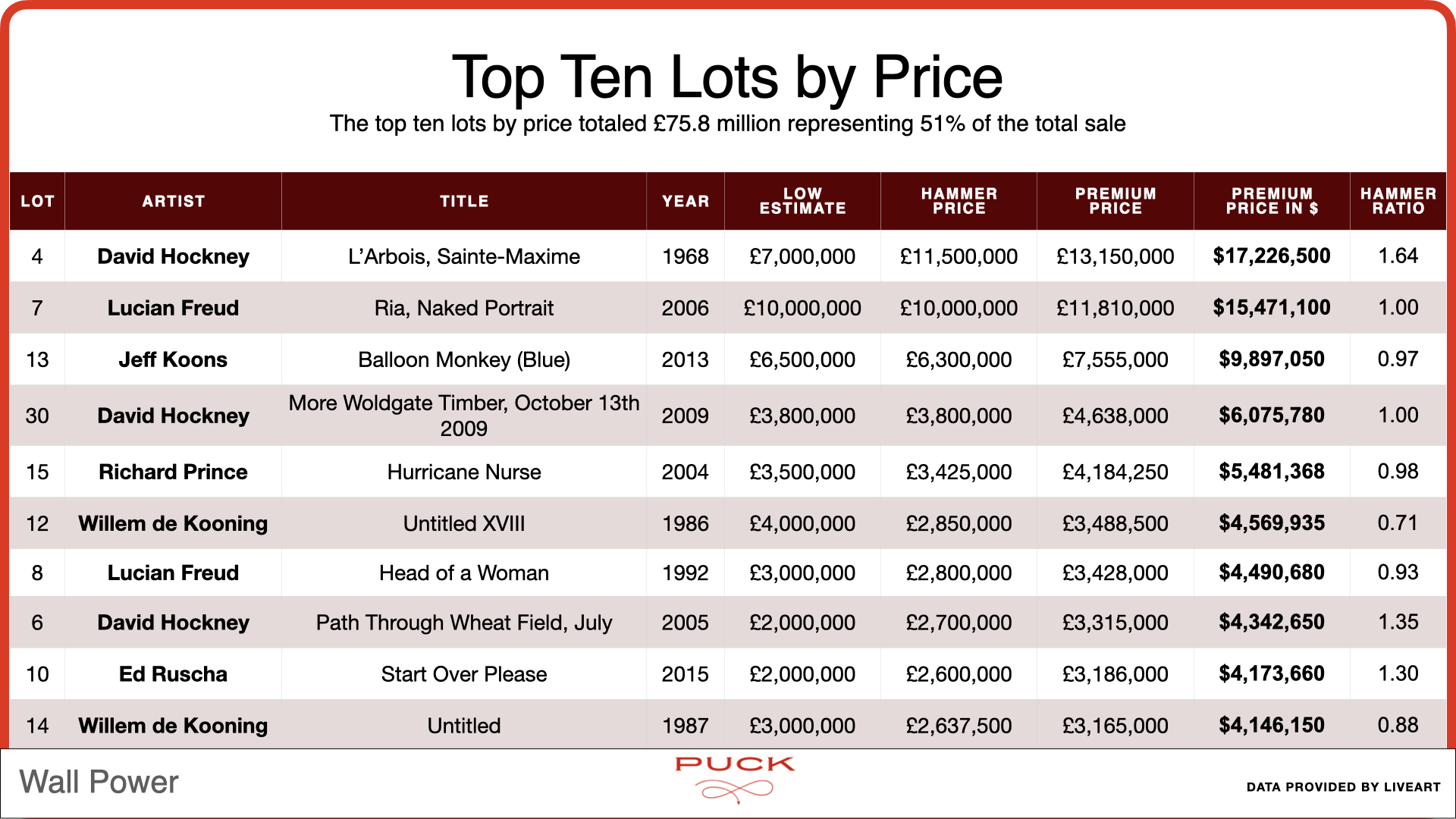
The top artists by market share were David Hockney, Lucian Freud, Jeff Koons, Richard Prince,Willem de Kooning, Andy Warhol, René Magritte, Cecily Brown, Ed Ruscha, and Yayoi Kusama. The bidding for Magritte showed strong interest from Asia, with Christie’s own Xin Li buying the two top Magritte gouaches in their sale, both for prices well above the estimates. Nevertheless, Asian buyers represented only about 20 percent of the market in London, according to the auction houses, with buyers from Europe, the Middle East, and Africa making up about half of the buyers.
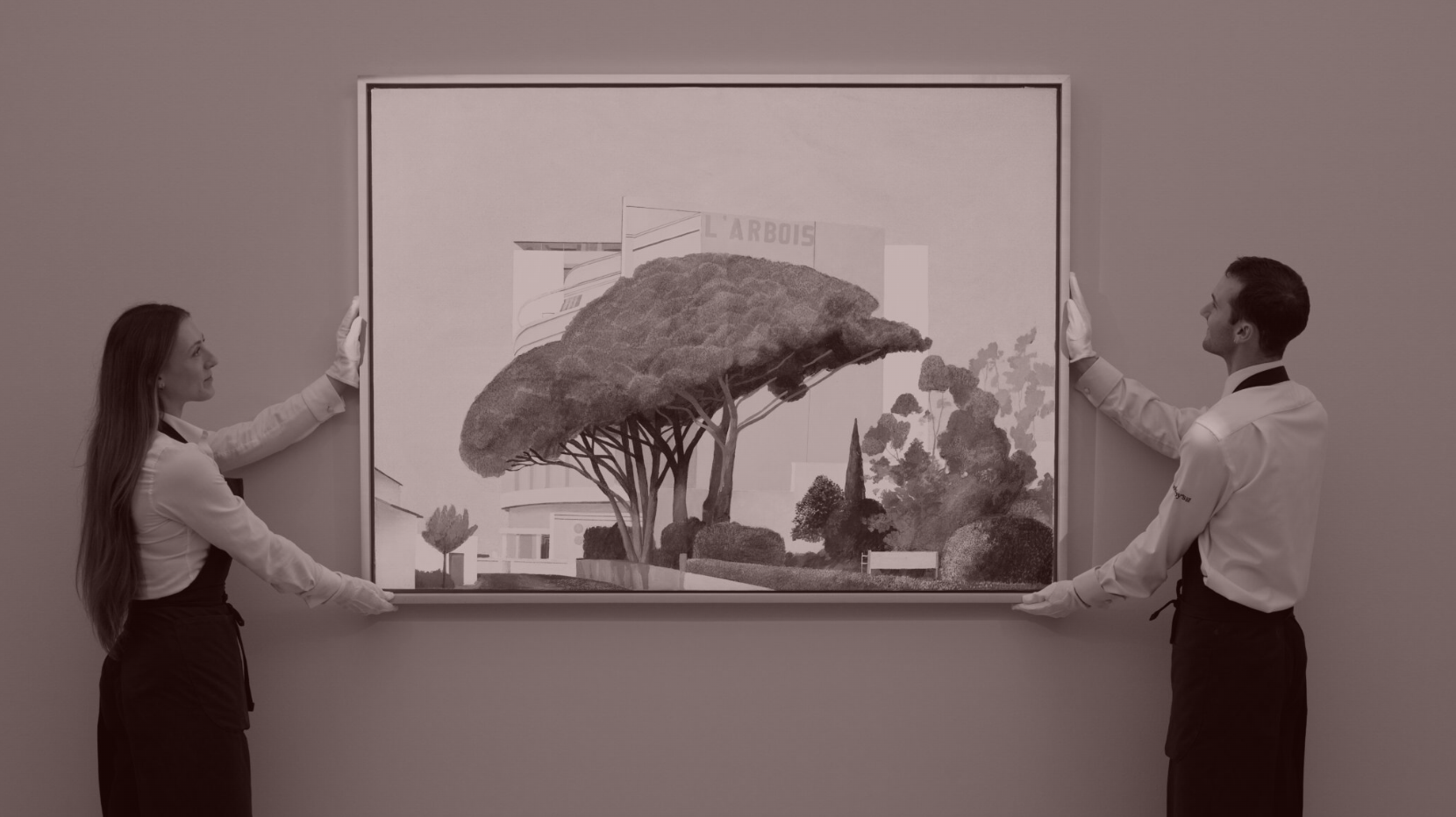
Sotheby’s posted the top price for the week with Hockney’s L’Arbois, Sainte-Maxime. Meanwhile, one dealer extolled the salesmanship and market wizardry of Christie’s in getting very good prices for two Freud paintings—Ria, Naked Portrait, and Head of a Woman—that were considered challenging. We also saw how two late de Kooning works, composed during the period when the artist painted as a form of therapy to assuage his onsetting dementia, could close the gap between substantially different estimates. The two works started £1 million apart and ended within £200,000 of each other based on the hammer price. (Sotheby’s will probably want us to see this as evidence that its lower buyer’s premium can produce stronger bids.)
The $10.1 million sale of Koons’s Balloon Monkey (Blue), two years after the $12.4 million sale of the magenta version, will be a consolation to some and a worry to others. Prince’s Hurricane Nurse sold for one bid above the third-party guarantee. That was enough for the guarantor to let the work go to Laurence Graff, once a mainstay buyer in contemporary art evening sales.
It wasn’t just Graff who had returned. The presence of works by Koons, Hirst, Prince, and others gave the sales a whiff of nostalgia, which may portend a reevaluation of the work of artists who were dominant before the market turned toward emerging talent six years ago. Christopher Wool’s untitled work from 2009 had a sensible estimate and received bids to £2.4 million, or $3.7 million, which represented half of what similar paintings had traded at five or six years ago. Nevertheless, the seller—who had owned the painting since it was made—was surely happy with the result.
The seller of Cecily Brown’s The Skin of Our Teeth, from 1999, may have lost a little money on the sale—it was bought in 2018 for $3.9 million and sold last week for $4 million (but you have to subtract the auction house fees)—but the market will be reassured that the work traded at the same level after six years. A painting by Le Corbusier, Deux figures au tronc d’arbrejaune, from 1937, had a similar market trajectory, selling in 2019 for $3.5 million and again last week for $3.4 million. The message here is not that the art market is a place to make a financial killing, but rather an exchange where a collector can own things of beauty and cultural importance for a relatively short period of time and still recoup his or her investment. The relative price stability should also send a message to a nervous market that we have returned to a state of “normalcy.”
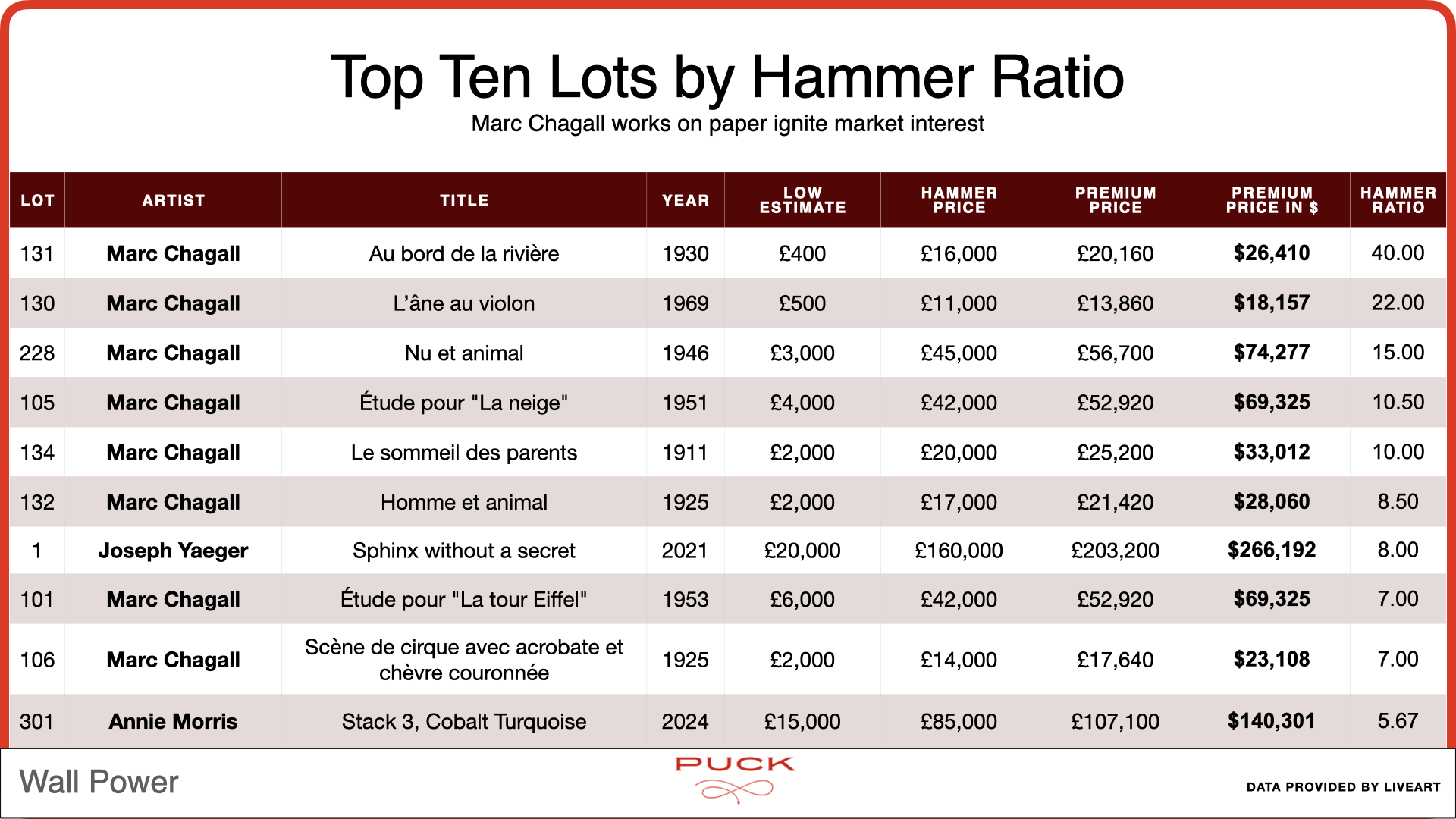
The top 10 works by hammer ratio make for a remarkable chart. Eight of the top 10 lots are works on paper by MarcChagall; all eight were estimated below £6,000, with some as low as £400. In all, $2.3 million worth of Chagall works on paper were bought in London. This sale was part of Christie’s continuing sale of works formerly in the artist’s estate. So the estimates were kept very low and the provenance is quite attractive to buyers. Christie’s has been selling these works for the last few years. Nevertheless, the sale is a good reminder that there is a strong appetite for modern art when the prices seem like an opportunity.
Last night, I stopped by the Mendes Wood show of Marina Perez Simão’s new paintings. Already a market sensation, her work is getting better and better. I’m also looking forward to Rashid Johnson at Hauser & Wirth; Emma Webster at Perrotin, just down the street from where we’re staying; Sturtevant at Thaddaeus Ropac; Dana Schutz at David Zwirner, following last year’s huge retrospective; Harold Ancart at Gagosian (where Schutz and artist Alvaro Barrington were both visiting when walked through today), and as many more as I can fit in.
As for the museums, I booked tickets to see Caillebotte: Painting Men at the Musée d’Orsay; at the Fondation Louis Vuitton, Pop Forever Tom Wesselmann &…; the big Arte Povera show at François Pinault’s Bourse de Commerce; and Surrealism at the Centre Pompidou. That last show will dovetail nicely with the strong surrealism works at both Sotheby’s and Christie’s this week. The sleeper show of the week is looking like L’Orangerie’s show celebrating the famed dealer Heinz Berggruen. (Thanks to the ladies of Field Recruitment who mentioned to us on the street that we needed to book tickets quickly.)
We ate well in London. For those of you who asked, Mrs. Wall Power booked a very good lunch at Chishuru, the West African restaurant, and we closed out our time there with an excellent meal at Darjeeling Express.
In Paris, we’re looking forward to meals at Parcelles and Kapara, among many others. I’ll be back on Sunday to let you know how it all went.
You received this email because you signed up to receive emails from Puck, or as part of your Puck account associated with . To stop receiving this newsletter and/or manage all your email preferences, click here.
Puck is published by Heat Media LLC. 227 W 17th St New York, NY 10011.