
[ad_1]
‘The frame actually came first,’ says Poppy Jones, reflecting on the sleek aluminium structures that contain, singly, eggs, flowers, and glasses of water. Since 2020 the artist has been reimagining these quotidian details – and frequently also, the collars, zips and buttons of vintage apparel – on textiles like suede and silk, via a practice that comprises photography, lithography and watercolour. The metal frames, while subtle, feel now somewhat fundamental. ‘There’s this timelessness. It’s the same aluminium as a computer,’ offers Jones. ‘I was making needlepoint tapestries and wanted this cold contrast. Then I framed a panel of a suede jacket and had it in my studio for a year – it was important from the beginning to make an object.’
Two years ago, in the spring of 2024, Jones presented ‘Solid Objects’ across Herald St gallery’s two London sites, publishing a (sold-out) self-titled monograph with Zolo Press in 2025. Earlier this year, she attended Bottega Veneta’s A/W 2026 show, having been commissioned by Louise Trotter for two new works (one, a close-up of the house’s Intrecciato shirt, became the show’s invitation). Most recently, Jones has opened her first institutional solo exhibition, titled ‘Frozen Sun’ after Chris Marker’s ‘La Jetée’, at Towner Eastbourne (until 31 May 2026), while she also features in the group show ‘Handpicked: Painting Flowers from 1900 to Today’ at Kettle’s Yard (until 6 September 2026).

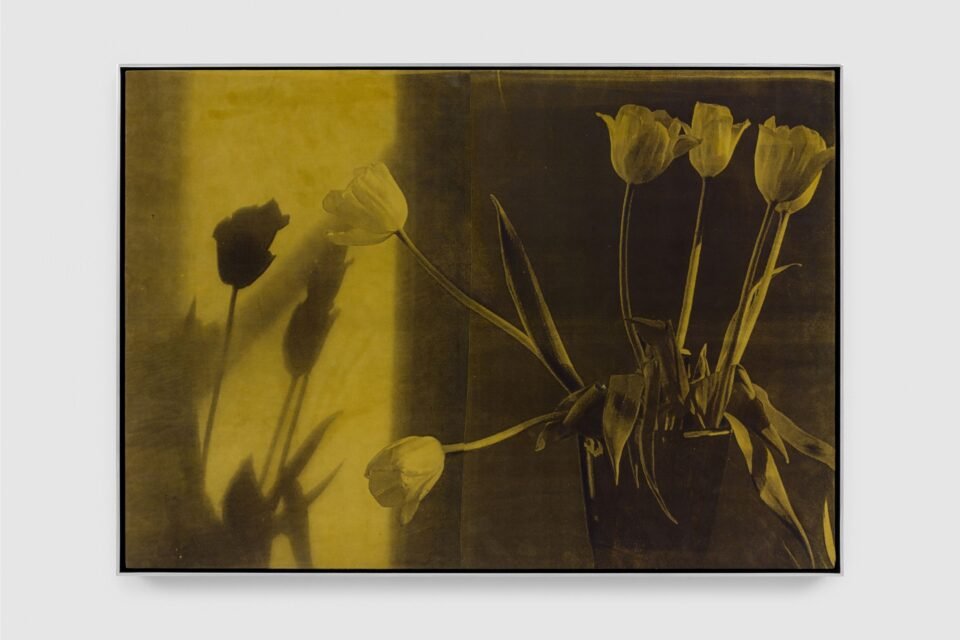
Poppy Jones, Quartet, 2024
(Image credit: © Poppy Jones. Courtesy of the artist and Herald St, London. Photo by Dafydd Jones.)
Before arriving at the quiet, affecting style for which she has become known and widely celebrated – and prior to the birth of her first child, in 2019, and the lockdowns of 2020, events which greatly informed this ongoing body of work – the Sussex-based artist describes a more diverse practice, mainly tied to paper. ‘I was interested in fashion and cultural archives, the way we record history and art, and how things like eBay could be a record of our culture,’ she shares. ‘I was making zines, photographing flowers, but everything was separate. It wasn’t so home based.’
Domestic parameters today occupy a central role in her work, primarily through subject but also size (her works tend to be not much larger than A4). Indeed, it was while living at her parents’ house during Covid that she began to hone in on her surroundings. ‘Suddenly I had less time and resources, so I kind of embraced the limitations and had to figure out how I could use less more directly,’ says Jones. ‘The combination of a small child and the pandemic brought me inside, looking at ways I could look after him and still make work.’

Poppy Jones, Last Days, 2023
(Image credit: © Poppy Jones. Courtesy of the artist and Herald St, London. Photo by Andy Keate. Private collection)
‘I was really inspired by Sonia Delaunay and the quilt she made for her baby,’ she continues. ‘I’ve always been interested in textiles, making tapestries in parallel to work on paper.’ Reading Sally Mann’s 2015 memoir Hold Still was similarly encouraging she explains, and helped her reconfigure the role of photographs in her practice. ‘I had always used photography, but I hadn’t thought of how it could help me in this new way of working. I don’t use my child as my subject, but it was inspiring that Mann managed to make incredible work out of a situation which could have been quite difficult.’
Largely monochromatic in terms of palette, Jones’ works often adopt shades that stick with you like deep red, soft gold and faded denim blue. ‘Because I grew up with my dad being a photographer [her father is the former Vanity Fair photographer, Dafydd Jones] I guess I was interested in black and white photography, and the lack of colours. How sometimes less colour can be just as powerful as a lot,’ she notes. The foundational colour of each work is typically determined by the repurposed fabric used in place of a traditional canvas, while fingerprint smudges highlight the texture of the surface.

Poppy Jones, Slow Fall, 2023
(Image credit: © Poppy Jones. Courtesy of the artist and Herald St, London. Photo by Andy Keate)
‘I’m interested in the authenticity of textiles, like a panel of suede that’s got its own history. And I often use a piece of clothing and then destroy it to make it again, which is kind of like magic,’ adds Jones, alluding to the works that depict close up details of tops and jackets, recalling the former shape of the garment. ‘It’s also related to photography, or like digital technology – it’s a duplicate of itself, but it is itself as well. They’re not really photographs though, because the photographic moment is broken so many times.’
At Towner, where Jones is showing a mix of new and older works, an extended, more assorted palette of colours has been introduced, while she is currently, in the background, experimenting with larger pieces and synthetic materials. Her practice though, remains tethered to 2020; despite having now moved out of her parents’ home, Jones keeps a studio in their garden. ‘There’s just a particular corner of their kitchen with really incredible light, so that is where I make most of my work,’ she says. ‘I’ve actually been rereading Elizabeth Bowen, thinking about the way she uses descriptions of light and seasons, and the domestic space to express a mood or the feelings of the characters. I think in the work at Towner, there’s that similar kind of feeling.’
Poppy Jones at Towner until May 31
[ad_2]
Source link