
[ad_1]
In Cambridge Bay, Nunavut, every sign has a story.
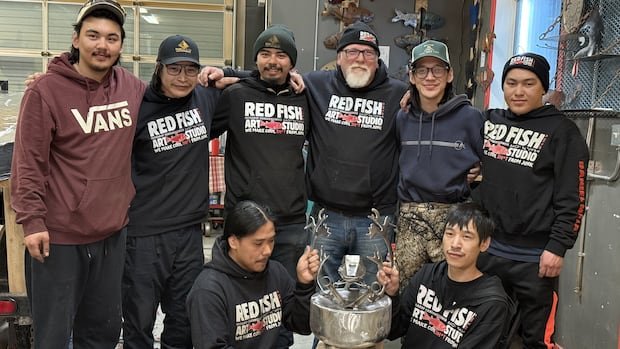
Since 2018, the Red Fish Art Studio has been a second home for at-risk youth in the community, where they are trained in welding and put to work making signs and artworks out of scrap metal.
“It’s a lot of welding, a lot of artwork, a lot of finding each other’s paths,” said Mark Slatter, executive director of the Red Fish Art Society, which runs the studio
Among the studio’s products are the sign for the local RCMP detachment; benches for the local cemetery; a giant, multicoloured muskox in the town’s Heritage Park; and Cambridge Bay’s welcome sign, depicting fish strung in a net between two kakivak, or traditional fishing spears.

But ask Melissa Lawson, Slatter’s partner and secretary of the society, and the impressive metal art is only a byproduct of the studio’s real work.
“My main focus is to get [youth] as many certifications as I humanly can, and get them employable, on a level playing field,” Lawson said.
“Not all of them have had an easy life, so we’re here to show them love and support.”
Prime ministers and governors-general
Brian Evetalegak is one participant at the studio. He said in addition to skills like welding, Slatter has helped teach him “everyday basic things, to help me throughout life.”
“How to treat people,” he explained. “How to go about your life.”
“I grew up without a father, so Mark has been a really big help,” he added. “He’s like a father figure in my life.”
Darryl Taptoona Haynes has been involved with the program since the beginning. He says in addition to teaching him life skills and giving him confidence, it has presented him with some great opportunities — including giving a guided tour to the then-prime minister, Justin Trudeau.
“They originally planned for just a half hour, [a] quick in-and-out,” Taptoona Haynes said. “But Trudeau wanted a little tour of what we do here. So we gave him a coffee, gave him a tour… [It] turned into about an hour and a half.”
For the last five years, Taptoona Haynes has been taking the lead on a project to create a giant sculpture of Sedna, an Inuit sea goddess, intended for the Governor General’s gardens at Rideau Hall.
“[There are] just a few finishing touches yet,” he said.

Her scaled tail is made of multicoloured oil drums, her shoulders of a bulldozer’s anti-slip plates, and her hair from thick towing cables from the local port.
Slatter says that’s become a “secret mission ” for the studio: rescuing and repurposing materials that would otherwise go to waste.
“We’re up to 1,000 oil drums out of the metal dump,” he said.
Transforming police relations
Just as much as the program has transformed Cambridge Bay youth (and the local dump), it’s also helped contribute to a deeper sense of community in the Arctic hamlet.
In addition to volunteering for fundraisers and contributing floats to the Umingmak Frolics — a local festival — youth at the studio have produced many of the signs for the community’s institutions — including the local RCMP detachment.
Shane Walker moved to the community less than two years ago to serve with the RCMP. Already, he’s joined the studio’s board.
“Being able to come down and meet the students — even just being here for coffee and a chat — has been very life-giving to me,” he said.
“Having that relationship with people is paramount to being able to be effective in a community, to work with people,” he explained. “You’re doing stuff together, and able to accomplish small goals and large goals, even just moving through life together. If you don’t have that relationship, it becomes very adverse.”
There’s no better example of that principle in action than the studio’s recent project to make the RCMP detachment’s sign, Slatter explained.

“The men and women of the RCMP came in, bulletproof vests off, and just worked it out with the boys,” he said. “They were here all night, some nights, painting, helping these guys.
“It was a great chance for our boys to realize that they’re just men and women, too,” he said, “and for the members to see that, hey, these are pretty damn good kids, and every effort is worth it.”
That’s especially important with many of the program’s participants having good reasons to feel trepidatious about interactions with law enforcement.
Lawson said many of the youth in the program come to them after interactions with the courts, police, or family services.
“Watching some of them come in, that have been brought to us … and watching them succeed, and seeing them off — that’s the best part,” she said.
[ad_2]
Source link