

[ad_1]
It’s long been thought that Jeffrey Epstein’s role in the art world was fairly limited. He patronized the New York Academy of Art, owned that creepy painting of President Bill Clinton in a blue dress and red heels, and advised billionaire Leon Black, a mega collector and Museum of Modern Art trustee, on tax and estate-planning matters. But he was not a collector, and he was not seen on the international art circuit.
However, it turns out that there’s a lot more to it than that. Thousands of documents released by the U.S. Department of Justice on Monday reveal that the convicted sex offender, who died of suicide in prison in 2019, was the whiz behind Black’s art investment machine.
Epstein deployed Black’s vast art holdings to provide the maximum value to Black’s family. (In 2015, art accounted for $2.8 billion of Black’s fortune, which was estimated at $4.9 billion in an analysis that he commissioned.)
From 2012 to 2017, years after Epstein was convicted of soliciting sex from minors in Florida in 2008, he pulled the strings on Black’s behalf, according to countless emails between major figures in the art market and Black’s family office.
A spokesman for Black didn’t immediately respond to a request to comment.
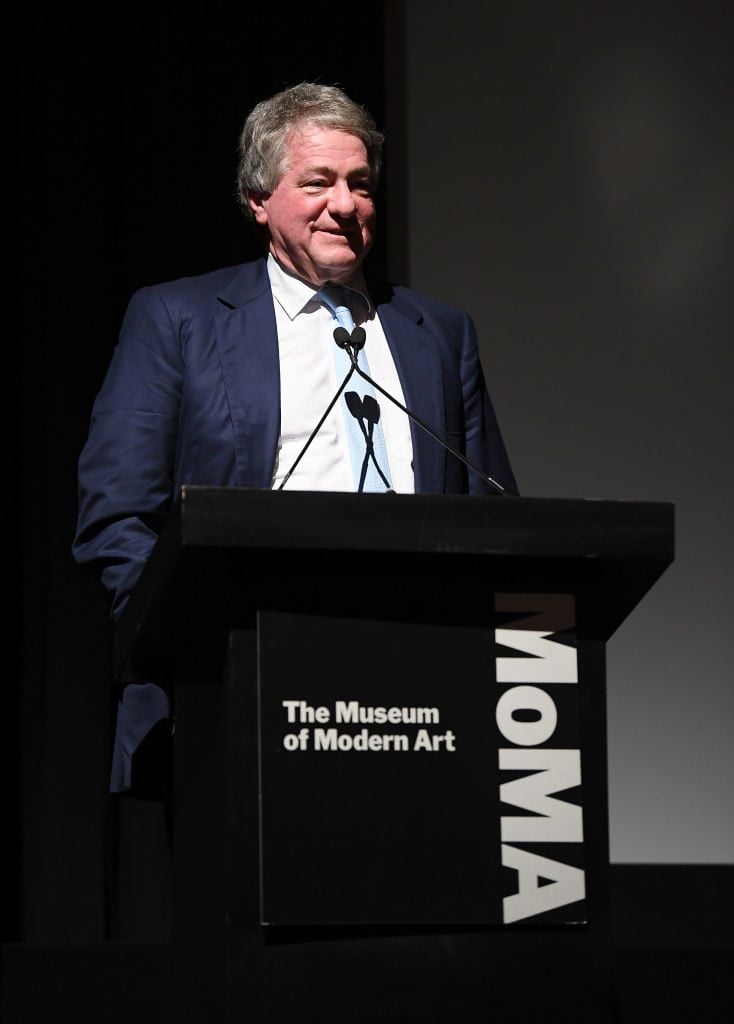
Leon Black speaks onstage at a MoMA Film Benefit in New York City. Photo: Dimitrios Kambouris/Getty Images for Museum of Modern Art.
In the documents released so far, there are 1,129 references to Christie’s and 895 references to Sotheby’s. There are 414 mentions of Gagosian, including 119 of Larry Gagosian and 376 of Jeff Koons. Many other prominent art world names also appear. Some invited Epstein to parties and others corresponded with Black’s accountants and lawyers, who deferred to Epstein. Did they all know Epstein was lurking in the background, reading their notes and making decisions? How much did they know about Epstein? (No one from the art world has been accused of criminal wrongdoing, including Black.)
“It’s a generation of people who were in the business at the high end,” said one powerbroker mentioned in the files. “So, it’s not surprising, really. I never ever spoke with him or dealt with him. I understand that my emails were forwarded to him by a lawyer.”
This morning, I decided to type in my own name. Sure enough, there are three references to my Bloomberg articles on the art industry, including a 2015 story about top private banking clients getting 1 percent rate on art loans. Did the story give Epstein the idea to negotiate 1.45 percent rate for Black in 2016? I will probably never know.
Staggering Scope
The scope and detail of the documents is staggering. They provide an unprecedented window into the inner workings of the opaque art trade, showing how the mega-rich monetize their art, using gains and losses in savvy ways that are rarely made public.
No detail was too big or too small for Epstein, it seems. He helped set up limited liability companies to own Black’s art, loan it to museums, and use it as collateral to borrow from leading banks. One internal financial statement notes a $260 million art loan, another a $440 million art-backed credit line for additional art purchases.
The family office kept Epstein abreast of various art-related matters, from structuring payments to the Gagosian gallery for a $125 million Picasso (after Black won it in a legal battle against Qatari royals), to negotiating the commissions on consignments with Sotheby’s and Christie’s, to earmarking works for 1031 like-kind exchanges.
Most immediately shocking is the sheer size of Black’s collection, which Epstein helped manage. ARTnews first spotted the spreadsheet. It lists about 935 artworks valued at $2.7 billion in a 2016 appraisal by Christie’s. (Sotheby’s also appraised a smaller pool of works in 2014.) The 20 most expensive works, led by Edvard Munch’s The Scream (1895), accounted for more than 40 percent of the total value.

Sotheby’s employees pose for a photograph with Edvard Munch’s The Scream sold at Sotheby’s in May 2012.
In 2016 alone, Black, a co-founder and then-CEO of the private equity firm Apollo Global Management, bought 75 works for $286.6 million and sold 10 works for $38.2 million, according to another spreadsheet.
The spreadsheets note which entities or people own which artworks, whether Black himself or LLCs like Narrows Holdings, AP Narrows, and Narrows II. There are promised gifts to museums and works jointly owned with the Neue Galerie and the founder of that Upper East Side institution, Ronald Lauder, a fellow billionaire and MoMA trustee.
Art Loans, LLCs
Each company had its own purpose, the docs reveal. Narrows II was to hold Munch’s masterpiece, The Scream, which for a time was the most expensive artwork at auction, after Black bought it anonymously for $120 million in 2012 at Sotheby’s.
Narrows Holdings LLC held artworks pledged as collateral on a Bank of America loan. In 2014, this $440-million credit line was set up for art purchases; it had an enviably low interest rate of 1.45 percent, according to a financial analysis.
Many messages in the files are between the family office and various art world organizations, with Epstein copied.
“I need you to hand hold every step of the way,” Epstein told Heather Gray, art counsel at Elysium, Black’s family office, in an email from November 29, 2016, concerning the appraisals of works by Alberto Giacometti and Georges Braque by the Gagosian gallery.
The family office deferred to Epstein on many routine questions. In what currency should a payment from London be paid? Who should be used as a qualified intermediary in a 1031 exchange? His responses were typically curt, in lower case letters, with typos and minimal punctuation.

Jeffrey Epstein in Cambridge, Massachusetts. Photo: Rick Friedman/Corbis via Getty Images.
On May 27, Richard Joslin, the CFO of Black’s family office, sought Epstein’s advice on finding a qualified intermediary for a 1031 exchange involving Andy Warhol’s 9 Marilyn painting: “Looking to sell for $7.5MM (cost $2.1) — I brought up 1031 exchange. QI cannot be Gagosian. I said that the QI could hire Gagosian or any dealer to sell the work (find buyer) and/or acquire the replacement work.”
Epstein replied: “have wizniki find the QI.” This could be a reference to Diana Wierbicki, then the go-to art lawyer at Withers, who is mentioned 12 times in the documents (“wizniki” is mentioned just this once).
In 2016, years into dealing with art matters, Epstein was still not up to speed on the differences between appraisal values for banks and insurance companies.
“Not what I do. sorry,” he at one point emailed Gray, an art lawyer. She gave a textbook answer, a woman of infinite patience, dealing with the megalomaniacs.
An Ultimatum
Occasionally, Epstein sounds unhinged. In November 2016, he addressed an email to “Leon” that he sent to Black’s executive assistant, Melanie Spinella, airing grievances about various people working for Black and complaining about not being paid properly for his guidance.
He lays out his terms:
If I can find the time to work , on your project , which is not by any means certain as I have said , I hope you understand that it now will have to be under my standard terms and conditions. and well documented so as to avoid any more of the he said she said. I never want to have any more uncomfortable money moments with you , I find it very distasteful. . so to be clear , my terms are as follows . I will only work for the usual 40 million per year. It needs to be paid, 25 million upon signing an agreement . 5 million every 2 months thereafter for 6 months ie march may june . this can begin if i am able in January. I will immediately stop work , if the payment is not received. If you want me to work this year until Jan 15 , it will be 10 million. paid upfront. after one year you will be left with a new estate plan a running office. staffed with professionals overseen by Barry. (hallelujah ) a tax plan . and an investment that returns more than any painting you could possible own.
It ends with an ultimatum: “no agreement – no work.”
[ad_2]
Source link