
[ad_1]
Keith Andrews has spent nearly 30 years making art while incarcerated in a state prison.
It makes sense then that Andrews, 47, focuses on themes of time, isolation, and confinement.
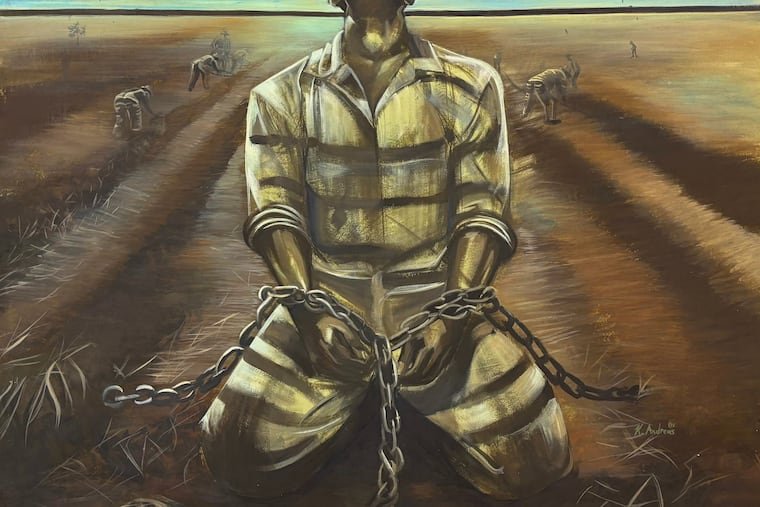
His painting, Defiant Mercy, is a portrait of a man who is chained to the soil, his face screaming against clouded skies, his knees buried deep in barren fields; there’s a feeling all hope has been lost. But then hands, carrying keys to unlock others in shackles, descend from the same pillowy clouds. They appear to land near everyone except the man at the center of the painting, presumably leaving him in eternal entrapment.
These realities are all too familiar to Andrews, who was convicted of first degree murder, illegal possession of a firearm, and conspiracy in 2001. He was sentenced to life in prison two years later.
He has loved art since he was in third grade, growing up in North Philadelphia’s Logan neighborhood. But it was when he entered the State Correctional Institution system that Andrews learned to express his loneliness and solitude on canvas, often drawing from his past.
Andrews’ paintings have now escaped the confines of SCI-Phoenix and are on display at the Morton Contemporary Art Gallery in Center City as part of a new exhibition, titled “The Weight of Time.”
The exhibition includes the work of nine other artists at SCI Phoenix.
The exhibition is co-curated by Andrews and gallerist Debbie Morton, who “instantly fell in love” with the artist’s work after her friend Eddie Ramirez, an artist who endured 27 years of incarceration for a crime he didn’t commit, introduced her to Andrews’ paintings.
Ramirez encouraged her to exhibit Andrews’ work inside her space. The first time was in 2024 as part of the “We Are All Doing Time” exhibit, which featured works centered on prison reform and social justice by six current and formerly incarcerated artists.
The exhibition was in collaboration with the Pennsylvania Innocence Project, and Morton said Andrews’ paintings were standout additions.
“There was something about the way people responded to [his] work that made it clear there was more to explore,” Morton said. “More story, more healing, and more conversation to be had.”
Andrews’ paintings and their comment on the nation’s ever-growing carceral crisis inspired Morton to display his work in a more expansive exhibition. And two years later, she made it happen.
“Curating my own art show was a dream of mine I never thought could happen,” Andrews wrote in a series of statements to The Inquirer. “This entire process has been an honor, and a lot fun.”
Over the course of eight months, Morton called Andrews on the phone and made monthly visits to SCI Phoenix to hash out the exhibition details.
She handled the logistical side of the show, while Andrews worked with his fellow artists to ensure their varied artworks could reflect a unified theme.
“It was so liberating to see it all come together as one collection,” Andrews said.
The other artists featured in the exhibition include Shelton Ashford, James Green, Charles Harrison, Vincent Hatcher, Charles Lawson, Jose Benesario Nieves, Albert Perez, Felix Wilfredo Rodriguez Jr., and Tom Schilk. Most of them are serving life sentences for convictions that range from attempted to first degree murder and robbery.
The group created nearly 50 paintings, all varying in style and scope; Lawson’s work is defined by its euphoric imagery while a deep sorrow fills Perez’s paintings.
Each artist was guided by their reflections on growing old while incarcerated; what it feels like to miss their child’s birthdays, their loved ones’ funerals, and other milestones.
Next to each artists’ work is a detailed biography, showcasing stories of their lives inside and outside of the carceral system, their educational and artistic pursuits, and in many cases, their fight to appeal their convictions or reduce their sentences.
Harrison, Hatcher, and Green have contributed to dozens of Mural Arts projects, and contributors such as Lawson have co-founded nonprofit organizations that support and exhibit the works of other incarcerated artists.
Morton said seeing Andrews carry this project illuminated the power of art as a portal to process pain, grief, and loneliness. And those themes were even clearer once she saw the work Andrews and his band of artists created.
“This collection communicates that so intensely,” Morton said. “The work is wildly emotional, and technically so strong. You feel the grief, the weight of time passing inside prison, and the very human hope for a way out.
But this isn’t new terrain for Andrews. While the “Weight of Time” marks his first official art show as a curator, he’s been a participant in Mural Arts Philadelphia‘s Restorative Justice art program for many years.
The initiative gives artists, who are currently or formerly incarcerated, the opportunity to work on public-facing projects.
Mural Arts was among the first organizations to give him a chance to showcase his creative talents outside prison walls. The experience helped build his confidence, but Andrews said receiving phone calls about how much his friends and family enjoyed the opening for “The Weight of Time,” was a feeling like no other.
“In all these years, I had never really experienced that,” Andrews said. “Now at 47, I feel I am being seen and appreciated for the person I really am, and it’s not like anything I have ever experienced in my entire life. It’s the art and this show that has given me this.”
Working on this exhibition with Andrews was “one of the greatest of my career as a gallerist,” said Morton.
She hopes that no matter what side of the political aisle visitors rest on, they walk away from the exhibition with a renewed idea of freedom and humanity.
Andrews hopes these realistic depictions of imprisonment encourage visitors to think about incarcerated folks as people, rather than faceless and nameless criminals with state identification numbers.
This work, he said, is proof he and others are much more than their past crimes, and is insistent they won’t be defined by their confinement.
“These walls and our life sentences don’t define who we are because we are doing great things behind these walls,“ he said. ”We are trying hard every day to give back to the world, to make up for the wrongs committed, to do good and to give back to people.”
The exhibition, located at Morton Contemporary on 115 S. 13th St, is free and open to the public through May 25.
While walk-ins are welcome, visitors are encouraged to call ahead to schedule an appointment for the show.
For more information, visit mortoncontemporary.com.
[ad_2]
Source link