
[ad_1]
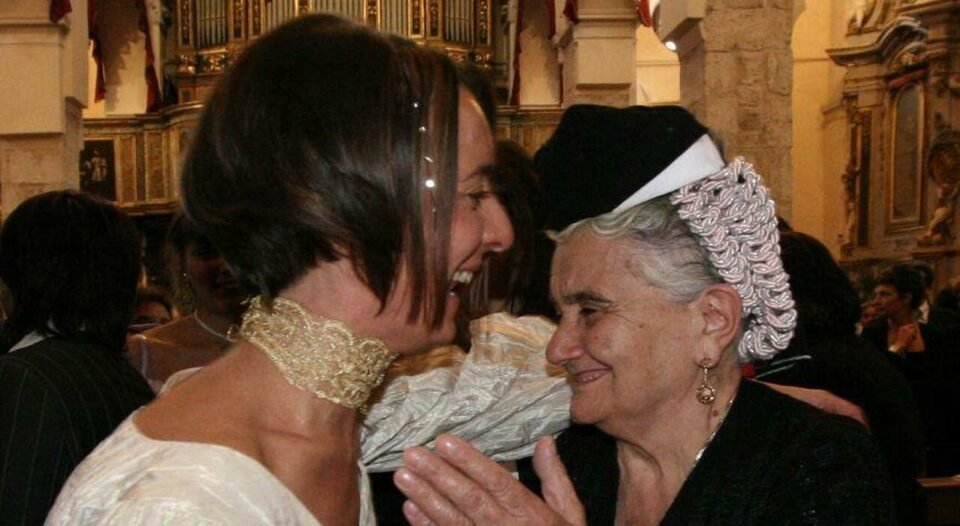
The traditional costume has almost become a mission for Liliana Spacone, 54, a designer originally from Scanno, who explains how she transformed the local traditional dress into contemporary art. Her story of passion pays homage to the women’s dress, an icon of an ancient culture, nominated as an Intangible Heritage of Humanity. Starting from the origins, how did your journey in the fashion world begin? “Since I was a child, I dreamed of working in the fashion world. To realize this dream, I moved to Urbino, where I studied at the School of Costume and Fashion.” How much has the connection with your homeland influenced your creative work? “It has always been very strong. In 2001 I graduated as a fashion designer, presenting a thesis on the women’s costume of Scanno, always carrying my Abruzzese roots with me. My advisor, Professor Benedetta Barzini, was a true mentor. She believed in me, supported me in every initiative, and was the godmother at my first conference ‘Tradition and Innovation in Styles and Decorations’. It was there that I launched my first line inspired by the Scanno costume, enhancing the ancient art of bobbin lace.” What were your first professional steps? “My journey began in 2000, working in the style office of Antonio Berardi. It was a huge growth experience. I then had the opportunity to collaborate on various lines for famous brands like Gianfranco Ferré, the designer who made me fall in love with fashion at thirteen, and Trussardi Uomo, where I refined my creativity in the male sector. Later, I also worked in children’s fashion for brands like John Richmond, Les Copains, N°21, and Miss Grant.” In the meantime, have you continued to work on special projects, always linked to Scanno? “Always. I created a line inspired by the traditional costume, making clothes, jewelry, bags, small leather goods, and t-shirts. I innovated the use of bobbin lace by employing new designs and lurex yarns, and created perforated leather bags that recall traditional craftsmanship.” You organized a very special fashion show. Can you tell us about it? “On August 22, 2024, I realized the ‘Interweaving and Weaving’ project in Scanno, a fashion show that involved women of all ages, enhancing every physique. It was a great team effort with photographers, makeup artists, hairdressers, and models. Seeing the participants smile and thank me was moving. It was also an event with a strong social value because it created cohesion in a mountain environment that is not always easy.” The theme of sustainability is central to your work. “For many years now, when the theme was not so felt. I pursue creative recycling to give new life to materials. In 2016 I organized a fashion show on the terrace of the Park Hotel at Lake Scanno, combining pieces from my wardrobe with the traditional costume and artistic t-shirts dedicated to the territory.” How is your production structured today? “In addition to the sartorial line inspired by the Scanno costume, I created a unique creation. A denim version of the women’s dress, maintaining identity elements such as lace, bobbin lace, and pleats, revisited with modern materials and innovative techniques. Alongside this sartorial project, I developed a line of perforated nappa leather bags, presented at Linea Pelle in Milan Collections, in collaboration with a leading company in the sector.” What are these special bags like? “It is a project where I applied the ‘Lomè’ technique, a manual processing that recalls the vertical pleating of the traditional dress skirt. It was exciting to reinterpret that ancient artisanal gesture on a precious material like leather.” Your creativity has also been expressed in pop fashion. “Yes, I created a collection of artistic t-shirts inspired by the female iconography of the Scanno dress. The graphics are inspired by great artists like Andy Warhol and blend tradition with modern visual culture.” Who has worn your creations? “Maria Grazia Cucinotta wore a t-shirt dedicated to Frida Kahlo with the iconic ‘Ju cappellitte’, while Ornella Muti chose the ‘Blindfolded Goddess’ in the Scanno version. It was a great honor.” What is your relationship with Scanno? “I move between Bologna, where I live with my husband and son, and Scanno, an inexhaustible source of inspiration. In Scanno, there is still a community of elderly women who wear the women’s dress, often photographed by foreign tourists. For me, it is essential to continue telling that story, bringing it into the present and spreading it through every creation of mine.” What dream do you hope to realize soon? “To continue to keep the traditions of my land alive in unique and modern pieces, everywhere in the world. And, above all, to contribute to having the Scanno dress recognized as an Intangible Heritage of Humanity. It would be a dream not only personal but for our entire community.” Next commitment? “On May 16, I will participate in Rome at the Capitoline Hill, at the conference ‘Memory from Tradition to the Future, Scanno and its Costume’.” How do you see the future of the traditional costume of Scanno? “I believe that the traditional costume of Scanno has a very strong soul, capable of crossing times without losing its essence.” Do you think it can continue to evolve without losing its identity? “The secret is to respect its deep language, reinterpreting it with sensitivity. For me, innovating means keeping the symbols alive, such as pleats, bobbin lace, and lace, but interpreting them with current materials and techniques, to make them accessible even to new generations. If there is love and knowledge for what is created, identity is not lost; rather, it is renewed and strengthened.”
© ALL RIGHTS RESERVED
This article is automatically translated
[ad_2]
Source link