
[ad_1]
Exhibited at the Fondation Louis Vuitton, Alexander Calder left a lasting mark on the art world through his vision of movement and his works, which still remain today a source of inspiration and reflection for his admirers.
Alexander Calder is now considered one of the major artists of the 20th century. Known for his famous suspended mobiles, he profoundly renewed sculpture by introducing movement, chance, and space into it.
From engineering to art
Alexander Calder was born in 1898 in the United States into a family of artists. His father was a sculptor and his mother a painter. This creative environment played a fundamental role in his development, even though he did not initially set out to pursue an artistic career. Calder first studied engineering, which gave him a technical understanding of materials and mechanisms, as well as a way of thinking about balance, movement, and structures. It was only around the age of 25 that he turned back to art, reconnecting with his family heritage. He then trained at the Art Students League of New York, where he learned drawing and painting.

In 1926, a major turning point occurred: Calder moved to Paris, at the heart of the artistic avant-garde. There, he associated with figures such as Fernand Léger, Piet Mondrian, and Marcel Duchamp. His early work was marked by drawing and caricature, which he sold to the press, but also by a particular focus on movement. Very quickly, he created the Cirque Calder (1926–1931), a unique work composed of small animated figurines that he manipulated himself during performances. This creation already announced his obsession with movement and staging.
At the same time, he developed his famous wire sculptures, which he called “drawings in space.” These works depict human or animal figures with great economy of means, capturing the essence of movement with just a few lines.

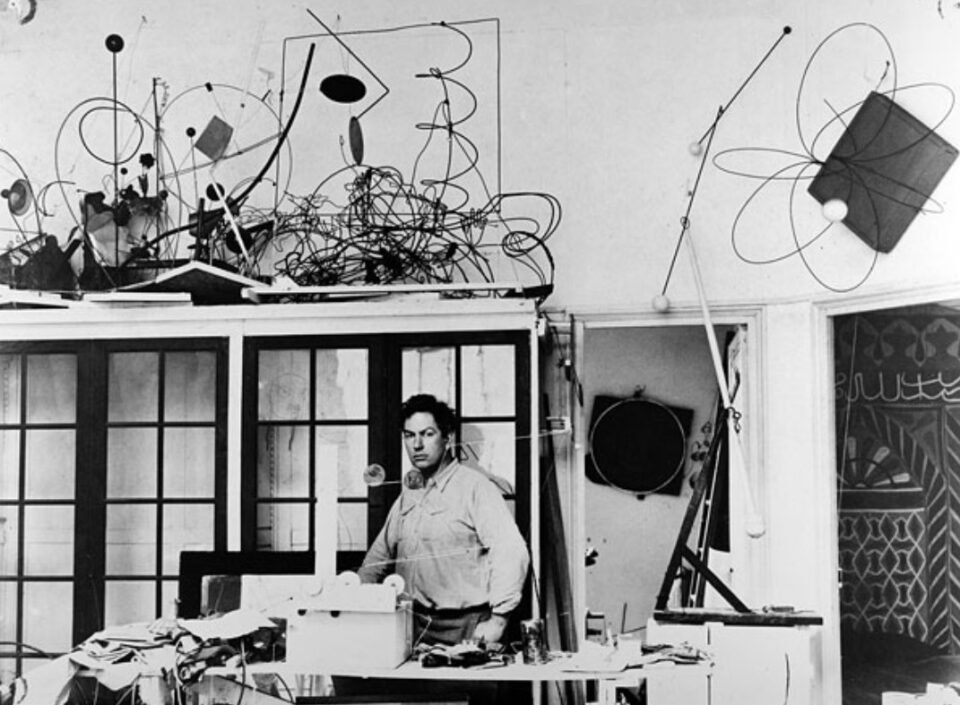
A decisive encounter with Piet Mondrian marked another turning point. Fascinated by his abstract compositions, Calder imagined giving them movement. Thus, in the early 1930s, he invented the first mobiles—abstract sculptures set in motion by air or mechanical systems.
Painting, drawing, sculpture…
Calder’s work is marked by several emblematic creations that illustrate his inventive genius. Among the notable works is Small Sphere and Heavy Sphere (1932–1933), an installation in which elements collide randomly, producing unpredictable sounds and movements.
Click here to read the full article on Luxus Magazine.
Featured photo : Calder Foundation
[ad_2]
Source link