
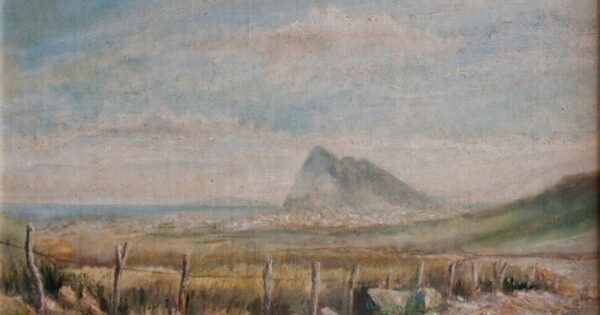
An annual painting competition honouring the legacy of Gibraltarian teacher Dora Montegriffo will take place this month, with entries now open to primary school pupils.
The fourth edition of the competition is open to pupils in school Years 3 to 6 and is themed on Gibraltar heritage. Entries must be submitted to the Head of Art at each student’s school by Friday, March 27.
There are two prize categories: Upper Primary School senior, for pupils in Years 5 and 6, and Upper Primary School junior, for pupils in Years 3 and 4.
Last year’s winners received £100 in cash and £75 in vouchers. Runners-up received £50 in cash and £50 in vouchers, while highly commended entries received £40 in cash and a £40 voucher.
Winning and commended artworks will also be published on the competition website.
Mrs Montegriffo, who dedicated her life to teaching and maintained a lifelong passion for art, began her schooling at Loreto Convent in 1939. At the outbreak of the Second World War she was evacuated to London, where she continued her education for four years at St Aloysius Convent School in Clarendon Square.
As an only child, she often entertained herself by painting, and her talent was quickly recognised by school friends who asked her to illustrate their autograph books.
After the war she returned to Gibraltar and attended Brympton School, a private school established in 1920 mainly for the children of officers and officials in the naval, military and civil services.
Her interest in art was encouraged by the head teacher, Miss E.M. Simpson, the Gibraltarian artist Leni Mifsud, who gave her private art lessons, and Mr Brinton-Lee, who stayed at Hacienda El Almendral in San Roque.
Although encouraged to pursue art professionally, Mrs Montegriffo chose teaching as a career because of the security it offered, while still allowing her to pursue her artistic interests.
She began working as a student teacher with the Department of Education in 1951 and received a government scholarship the following year.
Mrs Montegriffo later trained at Digby Stuart College in Roehampton, now part of the University of Roehampton, where she specialised in art. During this period, financial constraints meant many of her paintings were produced on practice paper, which led to some deteriorating over time. Others have survived, including The College Ruins and Roehampton Common.
She obtained an Art Teacher’s London University certificate, which in 2017 was upgraded to the degree of Bachelor of Education.
After completing her studies, she returned to Gibraltar and began teaching at Castle Road School, later becoming its head teacher. She subsequently moved to St Mary’s Middle School as head teacher, where she remained until the end of her career.
The school was originally located at Johnstone’s Passage before moving to the site now occupied by Prior Park School, where Mrs Montegriffo retired in 1985.
Several of her works are currently displayed at Prior Park School, while others can be viewed online through the competition website.
Mrs Montegriffo was proud that St Mary’s was the first middle school in Gibraltar to have a library and of the record number of pupils from the school who successfully passed the eleven plus examination and gained places at grammar school.
After retiring, she devoted much of her time to painting and travelling to visit art galleries, including the Musée d’Orsay in Paris, which houses a collection of French impressionist works.
She also enjoyed photographing landscapes that caught her attention and later using them as inspiration for paintings.
On March 18, 1991, she held her first exhibition, which was opened by the then Chief Minister Sir Joe Bossano.
Her style of painting was once described in this newspaper as “conventionalism with a touch of impressionism”.
Mrs Montegriffo preferred to capture light and atmosphere rather than precise detail. She admired the work of Claude Monet, particularly The Japanese Footbridge, and was inspired to photograph the bridge during a visit to Paris so she could paint it from a different angle.
Among the other artists she admired were Joaquín Sorolla and Diego Velázquez, whose techniques and use of light she particularly appreciated. While she did not favour modern art, she acknowledged that it could still appeal visually.