
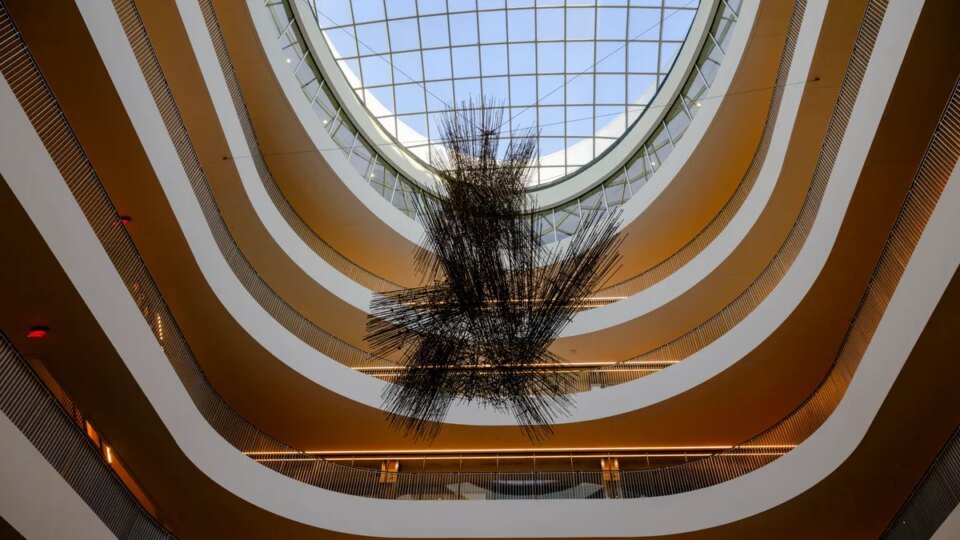
Detroit — Once mistaken for a dusty pile of construction materials in a shuttered mall basement, a $1 million sculpture by a famed artist with ties to Detroit is the jewel of General Motors Co.’s glitzy new downtown headquarters.
The Italian immigrant and Michigan-educated Harry Bertoia’s intricate welded sculptures (as well as his classic mid-century modern “diamond” chair) are on display in museums across the world and can sell for hundreds of thousands of dollars, sometimes more.
But because he rarely titled or signed his works, some privately owned pieces have fallen into disrepair and been sold for scraps. That was almost the fate of a nearly 30-foot-tall metal Bertoia sculpture commissioned by the Hudson’s department store in 1970.
The untitled piece ― two clusters of interwoven thin metal rods suspended in air ― was on display at Flint’s Genesee Valley Mall for only a decade before it was put into storage in the Northland Center mall basement in 1980 and forgotten.
Lost for decades, the sculpture and other works were nearly auctioned off as the failing Northland Center mall neared closure in 2015, Southfield Mayor Kenson Siver said. The city fundraised $500,000 to buy all the art left in the basement, including Marshall Fredericks’ famous “The Boy and the Bear” statue, without realizing the treasured Bertoia was among the rubble.
“It was all bent up, and it was filthy,” said Celia Bertoia, the artist’s daughter and director of the Harry Bertoia Foundation. “Just covered with grit and cobwebs and mouse turds and whatever else.”
But after Southfield acquired the art and the mall, a lover of mid-century modern design on the Southfield Public Arts Commission spotted the neglected sculpture and recognized it as a possible Bertoia during a tour, Siver said.
Years passed as Southfield looked for a new home for the massive sculpture ― no small feat as it needed extensive and expensive repairs and a space several floors high from which to hang.
Former members of the GM design team visited the piece in the dimly lit Northland basement after it was unearthed, said Christo Datini, GM Design Archive and special collections manager: “We have a great fondness for Harry Bertoia here at GM Design.”
Bertoia’s first public commission was for GM in 1953, bonding the automaker and artist. “Fast forward a couple of years, we were doing an arts program here at General Motors and a lot of our employees were going arts for our new design studio building, what we refer to as Design Studio West,” Datini said.
“We were starting to think about Hudson’s, and we were starting to think about this grand atrium that was going to be part of the new GM headquarters, and my team brought up the idea of this sculpture that we had seen in storage.”
The ties connecting the once-lost Bertoia piece to its future home at GM’s new headquarters at the renovated Hudson’s building were too strong to ignore: Bertoia’s previous work with GM, J.L. Hudson’s involvement with the sculpture’s creation, and Bertoia’s time at the Cranbrook Academy of Art and what is now named the College for Creative Studies.
“There are all these connections between the sculpture and Hudson and General Motors and Detroit,” Datini said.
Southfield sold the piece to GM for $1 million, Siver said. Restorers at Flatlanders in southeast Michigan worked for more than a year to rid the sculpture of rust, weld broken joints and put a protective treatment on the metal, said Flatlanders partner Ken Thompson.
“It is made up, literally, of several thousand rods, and there are god-only-knows how many thousands of brazed joints and how many of them were broken,” Thompson said. “So you’re trying to dig into this thing which is like a rat’s nest that your hands will barely fit into.”
Once cleaned, “it had life again,” Datini said. “It sparkled. It had a jewel quality. The brass was back to life, and it revealed all these new little elements, like these little buds that were almost like little jewels.”
Heart of GM headquarters
Bertoia’s art hangs at the center of the new Hudson’s Detroit building in downtown Detroit, where GM will stake out as its new headquarters the week of Jan. 12 after leaving the Renaissance Center amid readying a reinvention plan with Dan Gilbert’s Bedrock real estate development arm.
To install the sculpture, the renovated Hudson’s building had to be “unzipped,” said GM spokesperson Tara Stewart Kuhnen. Chain-falls and cranes were used to slip the sculpture, separated into two pieces, into a 75-foot-tall opening.
The sculpture now hangs several floors high in the atrium of the building, lit by a flood of sunlight that pours through a glass ceiling inspired by the headlight coverings of vintage Cadillacs.
“Bertoia felt that light was the sculptor’s most important partner, and that the play of light on metal gave life to the form,” Datini said. “And that without light, sculpture doesn’t really exist.”
To make the sculpture, Bertoia “would take a brazing rod of bronze or copper and take a torch and just melt it right onto the stainless steel base wire,” Celia Bertoia said.
“Any man or woman who’s a welder, they could definitely appreciate this work. A piece like this, I don’t know exactly how long it took, but it was probably upwards of a year. There’s a lot of detail in there.”
“He was a metals man,” she added. “He loved metal. He loved working with it, and he understood all the different alloys and how they responded.”
Bertoia’s focus on the interplay between light and metal struck a chord with GM designers, who similarly dial into those elements when building vehicles. Auto designers are “always cognizant of how the light is going to hit a particular surface on the vehicle,” Datini said.
“Light and metal is very automotive in nature, especially during that period of the ’50s,” Datini said. “The way that light would play on the chrome on the vehicles as they drove down the street, or the way that it would bounce off the mirror-finish paint.”
Datini said Bertoia’s craft in sculpting also parallels the work GM designers do as they experiment with new models.
“We sculpt by hand in both scale and full size as part of the product development process,” Datini said. “So to have the connection between these incredible sculptures, artistic sculptures on campus, but also sculpture as part of our process, it really hits home for us.”
GM in the 1950s commissioned Bertoia for a floor-to-ceiling screen made of hundreds of steel plates “coated in molten brass and bronze,” Datini said.
The piece originally was displayed in what was the cafeteria at GM’s Warren Technical Center, another design masterpiece by Bertoia friend and architect Eero Saarinen, who is also known for designing Dulles International Airport and the Gateway Arch in St. Louis.
Saarinen “championed art on campus as part of the human experience,” Datini said. The Technical Center is also home to several Knoll Bertoia “diamond chairs,” a staple of mid-century modern design and a credit to the artist’s multidisciplinary skill.
Even though the screen sculpture that now sits at Cadillac House at the Tech Center “is not automotive in nature, the fact that it’s metal and the light is playing with that metal evokes the automobile,” Datini said.
“Our designers are inspired by their environment, and their environment happens to be mid-century,” Datini said. “And mid-century modern design has stood the test of time. It has become classic. It has continued to inspire because there was a great deal of innovation in mid-century modern design. The designs were simple. They were intended to be elegant but approachable.”
The sculpture’s secrets
Siver said the fine, overlapping rods in Bertoia’s Hudson sculpture signal what fans describe as the artist’s “straw theory,” a reference to an image of sunlit straw bales that some see in his works.
Nature and the native forests near the family’s home in Pennsylvania inspired Bertoia, his daughter said. Her father “could stop at a tree and look at the bark and wonder at the intricacy of it. Walking in a golf course, he would kneel down and look at the grass and marvel at how close the grass blades were together.”
To Celia Bertoia, the Hudson’s piece “looks like something you’d find out in the universe.”
“My father was a very spiritual man, and he really was connected to the universe and to otherworldly realities,” she said. “When he came up with the ideas for various sculptures, especially one like this, he was really thinking in much larger terms than just our little planet Earth here.”
But both Celia Bertoia and Datini said the Hudson’s sculpture should be viewed without preconceived notions. Celia Bertoia said her father resisted titling his pieces “because he really felt that the viewer was just as important as the creator.”
“There are so many different people who look at it, and each one of them, of course, has a different life experience, different memories, and they will see something different,” Celia Bertoia said. “He felt that he was just one man. He was channeling a creative energy from above, from a divine source. And why should he put one man’s name on it?”
GM plans to offer public tours of its new headquarters ― and the Bertoia sculpture ― the weekend of Jan. 17. Datini’s advice: “If one has the opportunity to see it, they should just let it speak to them.”
sballentine@detroitnews.com