
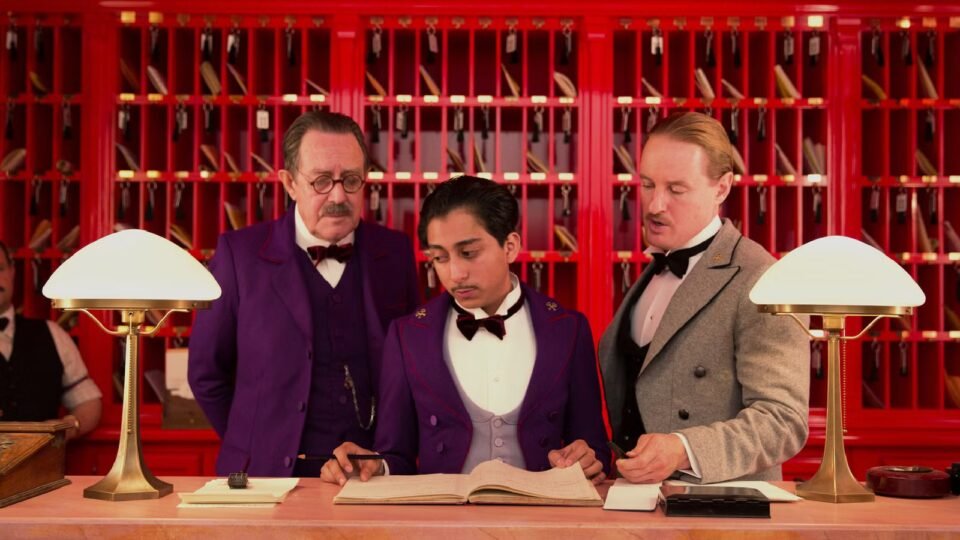
Considering cinema is a visual medium, a movie’s look can make or break the audience’s experience. Sure, things like story, music, and dialogue are certainly important, but a film simply cannot hope to entertain audiences without an aesthetically pleasing presentation. There are, of course, some films that intentionally break from this expectation, but for the most part, every good movie is at least partly beautiful, and the great ones aim to bring that beauty and artistry to every single frame.
Some of the greatest works in the history of cinema have been films that don’t just fulfill this requirement; they exceed it, presenting gorgeous visual narratives that rival the most celebrated works of art. These are the rare masterpieces that make you want to stop and drink in every shot, every frame, just like you would a sublime landscape by one of the great masters. Without further ado, here’s our handpicked selection of movie masterpieces where every frame looks like a painting.
8
‘The Grand Budapest Hotel’ (2014)

A comedy-drama film directed by Wes Anderson, The Grand Budapest Hotel follows the story of Gustave H. (Ralph Fiennes), a concierge at a 20th-century mountain resort in an Eastern European town, who takes pride in always offering first-class service to every guest, whatever it takes. When Gustave gets framed for murder, he sets out to prove his innocence with the help of his protégé, bellhop, and friend, Zero (Tony Revolori). The film’s 17-actor ensemble cast also includes Tilda Swinton, Adrien Brody, Willem Dafoe, Edward Norton, and Jason Schwartzman in important roles.
Anderson’s only Academy Award-winning feature film, The Grand Budapest Hotel is a sweeping example of incredible cinematography and art direction, featuring the auteur’s distinctive visual and narrative style. The film draws its art and design stylings from mid-century Hollywood films set in Europe, as well as the U.S. Library of Congress’s photochrom print collection of alpine resorts, combined with breathtaking vistas of its filming locations in Eastern Germany. Add in the changing color composition to accentuate narrative tones and convey visual emphasis, and the result is a film that’s richly artistic in every frame.
7
‘Hero’ (2002)

A Chinese martial arts epic directed, co-written, and produced by Zhang Yimou and starring Jet Li, Hero follows the story of Nameless (Li), an anonymous warrior in ancient China who claims to have defeated three dangerous assassins, thus protecting the king. When he narrates the stories of his battles, the king challenges his tales and questions some of the details, interjecting with his own take on the events. Other important characters are played by Tony Leung Chiu-wai, Maggie Cheung, Zhang Ziyi, Donnie Yen, and Chen Daoming.
A cinematographic extravaganza by Christopher Doyle, Hero is a fantastic example of a wuxia film where swashbuckling battle sequences are beautifully woven with visual poetry, philosophy, and symbolism. The narrative is divided into five sections, each depicted using different colors that represent various emotions and values, making every scene/segment feel like a live painting. At the time of its release, Hero was the most expensive Chinese film and became the first Chinese-language movie to top the American box office, earning an Academy Award nomination for Best Foreign Language Film.
6
‘Loving Vincent’ (2017)

Written and directed by Dorota Kobiela and Hugh Welchman, Loving Vincent is an experimental animated historical drama recounting the life of Dutch Master Vincent van Gogh, focusing on an investigation surrounding the events of his death. Robert Gulaczyk portrays the titular artist, with Douglas Booth, Jerome Flynn, Saoirse Ronan, Helen McCrory, and Chris O’Dowd in supporting roles. It is the first fully painted animated feature film with additional rotoscope animation.
If every frame of Loving Vincent seems like the Dutch Master’s paintings come to life, it is because they are created using the same painstaking techniques used by the post-impressionist maestro. Each of the film’s 65,000 frames is an oil painting on canvas, drawn by 125 artists from around the world. Even though the film’s storytelling and narrative style may not be consistently great, Loving Vincent succeeds in capturing the brutal elegance of Van Gogh’s oeuvre, earning critical acclaim and a nomination at the 90th Academy Awards for Best Animated Feature.
5
‘The Darjeeling Limited’ (2007)

Directed by Wes Anderson and written by Anderson, Roman Coppola, and Jason Schwartzman, The Darjeeling Limited tells the story of three estranged brothers, Francis (Owen Wilson), Peter (Adrien Brody), and Jack (Schwartzman), who meet a year after their father’s death and reconcile with each other. Journeying aboard the titular luxury train across India, the brothers find themselves on a spiritual quest, reflecting on their respective lives. The comedy-drama film also features Waris Ahluwalia, Anjelica Huston, Natalie Portman, Irrfan Khan, and Bill Murray in cameo appearances.
A film with deeply spiritual connotations, The Darjeeling Limited is a whimsical concoction of humor, grief, and existential philosophy, portrayed through beautiful production design. The story’s mystical undertone comes to life with Anderson’s signature style of meticulous, richly-colored frames blending Indian artistry and Art Deco, making its symbolic world both the staging and a character in the brothers’ quest for self-discovery. The film’s impressive production design and eclectic soundtrack, blending British Invasion rock, classic Indian film scores, and Indian and Western classical compositions, make it no less than a living portrait book.
4
‘Amélie’ (2001)

A French-language romantic comedy directed and co-written by Jean-Pierre Jeunet, Amélie tells the story of the titular woman (played by Audrey Tautou), a shy, isolated waitress in Montmartre, Paris, who is caught up in her fanciful world but secretly orchestrates small acts of kindness to bring happiness to those around her. Her quest to spread joy leads to quirky adventures and puts her on a path to discovering love for herself. The film’s ensemble cast also features Mathieu Kassovitz, Rufus, Lorella Cravotta, Serge Merlin, Jamel Debbouze, and Claire Maurier.
A widely acclaimed and enormously successful film with four César Awards and five Oscar nominations to its name, Amélie instantly steals your heart with the delightfully charming and imaginative heroine, brilliantly portrayed by Tautou. But it is the film’s enchanting art direction by Bruno Delbonnel that holds your attention throughout its two-hour runtime. The whimsical depiction of contemporary Parisian life through vividly shot, dreamy, postcard-like visuals with a vibrant color palette creates a distinctively surreal aesthetic that makes Amélie a visually serene film.
3
‘A Clockwork Orange’ (1971)

A dystopian crime film written, directed, and produced by Stanley Kubrick, based on Anthony Burgess‘s eponymous 1962 novel, A Clockwork Orange follows Alex, a charismatic but sociopathic teenage delinquent who engages in various acts of ultra-violence until he is captured and forced to undergo rehabilitation using an experimental psychological therapy that strips him of his free will. The film explores disturbing and violent themes, commenting on social, political, and economic issues, and raises profound questions about free will, morality, and state control over human nature. Malcolm McDowell stars as Alex, with Michael Tarn, James Marcus, Warren Clarke, Anthony Sharp, Patrick Magee, and Adrienne Corri in supporting roles.
Despite being a highly controversial film at the time of its release, A Clockwork Orange is easily one of the 20th century’s best dystopian thrillers and is considered one of the greatest films of all time. Besides its thematic significance, the social thriller finds its appeal in Kubrick’s mastery of visual storytelling, drawing from surrealism, brutalist architecture, and pop art. With its distinct, thematic color palette that changes with the shift in narrative, A Clockwork Orange is a benchmark for visual storytelling in cinema.
2
‘Pride & Prejudice’ (2005)

Based on Jane Austen’s novel of the same name and directed by Joe Wright in his feature directorial debut, Pride & Prejudice reimagines the classic tale of five sisters from an English family of landed gentry as they navigate various familial and social issues. The film focuses on Elizabeth, the strong-willed and sensible second daughter, who encounters the wealthy, arrogant Mr. Fitzwilliam Darcy and develops an unusual connection. Keira Knightley portrays Austen’s heroine, Elizabeth Bennet, with Matthew Macfadyen as Mr. Darcy. Rosamund Pike, Tom Hollander, Donald Sutherland, and Judi Dench appear in supporting roles.
A critically and commercially successful film, Pride & Prejudice is most noted for Knightley’s fantastic performance and Wright’s outstanding debut as a director-writer-producer. However, it is the film’s artistic cinematography that brings Austen’s 19th-century classic literature to life, with scenes framed as paintings with dreamy aesthetics. Combining Realism and Romanticism, every scene of Pride & Prejudice offers a distinct visual style that renders a grounded but artistic depiction of the original story’s setting.
1
‘2001: A Space Odyssey’ (1968)

One of the most influential sci-fi films ever made, 2001: A Space Odyssey was directed and produced by Stanley Kubrick, who also co-wrote it with Arthur C. Clarke. The movie follows the discovery of a mystifying monolith buried under the lunar surface. Not long after, a team of scientists and astronauts embarks on a voyage to Jupiter to investigate the mystery, with the assistance of HAL 9000, a sentient supercomputer. The film stars Keir Dullea, Gary Lockwood, William Sylvester, Daniel Richter, and Douglas Rain in the main roles.
On its release, 2001: A Space Odyssey was met with divisive reviews with varied interpretations of its themes, but was widely acclaimed for its pioneering special effects, which earned Kubrick an Academy Award. Drawing heavily from retro-futurism, neo-futurism, and modernism, with intricate effects and realistic architecture, every frame in the sci-fi classic feels like a living artwork. A mind-bending blend of historical art and intricate practical effects, 2001: A Space Odyssey is a visually stunning sci-fi movie that’s widely recognized as one of the greatest films of all time.

- Release Date
-
April 10, 1968
- Runtime
-
149 minutes
- Director
-
Stanley Kubrick
- Writers
-
Stanley Kubrick, Arthur C. Clarke
- Producers
-
Stanley Kubrick
-

Keir Dullea
Dr. David Bowman
-
Gary Lockwood
Dr. Frank Poole