
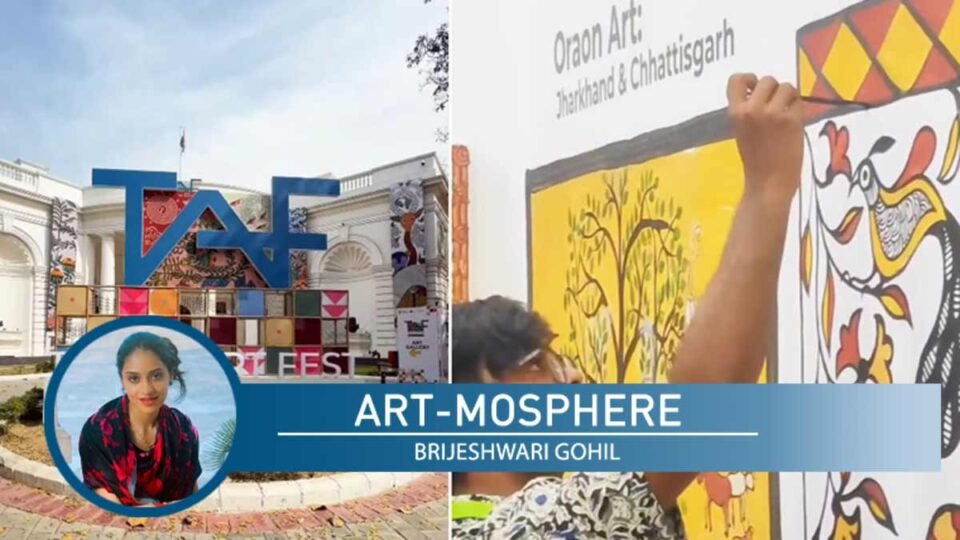
In the quiet, red-brick courtyards of Travancore Palace, a vivid cultural gathering is unfolding this season. The Tribes Art Fest 2026 has transformed the historic complex into a lively meeting ground for artists, storytellers, and craftspeople from across India. Colours spill across canvases, textiles flutter in patterned abundance, and conversations drift between visitors and artisans who have travelled long distances to bring their work to the capital.
At first glance, the festival appears to be a straightforward celebration of what is commonly called tribal art. But spend a little time walking through the displays, speaking to the artists, and observing the extraordinary variety of forms on view, and a curious question begins to surface.
What exactly do we mean when we say ‘tribal’?
It is a word used with great frequency in India’s cultural discourse, yet one that resists easy definition. In administrative language, it corresponds to the category of Scheduled Tribes, a grouping that includes hundreds of communities spread across forests, hills, plains, and islands. Their languages, myths, customs, and visual traditions vary enormously.
And yet, the art world often compresses these vastly different practices into a single phrase: tribal art.
The Tribes Art Fest, perhaps inadvertently, reveals the limitations of that label. Walking through its spaces is like travelling across multiple artistic worlds at once. There are luminous Gond paintings where animals, trees, and mythic beings emerge through intricate patterns of dots and lines, the surface of the canvas vibrating with narrative energy. Nearby, Warli artists work with the striking minimalism of white geometric figures against earthy backgrounds, depicting scenes of village life, harvest rituals, and communal dances with remarkable economy.
Further along, the eye is drawn to textiles whose complex motifs carry generations of cultural symbolism. Handwoven fabrics display geometric patterns, sacred motifs, and regional colour palettes that have evolved slowly through time. Sculptural objects, carved wood figures, metal ritual forms, masks, and ornaments sit beside everyday artefacts that blur the line between craft and art.
In some corners, artists quietly demonstrate their techniques. A brush moves steadily across a surface, a pattern emerges thread by thread, or a motif slowly reveals itself through patient repetition. Watching these processes unfold reminds visitors that these traditions are not merely aesthetic styles but living practices embedded within community life.
This is where the complications begin.
Many of the artistic traditions represented here did not originate within the structures of galleries or art markets. Historically, paintings might have been created on the walls of homes during festivals or on floors during ritual ceremonies. Objects might be crafted for worship, storytelling, or seasonal celebrations. Art was not separated from daily life; it was woven into it.
When these works travel into urban exhibitions and festivals, they inevitably change context. A wall painting becomes a framed canvas. A ritual object becomes a collectible sculpture. What once belonged to a community space now enters the curated environment of the contemporary art world.
This transition has brought recognition and economic opportunity to many artists, allowing them to travel, experiment, and reach wider audiences. But it also raises subtle questions about how such traditions are framed and understood.
Who decides what qualifies as ‘tribal art’?
Historically, the label itself was applied from the outside, by colonial administrators, anthropologists, and later by museum curators and collectors. Communities rarely used the term to describe their own creative practices. An artist might identify through their village, clan, or lineage rather than through a broad cultural category.
Today, many practitioners navigate that label with both pragmatism and caution. For some, it provides visibility within a crowded cultural landscape. For others, it feels limiting, an umbrella that flattens the diversity and complexity of their traditions.
Festivals like Tribes Art Fest therefore occupy a fascinating space between celebration and interpretation. They bring extraordinary artistic practices into the public eye while also quietly exposing the inadequacy of the categories used to describe them.
The setting adds another layer to this encounter. Travancore Palace, with its historical elegance and architectural calm, has long served as a cultural venue within Delhi’s artistic landscape. Within its courtyards, visitors wander between displays, pausing to speak with artists about the stories behind their motifs, the forests that inspire them, the myths passed down through generations, and the rituals that shape their visual language.
What emerges from these conversations is a striking sense of continuity. Many artists inherit visual traditions that stretch back decades, sometimes centuries. Yet they are not merely preserving something frozen in time. Increasingly, practitioners are adapting these languages to contemporary themes, environmental concerns, changing landscapes, migration, and identity.
The works on display therefore exist at an intriguing crossroads between heritage and modern expression.
And perhaps that is the deeper value of a festival like this. It reminds urban audiences that India’s artistic landscape has always been far broader than the walls of museums or the circuits of biennales. Across villages and forested regions, creativity continues to flourish in forms that remain deeply connected to land, ritual, and community.
Seen in this light, the Tribes Art Fest is not simply bringing “tribal art” into the city. Instead, it is revealing how incomplete that phrase truly is.
As visitors drift through the palace courtyards, pausing before luminous paintings, watching artisans at work, or carrying home a small handcrafted piece, the word ‘tribal’ begins to feel less like a precise definition and more like a doorway.
A doorway into an immense and diverse world of artistic traditions that cannot easily be contained within a single label.
And perhaps that is the most important lesson the festival leaves behind: that the story of Indian art is always larger, richer, and more complicated than the categories we try to place upon it.