
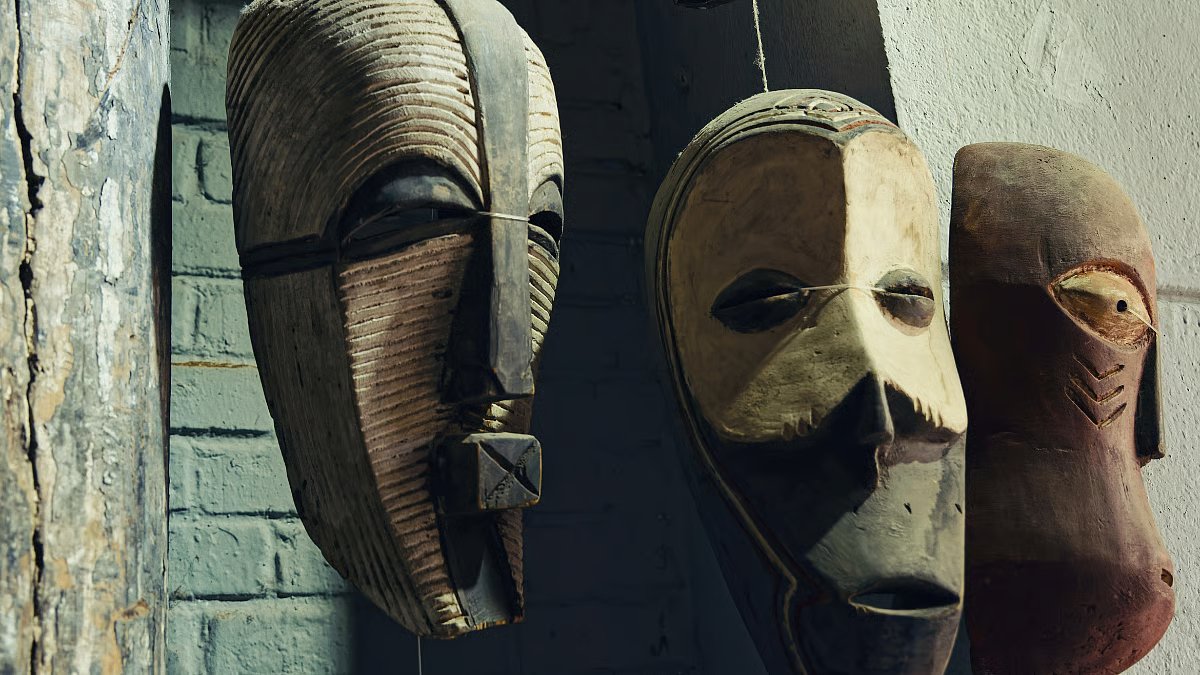
Despite Brooks’ careful explanation, there is still something uneasy in using the word “discovery” to describe something ancient that was deeply understood and appreciated within its home context, and as part of a rich and culturally advanced society. The root of this unease is also symbolic of broader social problems in Europe for which African art provided an antidote.
At the time, the Industrial Revolution had fundamentally changed European society. Cities were rapidly expanding as workers migrated from the countryside to work in factories, almost always in conditions that would be considered inhumane by today’s standards.
Politically, Europe was a mixture of colonial empires and nation-states, each dealing with their own internal and external challenges. The Austro-Hungarian Empire, the Ottoman Empire, and the Russian Empire were all showing signs of strain. The Dutch and French empires were weakening relative to the British Empire that was in its ascendancy, while newly unified nations like Germany and Italy wanted to assert their existence in the world
Among the new working class, rising nationalism set the scene for the eventual outbreak of the First and Second World Wars.
Intellectuals like Friedrich Nietzsche had commented on these dynamics before the turn of the century, arguing that the Enlightenment and the rise of scientific rationalism had led to a cultural and existential crisis in Europe, and eventually declaring that “God is dead” in his philosophical analysis of the decline of religious and spiritual belief.
At grass-roots level, especially in centres like Paris, these problems left people with an anxious feeling of loss and abstraction from the deeper meaning of life. This anxiety and ennui among the educated elite contributed to a reevaluation of the increasingly artificial and sterile character of European society. Despite all the technological advancements, geopolitical power and ‘social progress’, life still seemed to live up to its reputation of being “solitary, poor, nasty, brutish and short”, as the philosopher Thomas Hobbes had observed so long ago in 1651.
Among painters, the rise of Impressionism (which peaked around 1870–1880) had already started to challenge what Herbert Read called “the rigor mortis of academicism” by departing from the purely descriptive, almost photographic, style of realism and introducing elements of emotional interpretation and atmosphere in paintings. Yet by the turn of the 20th century, this movement was also unable to speak to a new, multifaceted range of social anxieties and existential dilemmas.
During this time, artists like Pablo Picasso and Georges Braque were responding to the changing social order by experimenting with new ways of depicting mysticism and deeper feelings of humanity through the creative use of abstract shape and colour. It was during this time that African art became available for public display.
Many of the African artworks on public display were ceremonial sculptures and masks that formed part of the religious and cultural traditions within their societies at home. They had striking geometric shapes that shifted focus to the essence of the subject rather than to a realistic representation. Being closely integrated with the cultural fabric and rituals of their communities, this art expressed a multifaceted symbolism and a closeness to the “source”.
Picasso and Braque are thought to have seen in African art something that spoke to what Europeans were yearning for, even if these yearnings were esoteric to the point of being almost impossible to pin down.
Clear descriptions are beyond my own vocabulary, so I’ll borrow from Paul Klee who wrote that: “We used to represent things visible on earth which we enjoyed seeing or would have liked to see. Now we reveal the reality of visible things and thereby express the belief that visible reality is merely an isolated phenomenon latently outnumbered by other realities.”
In Europe, the visible reality had been outnumbered by the social and individual realities associated with the commodification of labour, urbanisation, the development of a working class, and the loss of a life connected to religion, mysticism, traditional culture and meaning.
When Picasso and Braque brought African inspiration into their Cubism, it was these realities that it spoke to, and this changed the course of Modern Art. In Cubism they tried to capture the essence of their subjects by depicting them from multiple perspectives simultaneously, showing the fragmented nature of modern life.
From Cubism, there later developed a variety of artistic styles that drew both on its techniques and its ability to express an appreciation for mysticism. These include the dreamlike compositions of Surrealism and eventually Abstract Art, which truly cut the cord from visually realistic forms towards expressing a multidimensional range of meanings.
Somehow, and despite its previous obsession with realism, European art before Impressionism and Cubism was terribly unrealistic for it failed to interpret and address the human experience accurately and adequately. So it was with almost Shakespearean irony that, despite European condescension, African art helped European society step away from its ennui and towards a more grounded understanding of what it means to be human in a changing world.