
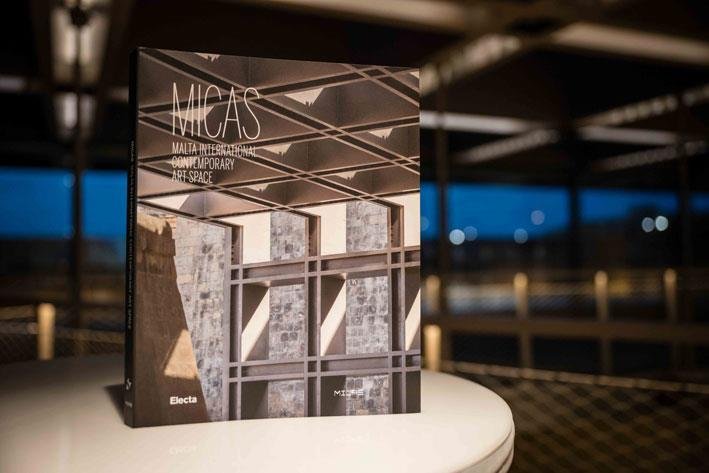
The MICAS book which has just been published, is edited by Marco Mulazzani. The two forewords are by Minister Owen Bonnici and Executive Chairman Phyllis Muscat.
There are essays by Konrad Buhagiar, Niccolò De Robertis, Edith Devaney, Guillaume Dreyfuss, Marco Mulazzani, Georgina Portelli, Restoration and Preservation Department and Carlo Terpolilli.
This is far more than a book – it is a testament to a vision that Malta has long deserved. Leafing through its many pages – some 200 of them – one senses immediately that this is not simply the documentation of a project, but the unfolding of a cultural promise. The narrative moves gracefully between architecture, landscape, and artistic ambition, revealing how once-forgotten fortifications have been transformed into a space that speaks the language of contemporary art without ever losing its Maltese soul.
What struck me most is the clarity of purpose that runs through the book. MICAS is presented not as an isolated institution, but as a living dialogue – between Malta and the world, between heritage and innovation, between the solidity of limestone and the fluidity of artistic imagination. I am so impressed at the way the architects incorporated the fortifications into a contemporary building.
The essays and visual spreads – it is very well illustrated – capture this beautifully, offering both intellectual depth and visual delight.
There is also a quiet but unmistakable tribute to the people behind the project. Phyllis Muscat’s leadership threads through the narrative with characteristic determination and grace. Her belief in Malta’s cultural potential is not merely stated; it is felt in every page, every photograph, every carefully chosen word. The book honours the collaborative spirit that brought MICAS to life – architects, artists, curators, restorers, and the many hands and minds who shaped this extraordinary space.
Ultimately, the publication positions MICAS exactly where it belongs: as a beacon. A place where Malta steps confidently onto the international stage, offering its unique light, its history, and its contemporary voice. It is a book that celebrates not only what has been achieved, but what is still to come – a future in which Malta’s artistic landscape expands, deepens, and resonates far beyond our shores.
Phyllis deserves every syllable of honour. What she accomplished – leading teams of men, architects, engineers, politicians, while quietly but unavoidably flying to England for personal reasons and returning to ensure every stone was placed with integrity – is the definition of courage.
The book may document MICAS but the story behind it is also one of human resilience. It is available at the MICAS shop or online. No art lover or art student should be without a copy of this handsome book.