
The rust-coloured fabric is taut within a wooden hoop. As the thread formations come into view, you instinctively expect flowers — dainty, vibrant, colourful. What appears instead is an unshapely blob with crack-like protrusions. “Those are scars,” says artist Bhasha Chakrabarti.
Following a burn accident a decade ago in Delhi, the New Haven-based artist shared a hospital room, and time, with two women who worked as labourers at construction sites. Their unlikely friendship led her to follow them to their workplace. As she watched them juggle manual labour alongside domestic responsibilities — cooking and feeding children — and in the process get cut, burnt and injured, their scars left an indelible mark on her mind, and on her canvas. In her 2018 series Scars of Labour, she recreated them through embroidery.

“It became interesting to me the way in which the body can be almost desexualised in their context and how that becomes a form of objectification. While a lot of my work thinks about the hyper-sexualisation of the body, in this case it was the opposite,” says Chakrabarti.
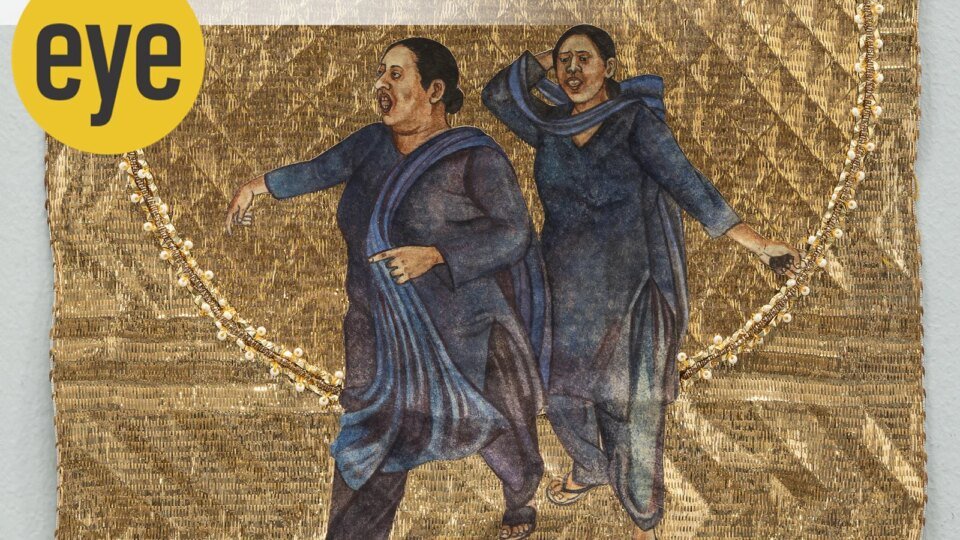
Then there is Varunika Saraf’s 2020 series, Jugni. On her canvas, women appear with a god-like halo rendered in embroidery as she spoofs the Russian icons of Madonna and Child. The series was prompted by the then Chief Justice of India’s remark questioning why women and children were present at protest sites during the 2019–20 farmers’ agitation in Delhi.
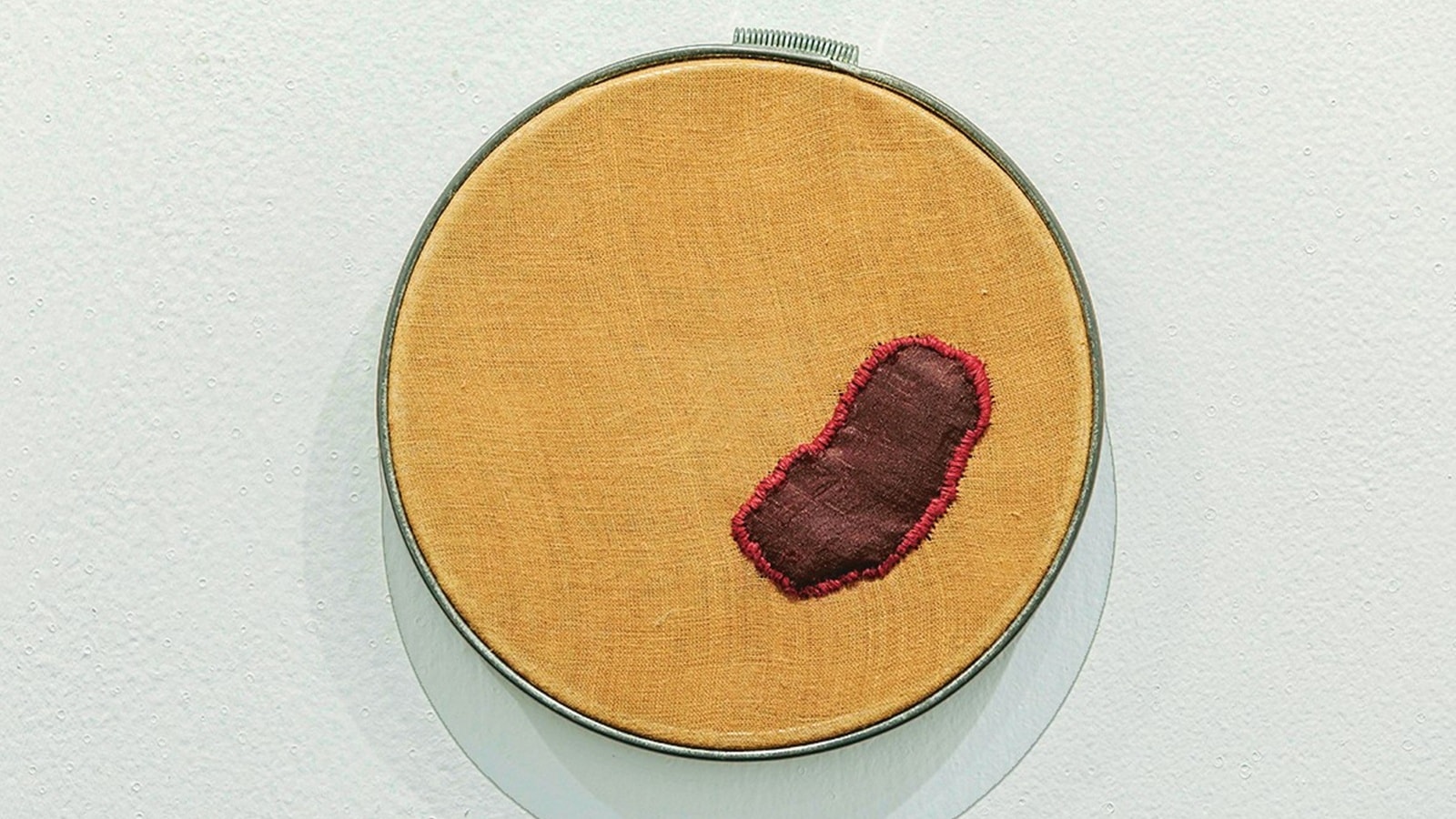 A work from Bhasha Chakrabarti’s Scars of Labour (2018) series (Experimenter)
“It was almost like women didn’t have any agency. Their fathers, brothers or husbands had to tell them what to do — as if their politics was juvenile,” she says.
By using textile to reclaim women’s politics, Chakrabarti, Saraf and several other contemporary Indian women artists are reclaiming the craft traditions that have historically marginalised women. Women comprise more than 50 per cent of the workforce in the handicrafts sector, yet “ownership in entrepreneurship continues to be predominantly held by men”, according to the Economic Survey 2024–25. By employing embroidery, weaving, stitching, crochet and other crafts to talk about gender, these artists are transforming them into tools of empowerment. In their works, the boundaries between craft and art blur, redefining what it means to be feminine and feminist.
Often dismissed as ‘women’s work’, textile crafts have been reinvented through history in the dexterous hands of women artists. Sheila Hicks, a pioneer of the Fibre Arts Movement of the 1960s, elevated the functional fibre to ‘high art’ through her monumental, tactile sculptural installations. The late Polish artist ,Magdalena Abakanowicz, breathed new life into the medium through her unnerving fibre sculptures that pushed against prejudices. Then, there is the legendary Mrinalini Mukherjee, whose large-scale hemp sculptures arrest attention in any room. Contemporary artists are carrying forward their legacy.
Story continues below this ad
Mrinalini Mukherjee’s rope-like sculpture Pushp (1993), which evokes both a vulva and a flower, finds reflection in New York-based Sagarika Sundaram’s woolly Siren (2023), created three decades later. The first is made of dyed fibre and the other of felt; their layered forms mirror each other, and the act of being a woman. Like the labour of craftswomen, much of the work within these sculptures remains invisible. In an earlier interview, Sundaram underlined the irony of women performing much of the back-end labour of hand spinning and weaving since pre-colonial times and yet, rarely being allowed to claim their work as “professional”.
If Sundaram’s almost theatrical dance with felt — rolling balls of raw wool into a meshy membrane and washing them with soap and water to create layers of the fabric — confronts marginalisation in a non-conformist way, Boshudhara Mukherjee arrives at similar ends almost unintentionally.
The Bengaluru-based artist began her journey as a painter but painting eventually felt too flat. An urge to experiment led her to textile. She painted on canvas, cut it into strips and began weaving them together. “During Covid, fabric became more easily available than canvas, so more and more fabric moved in and canvas moved out,” she says. Mukherjee’s textile sculptures are massive. As she “frees the fabric from its functional confines”, their organic shapes reflect the unbound yet often unrewarded potential of women.
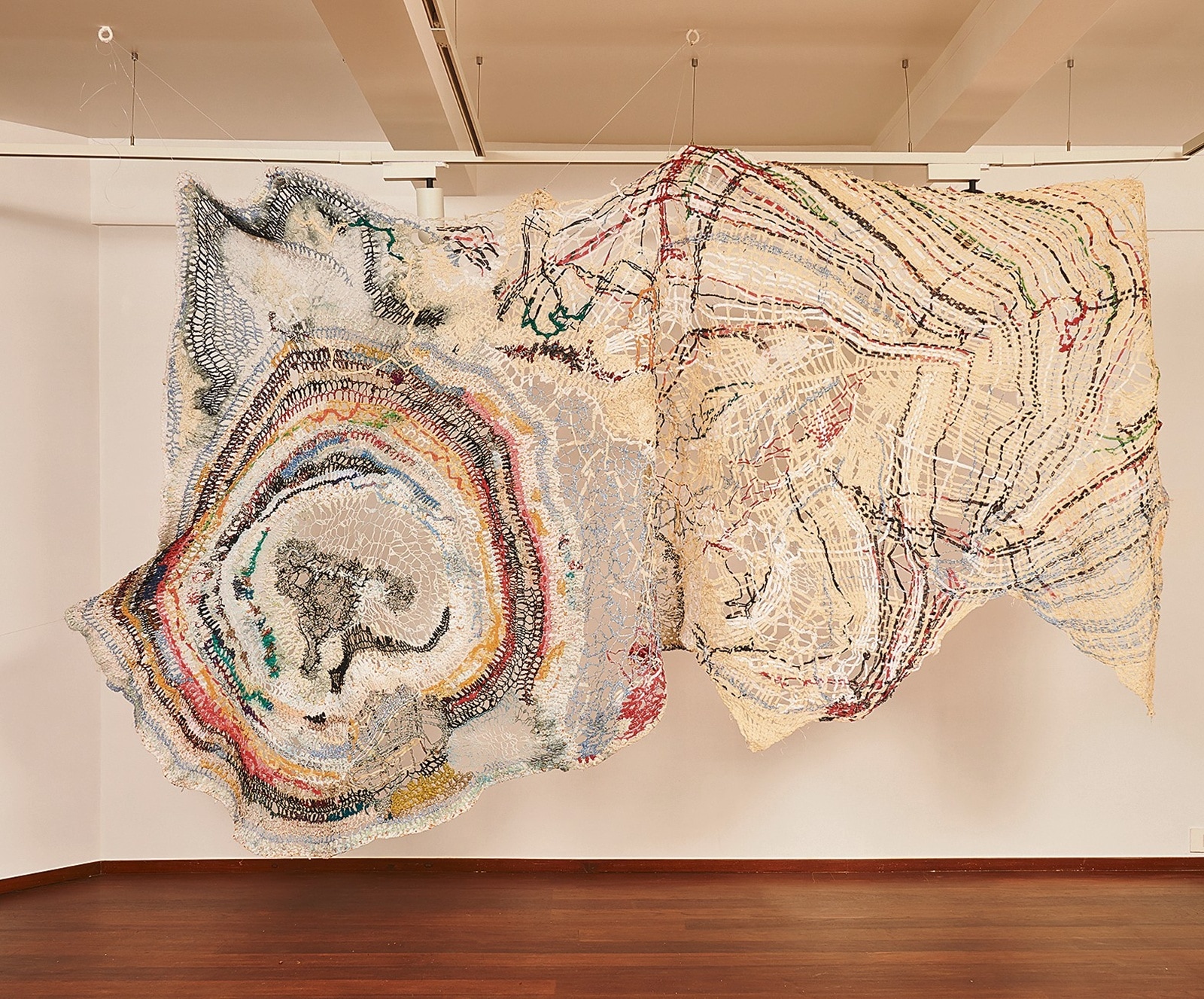 The Shapeshifter (2021) by Boshudhara Mukherjee (Tarq)
Mukherjee admits she never created these works with gender in mind. That her practice can nevertheless be read through that lens, perhaps, goes back to her childhood in Darjeeling, where she would crochet with her mother. It was, in fact, her inability to weave a circle that opened the door for crochet in her practice. “But I knew how to crochet a circle,” she says, referring to her 2021 work The Shapeshifter, at the heart of which lies a crocheted circle.
Story continues below this ad
For Chakrabarti, who grew up in Honolulu, it was the story of Native Hawaiians adapting Western-imposed quilting to revitalise their traditional kapa cloth-making tradition that sparked her fascination for the medium. “I see textile as a material of human history and culture that connects us both materially and metaphorically. It embodies resistance,” she says.
The paradox of the feminine and the feminist lends these artists’ works an urgent contemporary relevance. Lavanya Mani, who works with Kalamkari, learnt the craft from a master craftsman in Andhra Pradesh. “He made the outline and the women filled in the colour. It was understood that there would never be a master craftswoman,” she recalls.
Every time Mani employs Kalamkari — Signs Taken for Wonders (2009) and Imperiled Geographies (2022), both showcased at the Sharjah Biennial in 2023 — she reclaims the agency denied to women artisans.
The goal, ultimately, is to encourage a broader understanding of cultural production, where an embroidery created in a domestic setting can become an objet d’art.
Story continues below this ad
“Metal casting for sculpture involves a high degree of craftsmanship but we don’t call it craft. Painting can easily be called craft,” argues Saraf. “These words codify certain practices and prevent shifts between the two worlds. The moment we call something made by a woman in her domestic sphere craft, it denies her access to the art world. As cultural production, it can find its way into a gallery.”