
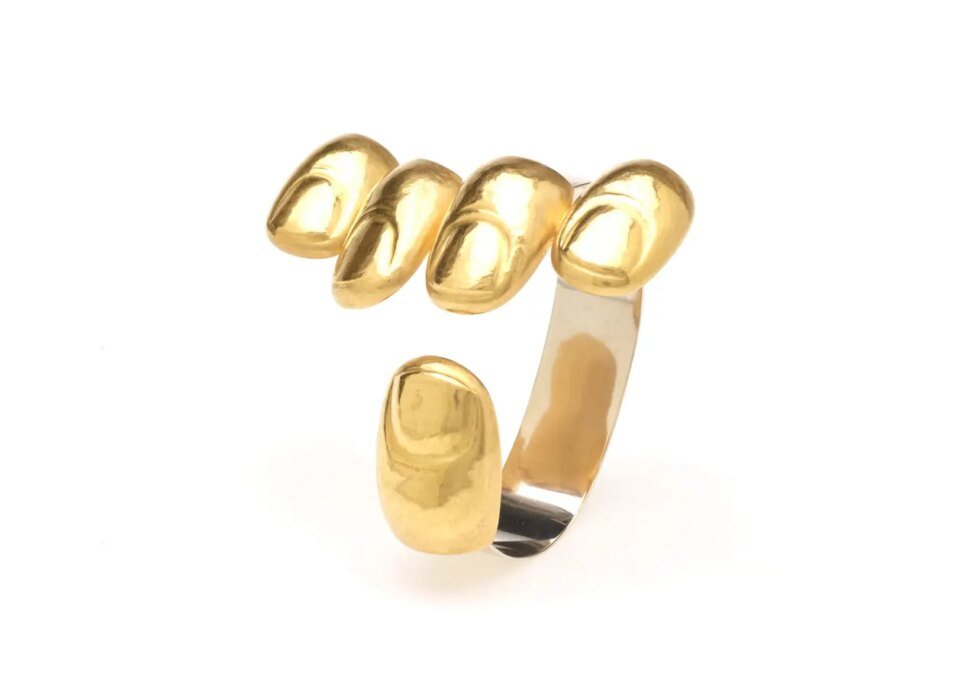
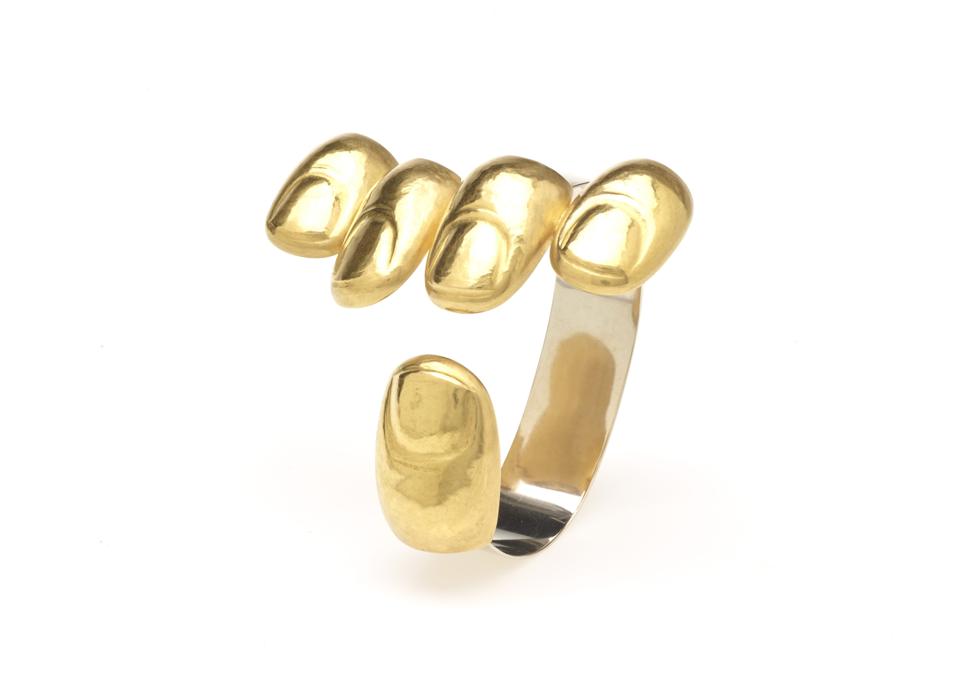
Goldfinger Bracelet by Bruno Martinazzi, 1969, 18k white gold and 20k yellow gold
Chad Redmon, courtesy Dallas Museum of Art
One of the largest and most significant collections of contemporary studio jewelry is now on view at the Dallas Museum of Art.
The exhibition, Constellations: Contemporary Jewelry at the Dallas Museum of Art, features more than 400 individual works drawn from the museum’s own holdings—an extraordinary collection of some 1,400 contemporary studio jewels acquired over the past 75 years.
Opened to the public on November 9 and running through May 3, 2026, the exhibition is curated by Sarah Schleuning, the DMA’s Margot B. Perot Senior Curator of Design and Decorative Art and presented in a multi-room installation designed by artist and architect Jarrod Beck. The show explores the depth, diversity and creativity of contemporary studio jewelry through distinctive artistic viewpoints and unconventional materials.
Constellations: Contemporary Jewelry at the Dallas Museum of Art
John Smith, courtesy Dallas Museum of Art
Many of the works are accompanied by artists’ sketches or archival photographs showing how the pieces are worn, offering insight into each maker’s vision and process.
The studio jewelry movement—born after World War II—is markedly different from traditional fine jewelry making. Rather than working in factories, studio jewelers are independent artists creating one-of-a-kind or limited-edition pieces from small private studios.
Art Smith, Galaxy neckpiece, circa 1962, sterling silver
Chad Redmon, courtesy Dallas Museum of Art
Play Puzzles & Games on Forbes
“These are all individual works that are one of a kind, made by artists in their own right,” Schleuning said.
Many of these artists are self-taught in jewelry techniques, using wearable forms as a means of artistic expression, much like painters use a canvas. Materials range from steel, glass, brass, and plastic to gold, silver, gemstones, and organic or recycled materials—anything that serves the artist’s concept. The movement is global in scope, and the exhibition reflects this international reach.
The breadth of the DMA’s collection presented Schleuning with both opportunity and challenge.
Some works in the “Constellations” exhibition are grouped by geometric form
John Smith, Courtesy Dallas Museum of Art
“I think it was challenging because I was trying to think about the visitor who may not be knowledgeable about this art to create curiosity and excitement, but also make the show really fun and enjoyable,” Schleuning said.
“It was also a challenge to go through 1,400 objects and really start to see what the common ideas are,” she added. “I think that’s really where the idea of constellations came for me, because I was mapping my own kind of ideas and saying, ‘what if this (group of jewels) became a cluster.’ Sometimes they’re my own interpretations, but that’s what looking at art is about.”
The Gleo neckpiece, 2023, by Genevieve Howard uses Japanese linen paper, Fabriano paper and elastic cord.
Chad Redmon, courtesy Dallas Museum of Art
The exhibition is organized around several themes, including Signals, Archetypes and Connecting the Dots, each with subcategories. In Archetypes, for example, works are grouped by geometric form—circles, triangles, squares. The final section, Kineticism, features pieces by German goldsmith and kinetic jewelry pioneer Friedrich Becker, including a white gold bracelet with four small marbles of chrysoprase and hematite that move as the piece rotates every 45 seconds.
Other notable works include Golden Fleece, an intricate gold ring by Italian artist Giovanni Corvaja enveloped in fine gold strands that create a fur-like texture, and Galaxy, a circa 1962 silver-and-pearl neckpiece by Manhattan artist Art Smith that evokes a star-filled night sky.
This Ellamarie and Jackson Woolley pendant is one of the first studio jewelry items acquired by DMA
John Smith, courtesy Dallas Museum of Art
Irish artist Genevieve Howard’s 2023 neckpiece Gleo translates the sound of the sea into visual form. Howard recorded ocean sounds, processed them through a computer to generate color patterns, and transformed the resulting data into an oversized blue-and-green neckpiece made of Japanese linen paper, Fabriano paper and elastic cord.
Constellations marks the first time the DMA has formally presented its extensive holdings of contemporary studio jewelry.
Constellations: Contemporary Jewelry at the Dallas Museum of Art
John Smith, courtesy Dallas Museum of Art
“The Dallas Museum of Art holds one of the largest and most diverse collections of contemporary jewelry in the world,” said Tamara Wootton Forsyth, the Museum’s interim director and Marcus-Rose Family deputy director. “It reflects our global and ambitious approach to collecting across all areas.”
The museum began collecting contemporary jewelry in 1950 with enamel works by San Diego artists Ellamarie and Jackson Woolley. The collection grew through acquisitions from regional makers, including North Texas artists Velma Davis Dozier and Esther Webb Houseman—known as the “Lady Blacksmiths”—and Thetis Lemmon, all self-taught metalworkers who shared their craft with others.
The Wrooar necklace, 2017, by Monica Cecchi, tin and silver
Chad Redmon, courtesy Dallas Museum of Art
A turning point came through longtime DMA supporter Deedie Potter Rose. In 2010, Rose donated a group of contemporary works, and in 2015 she and her husband, Edward “Rusty” Rose, gifted the DMA the Inge Asenbaum Collection—more than 700 pieces by 150 artists—along with drawings, catalogs and archival material.
The acquisition of the Asenbaum Collection, amassed by the late Austrian collector and gallerist Inge Asenbaum (1925–2016), transformed the DMA’s holdings.
“It shifted our collection from regional to international,” Schleuning said. “With Inge based in Vienna, it was mostly European with a lot of Eastern European imprints. We’re now one of the few U.S. museums in the U.S. with so many artists from Eastern Europe.”
The entrance to “Constellations: Contemporary Jewelry at the Dallas Museum of Art”
John Smith, courtesy Dallas Museum of Art
Rose also encouraged other collectors to contribute to the DMA’s studio jewelry holdings, broadening the collection’s range and perspectives.
For the exhibition design, Schleuning and Beck employed a combination of trapezoidal wall displays and freestanding vitrines to create rhythm, focus and space for contemplation.
“I think the ideas are so special and the works so great that to condense them, you start to lose them,” Schleuning said. “We tried to shift between moments where we would spotlight an individual artist, show the depth we have, and then other times grouping together of things with a sort of thread.”
The Dallas Museum of Art is at 1717 North Harwood, Dallas. The exhbition is located in the Chilton Gallery.