
[ad_1]
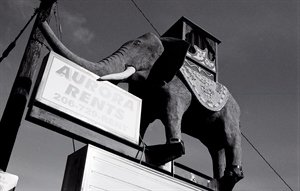
On November 2, 2009, a 9,500-pound steel-and-concrete elephant, which over the decades had advertised mosaic-tile services, flower arrangements, and lastly, tool and party rentals, is reinstalled on its pedestal above the north lanes of Aurora Avenue after a seven-month renovation. Created in the 1920s by Italian immigrant Giovanni Braida, a tile artist who lived near Seattle’s Gas Works Park, the life-sized elephant was first displayed in Braida’s backyard to advertise his skill with tile mosaics. Braida died in 1943 and his son sold the statue three years later to the Aurora Flower Shop where it was displayed outdoors for more than 34 years. In 2006, the shop and the elephant were sold to Aurora Rents, a local tool and party-supply company. By that time, 60 years outside had caused major wear-and-tear to the sculpture: colorful painted tiles had faded, body parts were missing, and its hollow core had been commandeered by generations of pigeons. A Snohomish County concrete firm began restoration in March 2009, cleaning, repairing, reinforcing, and replacing elephant body parts and tiles. In 2026, the elephant continues to stand sentry along Aurora Avenue, one of Seattle’s busiest thoroughfares, dwarfed by urban development.
An Immigrant’s Journey
The Aurora Avenue elephant was conceived a century ago by Italian immigrant and tile master Giovanni Braida (1873-1943). Born in Friuli, a northern region of Italy famous for its marble mosaics and terrazzo, Braida immigrated to the United States when he was a teenager, settling in San Francisco where he got into the tile business. In 1909, Braida moved with his wife Assunta (1880-1976) and son Hector (1897-1966) to Seattle in search of more opportunities.
He began creating tile and marble doorways and entry halls for Seattle’s downtown businesses, and by 1915, was able to buy a wood-framed house at 3408 Woodlake Park Avenue N, close to Gas Works Park. “In November of that year, [he] obtained a permit from the City of Seattle to adapt his residence to accommodate a store and marble workshop. The business was called Braida’s Art Mosaic & Terrazzo Co. The property also included storage sheds and a garden visible from the street which Braida used as an outdoor showroom. Passers-by could see examples of his garden ornaments and art. Eventually, a near life-sized elephant was added to the mix” (“How an Italian Immigrant…”).
Work on the elephant began around 1926, taking Braida and his helpers nearly a decade to complete the project. Built out of chicken wire over a frame and reinforced with pipes, the craftsmen molded wet concrete over the structure to create the shape of an elephant. The “howdah” – a traditional seat used in India to transport passengers – was built out of wood; both the howdah and the “cloth” on which it sat were enhanced with tile, showcasing the company’s skill with tilework. The backyard display became a popular sight for streetcar riders traveling along 34th Street. At times, children would be allowed to play on the elephant, scaling its sides to sit in the howdah or making their way into its hollow body.
An Elephant Never Forgets
Braida died in 1943 and three years later, son Hector sold the statue for $300 to $500 to Denny Graham Grindall (1915-2009), who owned the Aurora Flower Shop. Grindall grew up in the Green Lake area, graduated from Roosevelt High School, and initially opened a feed and pet store on Greenwood Avenue. Around 1939, he parlayed his love of the outdoors into a greenhouse and flower shop located at 8808 Aurora Avenue N.
In the 1930s, that stretch of Aurora Avenue was also known as State Route 99, a main artery lined with restaurants, motels, and filling stations that appealed to road-tripping drivers. After World War II, “Seattle had become a car city, and over the ensuing decades the elephant itself become a roadside landmark, perched over one of the city’s busiest thoroughfares” (“How an Immigrant Craftsman…”).
Grindall incorporated the elephant into his marketing plan, playing off the saying that “an elephant never forgets.” A large signboard outside the shop reminded drivers-by to purchase flowers for upcoming anniversaries, birthdays, Mother’s Day, or other significant events. One day the sign might read: “Today we sent flowers to Joe in Pittsburgh;” the next week, commuters would learn that “Elephants have a great memory – do you? Don’t forget your wife’s birthday!” The elephant was so famous that, for years, ads for the flower shop simply said: “88th & Aurora at the ‘Big Elephant'” (“Aurora Flower Shop Greenhouse”).
Around 1972, Grindall’s son Paul took over the flower shop which he managed for the next 34 years. It was a good fit: As a boy, Paul had earned a penny for each wooden flat he nailed together to display cut flowers at his father’s store. After serving in the Navy during the Vietnam War, he went back to the flower shop, working side-by-side with his father until his father retired a few years later. According to a newspaper interview, Grindall joined the family business “because he loves getting ‘grubby’ in the dirt. ‘You watch things grow and sprout,’ he said. ‘It’s a fulfilling thing'” (“Winding Down…”).
When the Aurora Flower Shop closed in 2005, lovers of Seattle street art worried that the statue would be demolished, evoking a “a herd of support” for the elephant’s future (“A Herd of Support…”). A Seattle Post-Intelligencer column at the time elicited an overwhelming reader response: “Calls, cards and e-mail messages have stampeded in since last week’s column on the imposing if decomposing life-size Aurora Avenue elephant. … And, with other oddball Seattle icons falling like leaves on an increasingly humdrum landscape, readers who have loved the elephant since childhood, as well as newcomers, trumpeted a protest” (“A Herd of Support…”).
In 2005, Paul Grindall sold the building complete with the big elephant to a contracting business which turned around the following year and sold it to Larry Steele, who owned a local tool and party-supply rental company called Aurora Rents. Steele gave some thought to selling the elephant, telling a newspaper reporter: “We thought maybe we’ll put it on eBay and get rid of it,” but he soon realized that would elicit a huge public outcry (“Seattle Landmark Set for Restoration”). So, on March 26, 2009, a crane arrived at 88th Street and Aurora Avenue N to remove the elephant from its perch high above the street. Watching, perhaps more breathlessly than others, were two of Braida’s grandsons, Theodore Braida (1929-2018) and Gilbert (1936-2022); this was the first time they had seen up close the elephant their grandfather had created.
Once safely removed, the statue was trucked to W. R. Heath Inc., in Snohomish County, a concrete contractor that would oversee restoration. It turned out to be more involved – physically as well as emotionally – than initially assumed. “When [owner Bill] Heath started the restoration, he and another man had to climb inside the elephant and remove several pigeons. The inside reeked of droppings, wood had rotted out, and concrete was on the verge of falling off, Heath said. (He later felt guilty about the bird eviction, he said, and took three baby pigeons home, nursing them with a syringe until they grew wings)” (“Aurora’s Aging Elephant…”). Heath spent more than six months cleaning and restoring the elephant’s body parts – it had lost it eyes, tail, and part of its trunk while standing sentinel over Aurora Avenue N. The contractors installed a screen inside the howdah and under the elephant’s stomach to keep birds from nesting. The tile work was repaired and the paint refreshed. The estimated cost for the project was about $10,000.
Back to its Rightful Perch
On Monday, November 2, 2009, a crane again was on site to lift the elephant back into position – not an easy task. A reporter on site described what happened next: “They tried to hoist the elephant several times. But the center of gravity was always off, and the 18-foot, 9,500-pound animal dangled precariously. Finally, just after 11:30 a.m., the elephant started to move. Up, up, up. Inch by precious inch. Within minutes, it rested atop two 15-foot steel posts. Nestled between its shiny white tusks was the Aurora Rents sign” (“Aurora’s Aging Elephant…”).
In 2011, Aurora Avenue North merchants paid $15,000 to artist David Heck to create a 20-foot by 60-foot mural that commemorates businesses and landmarks along the north corridor of Aurora Avenue that existed between 1932 to 1960. Included at the bottom of the mural was the Braida elephant, standing tall next to the Aurora Flower Shop sign. In 2024, after being repeatedly tagged by graffiti artists, the mural was painted over. Braida’s elephant, however, continues to be a roadside fixture outside Aurora Rents, although significantly dwarfed by the surge of mid-rise apartment buildings and other businesses along that stretch of roadway.
Sources:
Eric Nusbaum, “How an Immigrant Craftsman Gave us the Aurora Elephant,” Seattle Met, May 31, 2023, website accessed March 27, 2026 (https://www.seattlemet.com/news-and-city-life/2023/05/how-an-immigrant-craftsman-gave-us-aurora-elephant); Brad Wong, “Winding Down at Distinctive Aurora Landmark-Shop,” Seattle Post-Intelligencer, September 29, 2004, p. C-1; Susan Paynter, “A Herd of Support for the Aurora Elephant,” Ibid., September 21, 2005, p. E-1; Casey McNerthney, “Seattle Landmark Set for Restoration,” Ibid., March 27, 2009, p. 1; “Aurora Flower Shop Greenhouse,” advertisement, The Seattle Times, June 1, 1967, p. 15; “Denny Graham Grindall,” obituary notice, lbid., August 16, 2009, p. B-3; Sonia Krishman, “Aurora’s Aging Elephant Rises Again,” Ibid., November 3, 2009, p. B-1; “Mural Commemorates Aurora Avenue History,” Ibid., August 17, 2011, p. B-7; www.seattletimes.com; Rita Cipalla, “How An Italian Immigrant Turned an Elephant into a Seattle Icon,” L’Italo Americano, July 15, 2024, website accessed April 6, 2026 (https://italoamericano.org/seattle-elephants/); John Giovannia Braida, Findagrave.com website accessed April 8, 2026 (https://www.findagrave.com/memorial/159069325/john_giovanni-braida).
Licensing: This essay is licensed under a Creative Commons license that
encourages reproduction with attribution. Credit should be given to both
HistoryLink.org and to the author, and sources must be included with any
reproduction. Click the icon for more info. Please note that this
Creative Commons license applies to text only, and not to images. For
more information regarding individual photos or images, please contact
the source noted in the image credit.

Major Support for HistoryLink.org Provided
By:
The State of Washington | Patsy Bullitt Collins
| Paul G. Allen Family Foundation | Museum Of History & Industry
| 4Culture (King County Lodging Tax Revenue) | City of Seattle
| City of Bellevue | City of Tacoma | King County | The Peach
Foundation | Microsoft Corporation, Other Public and Private
Sponsors and Visitors Like You
[ad_2]
Source link