
[ad_1]
What beauty lives in our shadows? The delight I find in the irony of using film noir as a lens outs me as a linguistic nerd, one that also revels in shadows, both in my own work, my musings, my muses, my taste in contemporary art, and the basis of my joy. Color me goth, I find the juxtaposition of light and shadow to be the apex of moral ambiguity, the basis for visual stimulation and the dividing line of psychological constructs, not to mention most organized religions. Do we see more objectively in black-and-white?
Unlike the limited palettes of most films of this genre, the new broad, sweeping triumph of a show at the nonprofit private foundation The Warehouse in Dallas is a colorful journey through intermediality. Alexandra Terry, Head of Curatorial Affairs and Curator of Contemporary Art at the New Mexico Museum of Art, has thematically curated this immense private foundation with such panache, intelligence, and obsessive research, you may want to stay in those shadows for longer than you think. Is that idea uncomfortable? We learn the most in situations of discomfort and through transmuted exuberance. Here is a show that revels in that darkness, as well as summoning existential questions, political dismay, identity posturing, the power of narrative, and the acceptance of a lack of resolve.
Chase a Crooked Shadow: Film Noir as Contemporary Mirror takes us on a journey without end, one that moves in a circular pattern, making the shape of an Ouroboros – an endless loop in which, with any luck, we do not devour ourselves in the process. One can start in either direction in the gallery space; the show is ambidextrous both by design and within the direction of influence between contemporary visual art and the genre of film noir. Unlike cinematic constructs, this is not intended to be read as a narrative cycle, even with the world of fictional film serving as its foundation. We travel on foot through annotated tropes of film noir: The Detective, The Criminal and the Scene of the Crime, Psychological Interiority, Duplicity & Ambiguity, Violence and the Body (my favorite), The Femme Fatale (stereotypical favorite), Style & Mood, Landscapes & Environments, and Crisis of the American Dream. Terry’s wundercreation is not as formulaic as this list sounds, leading us into predetermined boxes of didactic categories. Instead, the erudite wall text throughout gives us the framework to imagine and place ourselves inside the womb of noir, a world of mysterious circumstances, lurking peril, and the depths of humanity.
The parallels within this exhibition to our current political climate of terror strata is no coincidence and not only is this an important way to look at culture across the board at the moment, but clearly, an inspiration for Terry. In her guided curator’s talk on the opening day of the show and in the preliminary wall text, she explained how the inspiration for film noir originated. Drawing from German expressionism and crime fiction from the Great Depression, this cinematic genre came about from a disenchantment with the country before and following the Second World War. Here, we yearned for “expansion, safety, and a return to security that doesn’t really happen,” due to the dual threat of nuclear war and communism.
While these are not the specific concerns of today, we still have a lack of leadership or safety that pervades our everyday life. History moving in its proverbial cycles, will we eventually learn from this? In her opening wall text, Terry asks us to ponder “how do we navigate systems we cannot control,” as well as “what does it mean to live with clarity when the world itself is fundamentally unstable?”

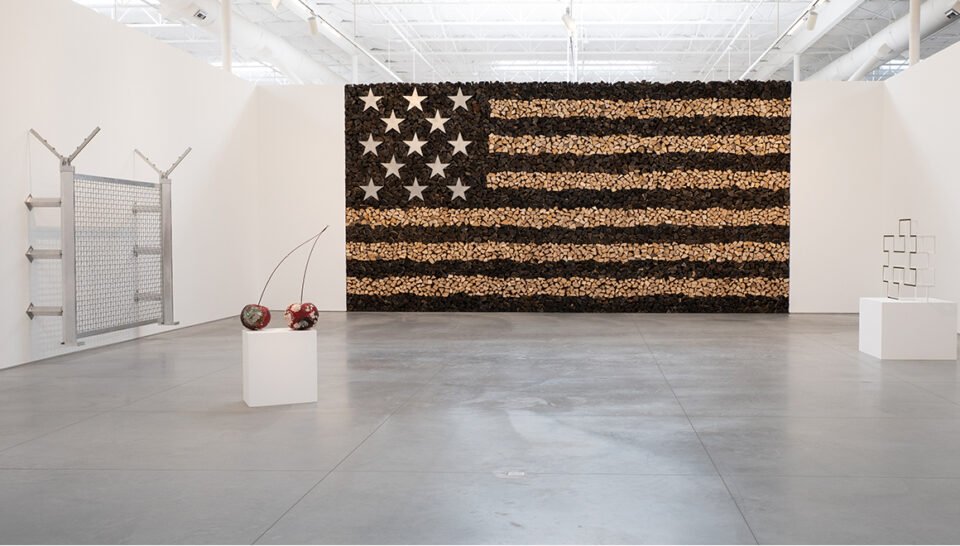
Using this metaphorical lens, it’s no coincidence that we enter this creatively forged exhibition in the large, open Crisis of the American Dream room, confronted by Danh Vo’s In God We Trust (2025) — a wall of firewood and metal stars that is designed to be dismantled as the exhibition progresses over the following months, begging for a return visit. The critical stance of Vo’s piece introduces a roomful of works regarding surveillance, incarceration, loss, and disillusionment, including Bad Cherries (BFF) (2020) by Kathleen Ryan. Her sculpture pays homage to the American iconography associated with the wholesome pie, reconfigured in a state of rot, using the fortitude of precious gems and stones to replicate moldy decay.
This voluminous great room of The Warehouse’s 16 voluminous gallery spaces serves as a welcoming gesture, replete with a variety of mediums, including painting, photography, metalwork, assemblage, installation, and sculpture. This multidisciplinary appreciation appears throughout Chase a Crooked Shadow, demonstrating not only the open minded, auteuristic curation of Alexandra Terry, but also the discerning eye of the collections from which much of these artworks are culled — the Rachofsky and Hartland & Mackie/Labora, as well as a few loans from institutions. Over 100 artworks from more than 80 artists occupy the majority of the galleries at The Warehouse.

I embrace my full-fledged museum flaneur mode and set out for uncharted lands, finding myself amid The Detective genre, which is split between two rooms and slightly vague. It’s an awkward beginning and I question whether I am swimming upstream, struggling to suddenly transition from American systemic instability to gumshoe charm. Then art wins. I revel in a masterful array of oil paintings – Zaam Arif’s I barely remember the last time I was myself (2024), Moonman (2004) by Cris Brodahl, Lee Mullican’s Ascension (1967), and the extra-memorable The Only Way Out Is In (2023) by Naudline Pierre. Do you ever see a work of art and immediately want to leave and go home and make art? Her work gives primitive and pagan energy while maintaining a stylistic outsider elegance. But I ponder where the detective is in this artwork. Is the imagery the mystery and the viewer then embodies this role? Once again, Terry’s brilliant wall text illuminates my plight. Here she frames the detective as “an existential figure” and a “stranger in a hostile world, cut off from institutions, intimacy and any stable sense of belonging.” I suddenly find clarity in these battles with moral ambiguities, not only in the works here but also all around us, as we all struggle to uphold our convictions in a world gone mad with mistrust and uncertainty.
Can art play both sides of this monochrome spectrum, perpetuating a world of symbolism, shadows and night while also giving us a path to clarity and a new language of illumination?

Like any Shakespeare character, the best of us still possess a symbiosis of good and evil, darkness and light, at once eliciting empathy and in the next moment, vitriol. In the next room, Sterling Ruby’s bronze Trough (2014) does precisely this to us, perverting comfort with a bed built like a Frankensteinian torture rack. The headboard is reminiscent of a tombstone, which ensures sliding into a solid night’s sleep. Aptly, we are now in the room of Criminality and the work presents how crime can be messy or impeccably psychotic, implying that the potential for this element of instability lurks everywhere, in everyone. Highlights include Louisa Gagliardi’s Rear Window (2021) painting, evoking the 1980s, Patrick Nagel, and airbrush, but executed with precision using gel medium, nail polish, and ink! The ghostly violence within Common Endearment (2021), an oil painting by Shuriya Davis, lingered in my mind, as did the classically cinematic Gregory Crewdson’s photograph of a boy with his hand in a drain, leaving us with the desire to see the nonexistent film world that this still could be derived from.

Less successful was the singular salon style presentation of 11 smaller works on the side wall, those of a size that could be lost on us in the vast white of these immense galleries. As the only display of its kind in the show, this layout seemed out of place, and I couldn’t help but wonder how a few colored walls, instead of the standard stark white throughout the show, could have conjured environments of noir atmosphere. Perhaps this is a restriction of the foundation, as is the pool from which to cull the selections. I rarely felt that as an impediment, except in the following room showcasing Psychological Interiority. Here is where film noir brings such a raw palette of fear, fractured psyches, looming suspense, and instability. Given such a juicy premise, I honestly expected more than a second Crewdson and abstract sculptures, although there is a Sterling Ruby pair of bloody monoliths on a graffiti-carved pedestal that was quite satisfying, albeit a bit more horror than noir. Rinella Alfonso’s oil canvas Protect the meat from the flies (2022) does delight with a sickly noir color spectrum and seems straight off a David Lynch set.

Continuing this path, we are led into Duplicity & Ambiguity, a frame of mind all too familiar with our current political administration and uncertainty toward our future. The conceptual reveal of Terry’s exhibition comes more into focus with every room as the intermedial play between the genre and the work expands. Staged ironically in two rooms, this lack of clarity and split intentions is deftly portrayed in both Alighiero Boetti’s Gemelli (Twins) (1968) photograph of a doubled self, Carol Rama’s haunting Bricolage (1967) and the Out of Body, Out of Mind (2020) canvas from Woody De Othello where we recognize the claustrophobia of daily living with our own shadows. In the adjoining room, the 1990 video installation by Bruce Nauman brings the darkness and lack of resolve that Terry is consistently ruminating on, although the materiality of his work seemed strangely dated and primitive compared to the elevated craft of other pieces in the exhibition.
One of the few weak points of the show was the video installation ragtag (2022) by Guiseppe Boccassini, even though it is positioned as the central heart in this toroidal exhibition. Thematically appropriate, Boccassini’s film is an 84-minute mashup of actual black-and-white noir clips, given a contemporary treatment with jump cuts, Boomerang effects, and repetition. However, the relevance stops here, as the handling of this material cheapens its original, delicious languorous pace and the resulting tension. Boccassini acts as a chaos agent, reducing a panoply of historical cinema mastery into a modernist collage for an attention-deficit generation. I understand from the press release that this is meant to “decontextualize them and reinterpret the genre as a timeless aesthetic” without identity or stability, but I couldn’t even watch enough to determine if that was true.
The haunting feeling of reduction spreads to the adjoining room, where incredible works by six artists are merely presented as a “prelude” to “accompany” the Boccassini installation, but I found them much more compelling. Sophie Calle’s Série Noire works from 2020 reimagine the sexy draw of pulp fiction novels by encasing them in glass with topical text of an interior dialogue that tries to process the modern trials of death. Lastly the lure of blurred or mislabeled identity is evident in three riveting works, which all have an element of portraiture, however abstracted. Cris Brodahl’s centerpiece The Yellow Tree (2007) commands the room as a devout altarpiece, bestowing sainthood on an iconoclast that looks like Candy Darling going up in smoke. Untitled (Big Head) a 1981 pencil drawing by Troy Brauntuch whispers its existence, the strong but silent type that takes patience and refuses to be adequately photographed. Lastly, flectere (2000) resounds as a classic Ann Hamilton print of figurative obscuration, intriguing to the end.

Next, the eye of this beholder must champion the beauty and tension created by the memorable arrangement and selection of works in the Violence and the Body room. The eye is drawn to everything simultaneously lunging for your attention. This leitmotif surely was also one of Terry’s most cherished, you can feel her rapture in the refracted energy between the works as they imply rather than demonstrate, much like film noir’s response to the censorship of the Hays Codes. In the far corner, I take in a hanging figure, draped and bound and frozen in midfall: Fallende Frau, Doppelköpfig (Falling Woman, Doubleheaded), a 2004 sculptural installation of carved limewood and fabric by Paloma Varga Weisz. How can danger appear so flawlessly elegant? Why is that liminal purgatory so palpably alluring?

Entering this room is voluntarily crossing a charged threshold, the seat of unease that we understand on a primordial level. I look down at another woman in a compromising situation, this time crawling on all fours under the heavy history of a full cattle hide, an invisible figure outlined in skin that is draped with a kindred grace. I had seen Janine Antoni’s Saddle (2000) before, but this context elicits a larger meaning. Christian Boltanski’s wall archive dismally recalls the anonymity in numbers, also addressed by Cecily Brown’s 2020 painting A Hunting Scene where movement is condensed into bloody arithmetic.
The aforementioned goth in me gurgled at the precise, chiseled, delicate beauty of Hugh Hayden’s Us (2023), comprised of two intertwined carved cherrywood skeletal torsos. An exquisite and careful embrace in wood, which is suspended on wood hangers and framed by a gargantuan wooden armoire, laments the death of various trees who stand in here for body, anchor, and container with a proud insolence that I could look at eternally. Overall, this room could function as a stand-alone group exhibition at any given gallery and leave the viewer entirely satisfied with its diversity of medium, depth of significance, and overall reverence. I was loath to progress but had an easy out into the following room of the Femme Fatales.
Who are they? I’ve been both accused and lauded as one. They are revered, feared, jeered, and emulated by women looking to reclaim a sensual power that society has ground out of us from day one. This trope of the femme fatale has transgressed and superseded its film noir origins exponentially as a touchy and controversial feminist archetype of danger — one that is so publicly embraced that it has transitioned into both commercial gift shop fodder as well as Hot Topic teen chic. Here we have a room of nuanced art, drawing from these very female gazes, celebrated solitude, villainous autonomy, and antagonistic antiheroes. Standouts for me included: Julie Curtiss’ Limule (Horseshoe Crab) acrylic rendering of a leather boot next to a leashed crustacean; the oil based optical precision in Still Life with Fishnets (2021) by Nolan Simon; Hannah Levy’s hilarious untitled 2024 sculpture of steel and silicone resembling a perambulatory chrome stork with a skin shirt; and Marlo Pascual’s tender 2009 photographs of a woman’s back and hairdo (think Vertigo as an influence, obviously). Anne Collier’s adjoining room with a separate slide installation of found images of women with cameras from vintage ephemera resounds as whipsmart, intentional, and politically commendable, just not that… fun.

The final two salon rooms of this colossal exhibition are called, respectively: Landscapes and Environments, and Style and Mood. For me, this vagueness signaled the need for a wide net, with the desire to include individual works that resonated with the curatorial proposal but defied codification. I would have preferred an even wider net with deeper specificity. In no uncertain terms, the collected works in these two rooms (and much of the show, for that matter) could have been assembled under a category of Melodramatic Ambiance. Urban landscapes, disorientation, fractured morals, suburban disillusionment all strut their stuff throughout this finale. The garish pendulum of desire and repulsion exemplified by Henry Gunderson’s oil painting Night Shack (2022) is worth the contemplation. It takes time before the holes that parade rays of light reveal themselves to be bullet holes. In the wall label for the Style section, Terry reminds us that the constraint and minimalism that defined film noir came from postwar shortages. Here, powerful minimalist works by Troy Brauntuch and Shinro Ohtake in inks and photography validate the Ludwig Mies van der Rohe paradoxical tenet that “less is more.”
Rounding out the exhibition (if your snake loop took this direction) is Christian Marclay’s classic single-channel video and sound installation Telephones, from 1995. Marclay delivers in full people-pleasing mode, using segments of gestures with telephones from American films, both black-and-white noirs as well as 1980s rom-coms, and beyond. The clips here create a broad, loose narrative arc that traces dialing to ringing to hellos, dramatic statements, and listening, to signing off and to hanging up — all in a glorious, endless loop. Somehow Marclay’s video lands differently than ragtag, as a universal, multifaceted, sweeping gift — replete with humor, emotion, nostalgia, and range. The cacophonous ringing can be heard at seven-minute intervals as you walk the exhibition, as if you are in a time loop where the past is reaching out to communicate, to check and see if we are still here, with our convictions held tight, reading the signs, holding down the front lines, asking questions, remembering the work of others, and living out what it means to be a compassionate human.
I adored this whole pioneering vision, this exhibition approached with sensitivity, intelligence, erudition, and pushing the boundaries of our expectations. Only slightly limited by needing to select primarily from these affluent and blossoming collections and a few outstanding museum loans, Alexandra Terry shows us both her devotional affinity for film noir as well as her extensive knowledge of contemporary artists. At The Warehouse in Dallas, this brilliant curator delved deeply into works that artists toiled over for years, making a cultural crime genre into a political stance to use as a lens through which to see the art world, and in doing so, demonstrated the powerful voice in artmaking and championed the art of intersectional close looking. Here, the curator is also an artist, a gatherer of feeling, an unseen magician who weaves together disparate worlds. Her astute knowledge of this symbiotic biosphere between cultural categories opens possibilities of how we can frame our cultural experiences. In an embrace of diversity, can we apply this categorically as an intersecting mapping tool for cultural civility?
Terry’s arrangement contains over 100 selections, which orbit one another in themed galaxies from the film noir universe, expanding this cinematic narrative into a plateau of resonant meaning and relationships. The themed segments align with our current sociopolitical climate of fear, violence, and power. Our country is losing its morale and its morals, kowtowing to an imperialist madman that has no baseline of truth nor integrity. Here we turn to the shadows, the seduction of the night, the sexyness of having no easy answers or clear solutions. How do we solve a mystery when we already know who the perpetrators are? We use creative culture and the freedom therein to comment, to grieve, to escape, to revel, and to loathe. This cross-cultural map of woven defiance in dark disguises is an ingenious metaphor and framework for our present day angst.
Chase a Crooked Shadow: Film Noir as Contemporary Mirror is on view through July 18, 2026, at The Warehouse in Dallas.
[ad_2]
Source link