
[ad_1]
LR Vandy fills ysp with rope sculptures caught mid-motion
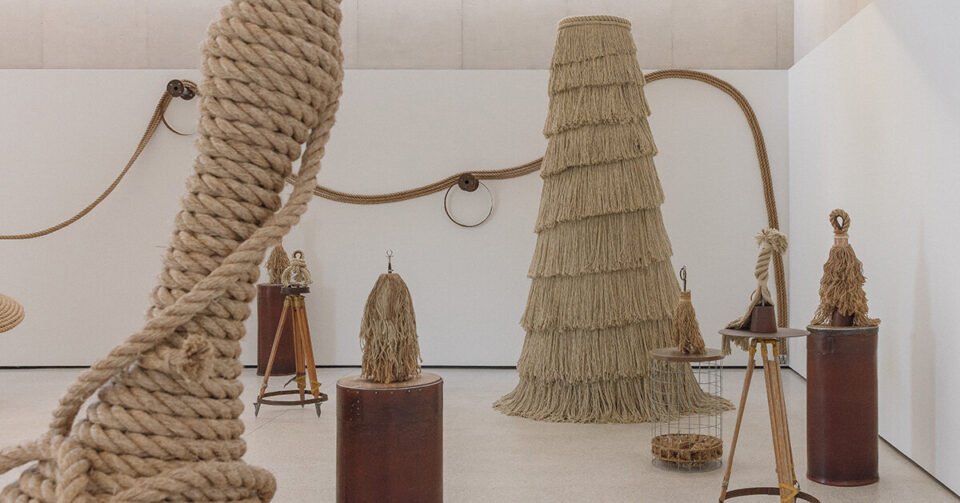
Thick ropes drift through the Weston Gallery at Yorkshire Sculpture Park, climbing walls, looping through pulleys, then collapsing back onto the floor in heavy coils. Some hang with the tension of something still being pulled upward, while others slacken and spread across the concrete like exhausted bodies at rest. In Rise, British artist LR Vandy fills the space with rope sculptures that never quite settle into stillness. Even standing motionless, they seem caught halfway through an action. At the center of the exhibition is A Call to Dance, a monumental maypole form whose braided strands descend from a dark metal ring and gather densely at the floor below.
Vandy has spent years working with rope from her studio at the historic Chatham Dockyard, and the material arrives here carrying more than texture or weight. It is difficult to look at these thick maritime fibers without thinking about where ropes have traveled historically and what kinds of labor they have always been tied to. Ships, cargo, dockyards, and extraction. The rope holds those associations, without needing to illustrate them directly. Sometimes the sculptures feel sturdy and architectural; elsewhere, the fibers begin to split apart at the ends, loosening into soft strands that look unexpectedly delicate up close.
‘The tactile quality of rope is defined by tension,’ LR Vandy tells designboom. ‘It relies on strength while remaining malleable, always pulling, never pushing.’ That push and pull stays present throughout the exhibition, on physical and emotional level. ‘I’m not interested in resolving or balancing these aspects into something neutral,’ she says. ‘The work insists that both remain visible.’

LR Vandy, Rise, installation view at Yorkshire Sculpture Park, 2026. In collaboration with October Gallery | all images © India Hobson, courtesy YSP
communal rhythm moves through the exhibition’s maypole
Walking through the gallery, it becomes difficult to tell whether the forms are tightening or relaxing. Some lean forward awkwardly, as though gravity were affecting them unevenly. Others sway lightly beneath the pale concrete ceiling and strips of daylight overhead. There are moments where the sculptures resemble bodies interrupted mid-turn, or dancers on pause, holding a position a fraction too long.
The maypole at the center of the exhibition pulls in a different set of references. Traditionally tied to May Day celebrations across Europe, maypoles have long carried associations of communal gathering, dancing, festivity, and public ritual. But collective movement has often made authorities nervous too. There is a long history of people becoming suspicious of what can happen when bodies move together for too long, especially in public, especially joyfully.
‘What interests me is how consistently dance functions as a form of social binding,’ Vandy explains to us. She speaks about attempts to suppress pagan rituals in medieval Europe alongside the policing of rave culture and public gatherings in modern Britain. Across very different periods, communal rhythm keeps reappearing as something difficult to regulate. ‘Communities that move together develop a palpable sense of connection,’ she says. ‘Dance creates bonds that support cultural continuity and collective strength.’

Rise at Yorkshire Sculpture Park
raying fibers and heavy knots hold the gallery in tension
That feeling spreads gradually through the gallery. Rope runs horizontally along the walls before disappearing into hooks and metal fixtures, connecting one sculpture to another. Wooden spindle-like structures rise toward the ceiling, while smaller wrapped forms perch on found industrial objects that feel scavenged. Indigo threads, maritime fragments, loom shuttles, lengths of fraying fiber — the materials accumulate slowly, and with them a broader sense of movement between industries, histories, and geographies. None of it feels overstated. The exhibition never pushes too hard toward explanation.
What stays with you most is probably the sensation of suspension. The sculptures do not appear fully free, though they never seem entirely restrained either. They hover somewhere in between those conditions. The softness of the rope draws people in initially, but the longer you spend with the work, the more aware you become of the strain holding everything together. Knots tighten. Fibers pull against each other. Heavy forms tilt slightly off balance in ways that make the room feel subtly unstable.
‘I think freedom, in this context, is something you feel rather than fully resolve,’ Vandy reflects. ‘The bodies in the work aren’t fully unbound. They’re held in tension; they have a sense of being on the edge of release.’
That sense of incompletion extended into the making of the exhibition itself. Much of Rise was produced directly inside the Weston Gallery, with forms evolving gradually in response to the architecture of the space rather than from fixed plans alone. More than 30 kilometers of rope were used throughout the installation process, with Vandy working alongside technicians and fabricators as the exhibition took shape.

A Call to Dance anchors Rise with cascading braided rope strands inside the Weston Gallery
nothing inside ‘rise’ feels entirely fixed in place
‘The project wasn’t fully resolved before we began,’ LR Vandy shares with us. ‘The whole process became very fluid. We were creating, problem-solving, and building simultaneously.’ Unlike fabrication processes, where every detail is predetermined through technical drawings, this installation was developed through adjustment, testing, and improvisation inside the gallery. ‘It felt genuinely collaborative,’ the artist says. ‘I can’t get that working alone in my studio.’
You can still feel traces of that negotiation in the finished works. Nothing appears completely locked into place. Rope bends under its own weight. Fibers unravel slightly at the edges. Some structures seem almost too heavy for the points holding them upright. The sculptures feel less like fixed objects than temporary arrangements that could shift again after everyone leaves the room.
At times, Rise feels unexpectedly tender. Not soft in a passive sense, but soft in the way something worn, handled, and repeatedly pulled apart can become soft over time. Joy appears here too, though never separately from exhaustion or pressure or history. Vandy allows all of those conditions to remain tangled together inside the same material, refusing to pull them cleanly apart.

rope sculptures and suspended forms create a sense of movement throughout the exhibition

maritime rope fibers unravel into dense fraying strands across the gallery floor

rope sculptures loop through the gallery alongside spindle-like structures and found industrial objects

a sense of movement throughout the exhibition

LR Vandy incorporates vintage weaving tools and colored thread throughout the exhibition

woven textile shuttles radiate outward in a star-like wall installation

smaller wrapped rope forms perch atop salvaged industrial objects throughout Rise

fraying rope fibers spill across a wire-frame structure in one of LR Vandy’s smaller sculptural works

close-up of woven rope and exposed fibers wrapped around industrial wire mesh
1/8

LR Vandy, Dancing in Time, Harlem Shake, 2024 ,Courtesy the Artist and October Gallery, London | image copyright Jonathan Greet, courtesy YSP

LR Vandy, Twist, 2024, Exhibition View at October Gallery, 2024 | image courtesy the Artist and October Gallery, London | image copyright Jonathan Greet, courtesy YSP

LR Vandy developing work for Rise exhibition, 2026. Photo © India Hobson, courtesy YSP

LR Vandy developing work for Rise exhibition, 2026. Photo © India Hobson, courtesy YSP

LR Vandy developing work for Rise exhibition, 2026. Photo © India Hobson, courtesy YSP


project info:
name: Rise
artist: LR Vandy | @lrvandy
venue: Yorkshire Sculpture Park | @yspsculpture
dates: March 14th to September 13th, 2026
[ad_2]
Source link