
[ad_1]
Prepare to be wowed by Sarah Eberle’s return to the RHS Chelsea Flower Show, where a giant Mother Nature sculpture takes centre stage alongside a bold celebration of the ‘weeds’ and wild green spaces we often overlook.
Marking her 50th year in horticulture — and her 20th year at Chelsea — the legendary designer has come out of retirement to create The Campaign to Protect Rural England Garden: On the Edge, a striking Show Garden inspired by England’s threatened edgelands: the fragile countryside on the fringes of towns and cities that campaigners say is increasingly under pressure from development and neglect.


Aiming for a Gold medal, the garden is sure to stop visitors in their tracks when RHS Chelsea officially opens from Tuesday 19th to Saturday 23rd May.
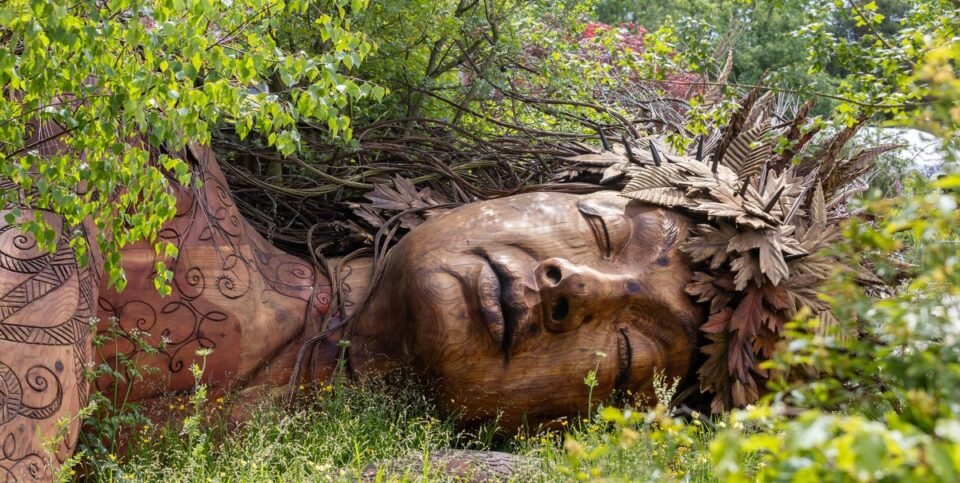
At the heart of the garden lies a monumental fallen tree sculpted into Mother Nature, surrounded by wild naturalistic planting, winding woodland pathways and rugged stonework.
‘Having thought I had retired from creating gardens at Chelsea, the Campaign to Protect Rural England changed my mind – I am a country girl at heart,’ says Sarah, who is the most decorated British garden designer in RHS Chelsea history.


Sarah Eberle
Sponsored by grant-giving charity Project Giving Back, the garden showcases nature’s resilience and explores how overlooked landscapes — including spaces filled with plants often dismissed as weeds — can recover and thrive for future generations.
‘It’s been a joy to create a garden that feels both restorative and deeply connected to nature, while highlighting the importance of the threatened landscapes on the edges of our towns and cities. Working with such skilled artisans has helped bring that message to life in a natural and very honest way,’ Sarah adds.
Take a look inside the finished garden…
The sculpture


At the heart of the garden is a striking piece of land art: a fallen mature tree carved into a monumental figure of Gaia, or Mother Nature, that still supports life. Set within an undeveloped landscape cared for by a community on the urban fringe, the sculpture’s hand rests beside a shallow pool, while her willow hair flows to form the top of a dry-stone wall that snakes through the landscape.
To bring the centrepiece to life, Sarah collaborated with a team of celebrated British artisans. Competitive chainsaw artist Chris Wood sculpted the 7m x 3m head and torso of Mother Nature, renowned willow artist Tom Hare wove her cascading hair, and award-winning fifth-generation wallers Lydia and Bert Noble created her dry-stone ‘body’.
The powerful female figure dominates the space, while also creating a sense of calm and sanctuary for visitors, plants and wildlife alike. Her sinuous form appears to move gently through the landscape, immersed in nature despite her impressive scale and powerful presence.
Layout


A winding pathway leads visitors beneath Mother Nature’s arched torso into a partially enclosed central space designed for both quiet reflection and community gathering. Here, rustic stone seating and a weathered water trough create a calm, contemplative atmosphere at the heart of the garden.
Throughout, boundaries blend soft and hard materials, capturing the essence of the rural-urban fringe.
Planting


The planting scheme embraces the beauty of Britain’s overlooked landscapes, transforming what was once neglect into something abundant and richly textured. Plants that have naturally established themselves through years of fly-tipped garden waste — including Echium and Crocosmia — sit alongside layers of UK native flowering plants traditionally dismissed as ‘weeds’, from meadow buttercup (Ranunculus acris) to common dog violet (Viola riviniana), but celebrated here for their ecological importance.
A loose native hedge of hazel, hornbeam and field maple frames the garden with characterful trees providing shelter and structure.
Hidden details


Throughout the garden, subtle details help tell the story of these overlooked yet life-filled landscapes. Birds’ nests are woven into Mother Nature’s flowing willow hair, which stretches into neighbouring trees, while an organically shaped archway takes inspiration from the curve of her hip.
Even the repurposed concrete water trough carries traces of rural life, complete with a chipped edge designed to suggest years of use and wear from livestock.
After the show
After the RHS Chelsea Flower Show, the garden will be relocated to a regenerated housing development in urban Sheffield, where it will begin a second life as a permanent community space.
The move also honours the legacy of Ethel Haythornthwaite — activist, poet and one of CPRE’s earliest campaigners — who played a pivotal role in the creation of the Sheffield Green Belt and helped shape the modern British countryside movement.
Follow House Beautiful on Instagram, TikTok and Pinterest
The Garden Edit

Folding Bistro Set, 3 Pieces
Now 19% Off

Scalloped Edge Smooth Fibre Clay Plant Pot

Marcy 2-Seater Sling Garden Sofa, Greige

Gsycle Watering Can

Natural Pebble Outdoor Solar Light

Dibor Dining Chair Seat Pad Set
[ad_2]
Source link