
[ad_1]
- Show explores how Zeid transformed lived experience, exile and memory into vast, kaleidoscopic works that reshaped modernist abstraction
- ‘This is a way for the public in London to rediscover her work,’ says curator Adila Laidi-Hanieh
There’s a particular kind of disorientation that comes with standing in front of a Fahrelnissa Zeid painting. The longer you look, the less stable things feel: perspective slips, colors seem to move, and what first appeared decorative becomes something far more engulfing. It’s not just that you look at the work; it begins, quietly, to look back.
This sense of immersion lies at the heart of “Fahrelnissa Zeid: Immersion,” the first UK gallery exhibition of the Turkish-Arab modernist in the 21st century.
On display at Dirimart London until May 30, the show is a triumphant homecoming for an artist who long before our era of globalized contemporary art, effortlessly straddled the creative epicenters of Istanbul, Paris, and London.
Following her landmark 2017 retrospective at Tate Modern, which firmly cemented her status as one of the 20th century’s most vital abstract painters, this new exhibition curates a tighter, more intimate focus.
“The works of Fahrelnissa Zeid have been exhibited a lot in the last 10 years in Europe, but mostly in group exhibitions,” explains curator Adila Laidi-Hanieh, author of the revisionist biography Fahrelnissa Zeid: Painter of Inner Worlds.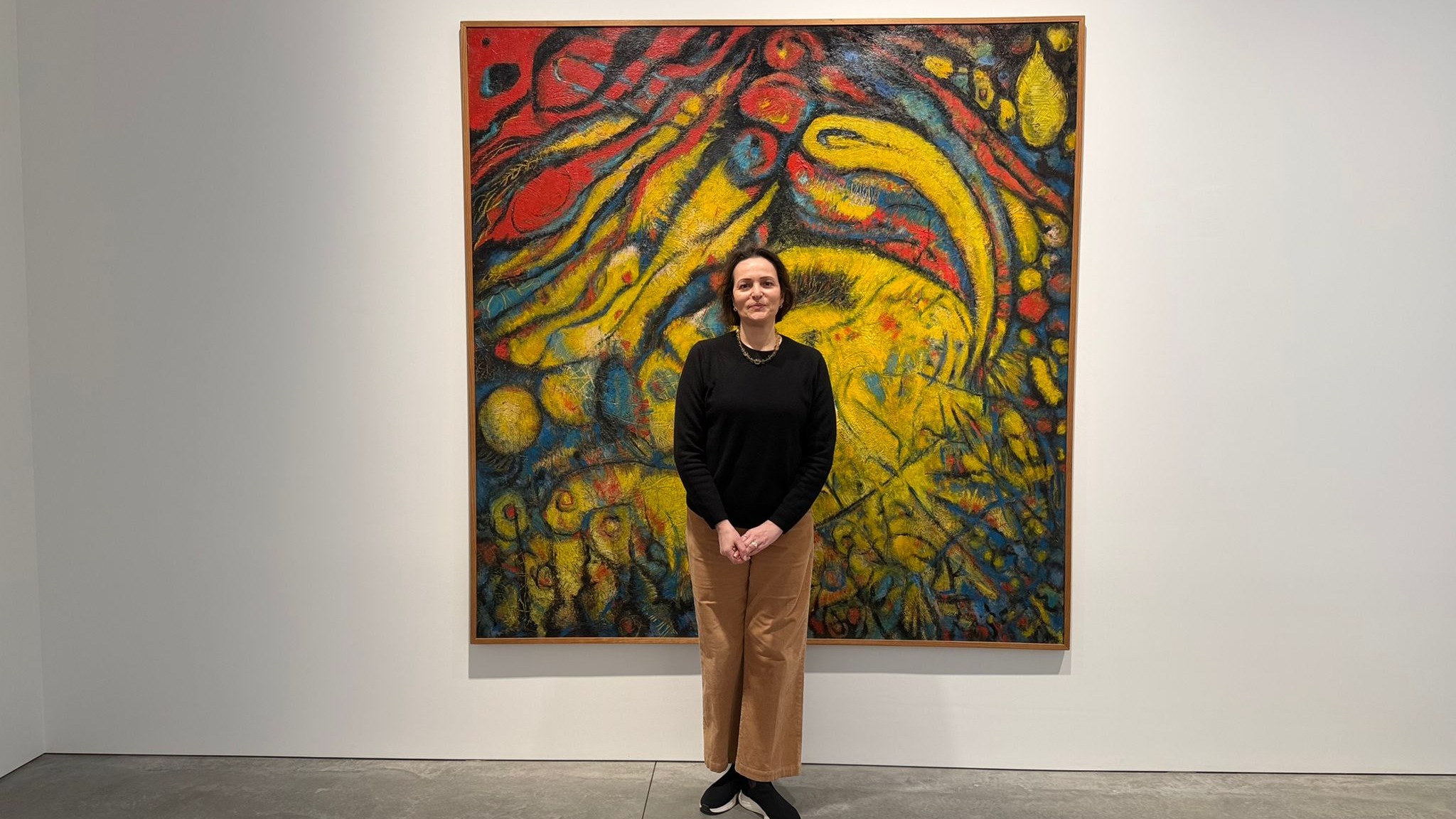
“This is a way for the public in London to rediscover her work … We are focusing on her three most productive, innovative decades – the 1940s, the 1950s, the 1960s – by selecting a group of works that she painted in Istanbul, in Paris, in London, and in Ischia,” she told Anadolu.
The Hammam
Before she became synonymous with monumental, kaleidoscopic abstraction, Zeid was a keen, boots-on-the-ground observer of Turkish life.
In the 1940s, she was the sole female member of the avant-garde d Grubu (d Group).
Laidi-Hanieh said: “Her (Zeid’s) approach to art at that time was to go out in Istanbul … on the Bosphorus, in the beaches, and in the city, everywhere—in the markets, in the cafes, in the taverns, in the mosques, in the bathhouses—and paint. She always had her sketchbook with her in her bag, and then she would go to her studio and paint for hours and hours.”
This hyper-productive period birthed works like Hammam (1945), a piece that radically subverts Western art history.
“The wonderful thing about this painting … is that it represents the lived experience of a Turkish woman going to the hammam,” Laïdi-Hanieh said. “This is not imagined and fantasized by a European Orientalist painter. No, this is the actual experience of a woman who went there to take a bath.”
Meanwhile, Adila was a painting student of Fahrelnissa Zeid during the period when Zeid was living in Amman, and received her artistic training under her.
Zeid taught art in Amman, where she founded a studio and trained local students. Many of those she mentored were young women and girls, and her teaching was often accessible, with some students receiving instruction free of charge.
Adam and Eve and the Broken World
By the late 1940s and 50s, Zeid’s life and art were shifting dramatically.
Married to Prince Zeid Al-Hussein, a former Iraqi ambassador to the UK, she transformed the maid’s quarters of their glamorous South Kensington embassy into a studio.
It was here she broke boundaries, becoming the first woman to hold a solo exhibition at London’s Institute of Contemporary Arts in 1954.
Her canvases grew massive, shedding figuration for dizzying geometric abstraction.
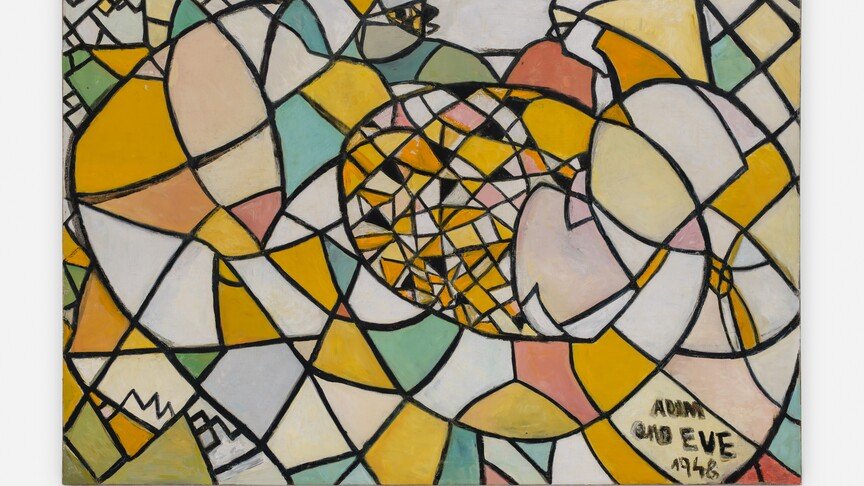
Adam and Eve and the Broken World (1948), on display here after being exhibited only twice before in history, perfectly captures this.
It replaces biblical literalism with a whirlwind of fractured, cosmic energy.
But that “broken world” soon became a brutal reality.
After the 1958 Iraqi revolution forced her and her family into exile, Ischia became a place of refuge, where her palette moved away from darker, more foreboding tones toward luminous compositions shaped by the sea and sky.
This difficult time temporarily halted her massive canvases; at one point, she was reduced to painting on leftover turkey bones in her cramped kitchen just to keep her creative spirit alive.
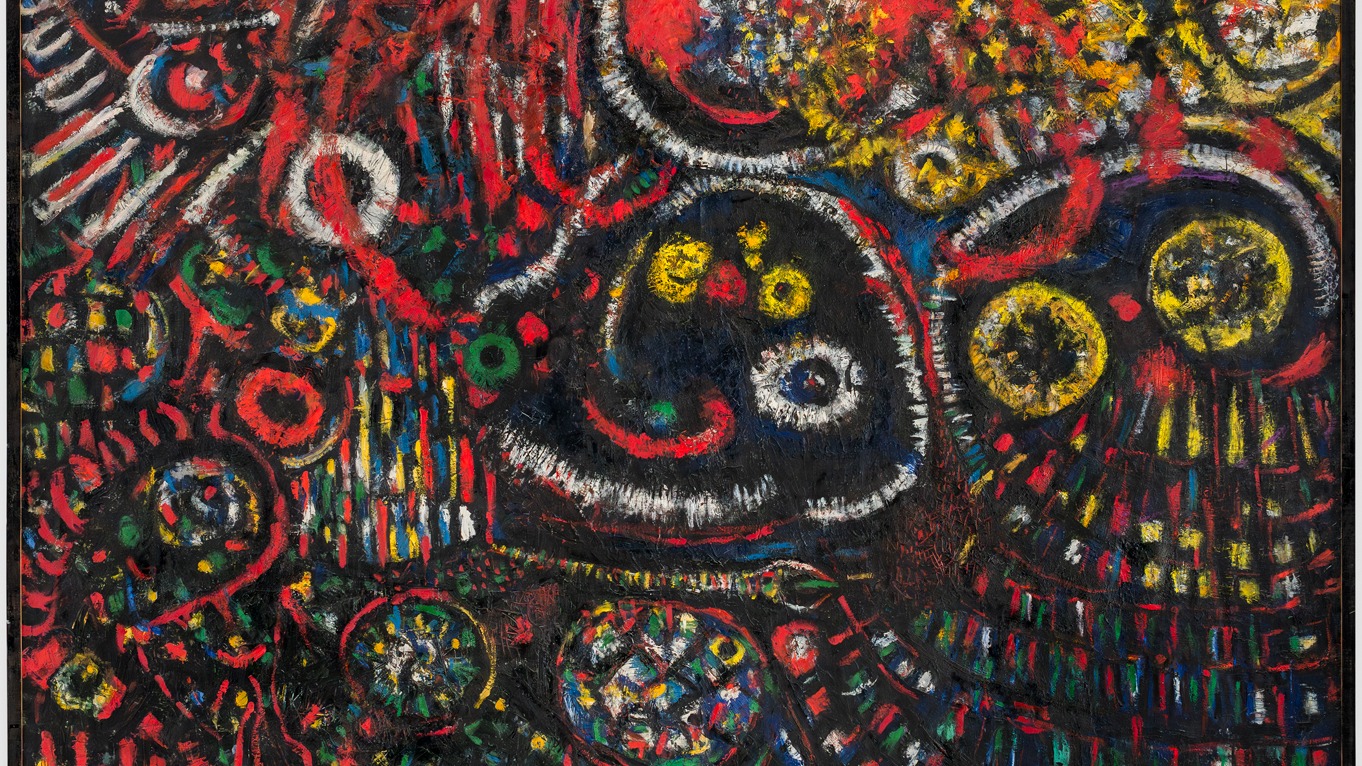
This darker, more turbulent phase is palpable in works like Alice in Wonderland (1955) and Depth (ca. 1953), where jagged markings and foreboding tones replace her earlier luminous geometry.
Yet, the exhibition does not leave us in the dark.
As the 1960s dawned, Zeid found refuge on the Italian island of Ischia. The trauma of her London exile began to lift, giving way to the sublime.
In Ischia Terra Incognita (1961), the canvas explodes into a red and yellow maelstrom, transforming an evening sky into an event of pure, unadulterated energy.
Reflecting on her own practice in 1950, Zeid wrote: “I am a means to an end. I transpose the cosmic, magnetic vibrations that rule us.”
Standing amidst the monumental works at Dirimart, it’s clear she achieved exactly that. She didn’t just survive the shifting tides of 20th-century history; she swallowed them whole, mixing them on her palette, and painting them back out as entirely new universes.
[ad_2]
Source link