

[ad_1]

The emergence of the Classical style in Greek sculpture marked the beginning of naturalism in art, a pivotal turning point in Western art that would influence generations for centuries.
It represented a complete departure from the Archaic style, as sculptors sought a deeper understanding of the human form and spirit. This new approach embraced a more realistic vision of humanity, striving for ideal perfection. As art historian Jerome J. Pollitt observes, “Classical Greek art is an art of reasoned clarity, of controlled emotion, and of a belief in the capacity of man.”
During the early 5th century BC, Greek sculptors of the Classical era developed a visual language focused on harmony, balance, and controlled movement. Their groundbreaking work led to the establishment of the Classical style, inspiring artists for centuries and leaving behind masterpieces of unparalleled skill and beauty.
From the rigid Archaic style to the new Classical style of Ancient Greek sculpture
Before the emergence of the Classical style in Ancient Greek sculpture, art during the Archaic period was largely confined to formulaic conventions. The statues of the kouroi and korai were elegant yet rigid: hair was patterned, postures were stiff, and the famous “Archaic smile” was always present. Their forms were well defined, but they often resembled abstractions of humans—more schematic than natural.
The Classical style did not entirely replace the Archaic; rather, through a gradual process of refinement, it culminated in a profound artistic renewal. As archaeologist Gisela Richter noted, “The Archaic artist was constantly striving toward realism, even when conventions still constrained him.” Sculptors were increasingly studying anatomy in detail and experimenting with variations in stance, expanding both their technical skills and their understanding of the human form. Artists also became more invested in reason and the exploration of beauty.
Yet a new spark was needed to transform this incremental progress into a full-fledged stylistic revolution.
Historical forces shook Greek sculpture
In the early 5th century BC, Greece experienced major historical events that shook entire societies. The most dramatic catalyst for artistic change was the Persian Wars (490–479 BC). The defeat of the Persian invaders instilled a profound sense of confidence and cultural pride, particularly in Athens. A new political climate—marked by collective action, civic responsibility, and the rise of democracy—encouraged artists to explore fresh representations of humanity.
At the same time, innovation was a key element of workshops. Greek sculptors gained greater access to high-quality marble, while bronze casting techniques became increasingly sophisticated. Bronze proved especially transformative, allowing for extended limbs, freer poses, and dynamic compositions that would have been difficult—or even impossible—to achieve in stone. These advances inspired sculptors to study the human figure not as a symbolic form but as a living, moving body.
Art historian Jerome J. Pollitt captures the spirit of this early Classical moment, noting that Greek artists “began to see man in a new way, as an individual whose actions and reactions were conditioned by internal as well as external forces.” This turn toward both psychological and physical realism laid the foundation for the emerging artistic style.
The Kritios Boy
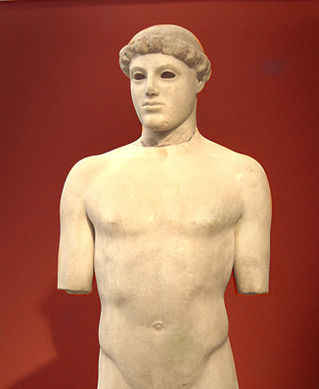
If any sculpture can be considered the first clear expression of the Classical style, it is the Kritios Boy (circa 480 BC). Art historians and archaeologists often cite it as the earliest statue to display true contrapposto, marking a breakthrough in representing the body’s natural weight shift. In the Kritios Boy’s stance, the hips tilt, the spine curves, and the entire figure seems poised in a moment of relaxed awareness.
Art historian John Boardman observes that the Kritios Boy “is the first figure in Greek sculpture that convinces us of a living body beneath the surface.” Several innovations contribute to this sense of a “living body”:
- The young man no longer wears the Archaic smile; instead, his face shows quiet seriousness.
- His body is modeled with soft transitions rather than rigid outlines.
- His pose reflects both gravity and internal balance.
Although the sculpture is not perfectly preserved, its impact is unmistakable. For the first time, the figure appears not as a formula or pattern but as a real person.

The Severe style
The first decades of the Classical period—roughly 480 to 450 BC—are often referred to as the Severe style, a term meant to capture the sober, restrained mood of the era. This new style emphasized clarity of form, calm expressions, and a certain austerity in drapery and gesture.
Art historian Jerome J. Pollitt describes the Severe style as “a conscious rejection of the ornamental and the formulaic, a turning instead toward solemnity, truth, and structure.” These sculptures seem to look inward, their expressions thoughtful or even stern, reflecting both the weight of the postwar period and a growing fascination with moral character, or ethos.
Notable examples of this style include:
- The bronze Charioteer of Delphi (circa 470 BC), whose stillness conveys self-control rather than rigidity, with eyes that seem to engage the viewer.
- The statues from the Temple of Zeus at Olympia (circa 470–456 BC), depicting mythological figures with heroic bodies yet serious, introspective faces.
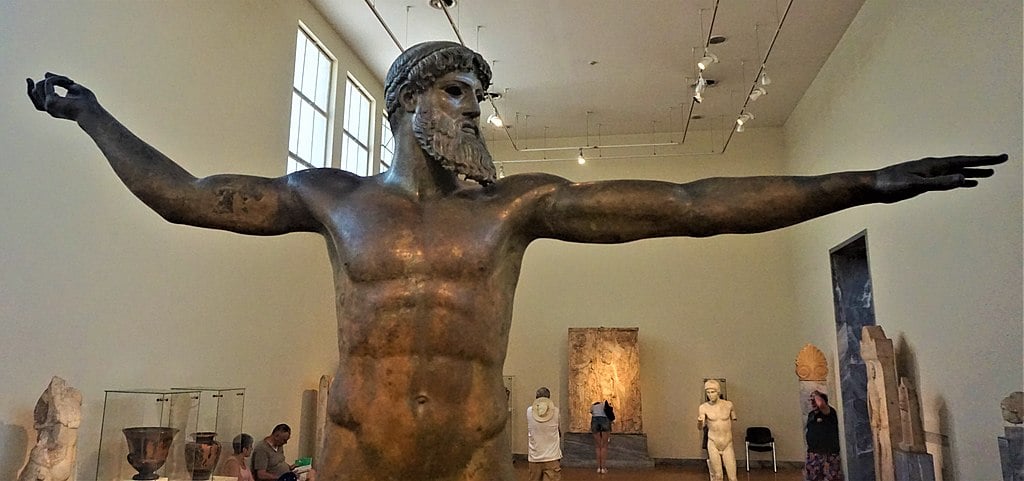
- The Artemision Bronze (either Zeus or Poseidon), which embodies controlled athletic power instead of dramatic tension.
Myron and motion
By the middle of the 5th century BC, sculptors were pushing Classical naturalism even further, particularly in their study of movement. Myron, an Athenian bronze sculptor, emerged as a pivotal figure in this exploration.
His most famous work, the Discobolus (Discus Thrower), is known today through Roman marble copies. The athlete is captured at the peak of action, just before releasing the discus. The pose is highly complex: limbs extend in opposite directions, the torso twists, and every line conveys a momentary yet explosive tension.
Art historian John Boardman notes that Myron “captured the visual truth of movement, not by exaggeration but by understanding the mechanics of the action.” Rather than creating a sculpture that merely appears dramatic, Myron carefully observed how bodies behave under physical strain.
The Discobolus also reflects the Classical Greek attention to rational order. Despite the complexity of the pose, the composition remains balanced and harmonious. The figure’s body forms a sweeping arc, demonstrating the sculptor’s mastery of geometry and rhythm. The result is both dynamic and controlled—a hallmark of the Classical ideal.
The Polykleitos Canon
If Myron became the master of motion in Classical Greek sculpture, Polykleitos of Argos concentrated on proportion, harmony, and the “perfect” human figure. His theoretical treatise, known simply as the Canon, outlined mathematical principles for sculpting the body. Although the original text is lost, ancient writers described it as a system of ratios that defined the ideal male nude.
Polykleitos’ most famous work, the Doryphoros (Spear Bearer), embodies these principles in physical form. The sculpture stands in a fully developed contrapposto pose: the weight rests on one leg, the hips tilt, and the shoulders counterbalance accordingly. Yet nothing appears exaggerated; the figure conveys both inner composure and outward harmony.
Art historian Gisela Richter highlighted Polykleitos’ impact, noting, “For the Greeks, Polykleitos became the measure of what was perfect in the human body.” The Doryphoros does not represent a specific individual but a universal type—the idealized young male, combining strength and serenity. Polykleitos formalized what earlier sculptors had approached intuitively, providing future artists with a clear method for achieving balanced proportions through mathematics.

Philosophy and the Classical style in Ancient Greek sculpture
Polykleitos elevated the Classical style, treating aesthetic achievement as both mathematical and philosophical, not merely visual. Sculpture was not just a matter of artistic technique; it was closely connected to the intellectual currents of the time. In the 5th century BC, Greek thinkers increasingly pursued rational inquiry, careful observation of nature, and the search for universal principles—all of which influenced the art of sculpture.
The notion that beauty arises from proportion reflects philosophical ideas found in the work of Pythagoras, who linked harmony in music to mathematical ratios. Likewise, the Classical emphasis on human dignity and self-control resonates with early ethical thought. Art historian Jerome J. Pollitt emphasizes this connection, observing that “Classical art in Greece is inseparable from the intellectual belief that man can comprehend and shape the world through reason.” Sculptors were not merely imitators of nature; they were investigators of form, structure, and meaning.
New techniques brought the expansion of possibility
The transition to the Classical style in sculpture was also fueled by technical innovation. Bronze casting, particularly through the lost-wax method, enabled lighter, more daring compositions. Bronze statues could balance on one leg, extend their arms into space, or twist their bodies dramatically without risk of breaking.
Artists often translated these bronze originals into marble copies, frequently crafted by Roman artisans. Marble, however, imposed certain limitations: supporting struts were needed, and some fine details were lost. Despite these constraints, the widespread distribution of these copies helped preserve the legacy of Classical sculpture.
Another key development was the increasing skill in carving drapery. Early Severe style drapery was simple and heavy, but by the mid-Classical period, artists such as Phidias and other sculptors of the Parthenon achieved a mastery often called “wet drapery.” The cloth appears to cling to the body as if damp, revealing the underlying anatomy while maintaining graceful folds. This technique exemplifies the Classical style’s interest in uniting idealism with naturalistic detail.
The human being at the center
The Classical style in Greek culture placed the human figure at the heart of artistic creation. While Egyptian, Assyrian, and earlier Greek art also depicted the human body, the Classical period gave it unprecedented attention and philosophical significance.
Historian and archaeologist John Boardman observed, “No artistic tradition has ever placed such sustained confidence in the human figure as a measure of all things.” The task of the Greek sculptor was not merely to replicate nature, but to refine it—expressing what humanity could aspire to be. The new style combined careful observation, mathematical principles, emotional expression, and civic ideals into a distinctive vision of human perfection.
Greek sculptors of the Classical era pursued a deeper understanding of the human form and spirit, embedding it in their art. They left behind a remarkable legacy of works that have survived for over two millennia, continuing to influence countless artists and inspire future generations.
[ad_2]
Source link