
[ad_1]
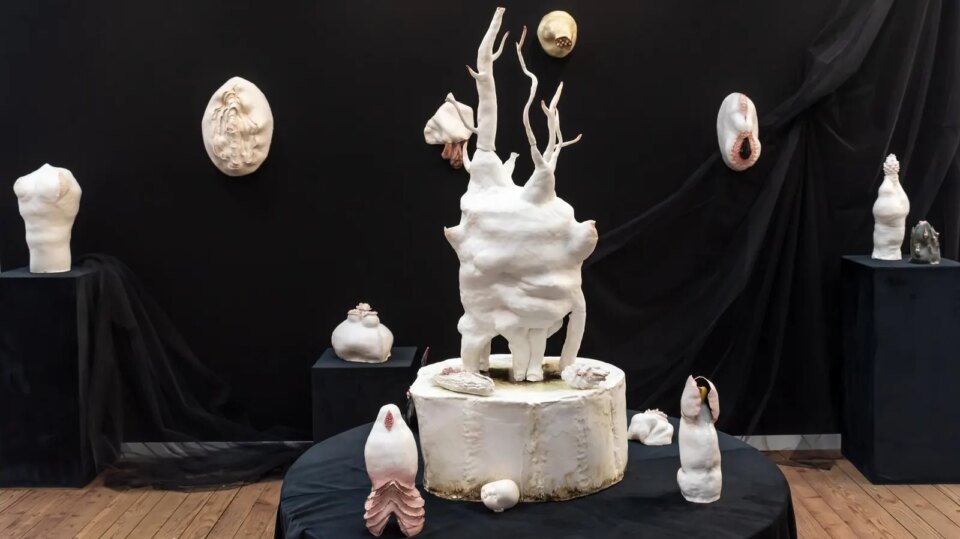
Hà My Nguyễn solo show at the Galerie Bao booth at Asia Now 2025 at the Monnaie de Paris
Photo Nancy Karam. Courtesy of Galerie Bao
Marking its 11th edition at the Monnaie de Paris, Asia Now returns with fresh energy and a clear sense of purpose. Cofounded by Alexandra Fain and her father a decade ago as Europe’s first fair dedicated to Asian contemporary art, it has grown from 18 to nearly 70 galleries, expanding its reach from East Asia to the Middle East. This year’s theme “Grow” positions art as fertile ground for empathy, transformation and collective flourishing. This year, Asia Now places West and South Asia at the center of its programming, with presentations by institutions such as the Lahore Biennale Foundation and Colomboscope, and new sections like The Third Space, which celebrates hybridity and experimental collaboration.
Highlights include first-time exhibitor Arario Gallery from Seoul presenting “Lottery Village” by Kim Soun-Gui who turns discarded lottery cards into a philosophical meditation on chance, stocks and contemporary life; Galerie Bao showcasing a solo show by Hà My Nguyễn’s whose “Flesh and Leaf, Sap and Seed” conjures an uncanny ecosystem where hybrid fruits and female forms bloom in ceramics, watercolors and drawings; and Sabrina Amrani exhibiting mentalKLINIK, Manal AlDowayan, Waqas Khan, Timo Nasseri and Jong Oh. Also on view are a series of delicate, embroidered silk and nylon thread sculptures called “Transience Monuments” by Sumakshi Singh suspended from the ceiling—presented jointly by Tak Contemporary and 193 Gallery—and a striking performance-installation in the central courtyard by Lebanese artist Pascal Hachem examining the fragility of memory and community through everyday materials. With galleries from Dubai, Shanghai and Singapore to AlUla, Berlin and Paris, Asia Now continues to expand what “Asia” means in art today: not a geography, but a vibrant, borderless network of ideas. Fain reflects on a decade that has reshaped how Europe views Asian contemporary art.
Artist Lee Hyun Joung at the Louis & Sack gallery at Asia Now
Photo Lionel Belluteau
You founded Asia Now in 2015. Why was the timing right a decade ago to establish the fair? Was there a lack of demand for Asian contemporary art in Europe back then, and how has Asia Now evolved over the past 10 years?
When Asia Now launched in 2015, the European art market was still very compartmentalized. Asian contemporary art was often shown in fragments—dominated by the so-called “Chinese bubble” and filtered through a Western lens that favored a few artists fitting familiar narratives. Pan-Asian or East-East exchanges conversations were rare. I sensed a need for a platform that could offer a more in-depth and genuine reflection of what I was witnessing firsthand during my field trips to Beijing, Shanghai, Singapore, Tokyo and Seoul—a space that reflected the true diversity and vitality of Asian art on its own terms.
That vision took shape exactly 10 years ago in 2015 in Venice, where our first project—featuring Zheng Guogu with Vitamin Creative Space and Galerie Chantal Crousel, curated by Martina Köppel-Yang in collaboration with the dslcollection—coincided with the collateral exhibition “Your East Is My West”, curated by Natasha Ginwala with the support of the Gujral Foundation. Featuring Rashid Rana and Shilpa Gupta, it highlighted the multi-centered reality of the world, which remains today a mantra for Asia Now, both a vision and direction. More than a geography, Asia Now treats “Asias” as a methodology—fluid and beyond borders.
Sabrina Amrani booth at Asia Now
Photo courtesy of Asia Now
How many art galleries are participating in the fair this year, and how does it compare with previous years?
In 10 years, I would say the fair has tripled in size: from 18 galleries in 2015, mainly coming from China, Hong Kong, Taipei and Southeast Asia, to a broader version of “Asias” stretching from Central Asia to Asia Pacific, spanning West Asia, South and Southeast Asia, as well as East and North Asia—51 territories in total, almost as large as Africa! For the 2025 edition, we are happy to welcome 68 participants. What’s exciting is not just the number but the diversity: Lahore, Colombo, Riyadh, AlUla and Tashkent are among the new centers we are happy to help bring to the international stage, even as they are themselves becoming key hubs of the global contemporary art world. The fair’s community has expanded organically, reflecting the dynamism of art scenes that are no longer peripheral but genuinely central to global conversations.
Is Asia Now still the only art fair in Europe dedicated to Asian contemporary art, and why do you embrace a vision of plural “Asias”, with West Asia and South Asia at the heart of this year’s programming?
Asia Now remains the only European fair devoted entirely to the artistic scenes of Asia and its diaspora—and that exclusivity comes with responsibility. From the beginning, we wanted to move away from a singular, monolithic idea of “Asia”. The 2025 edition places West Asia and South Asia at the center, recognizing that regions like AlUla, Sharjah, Lahore and Colombo are now vibrant hubs shaping global art discourse. Our vision of plural “Asias” affirms that contemporary creation today is inherently interconnected—it’s about building affective communities across geography, history and imagination.
Performance by Hiromi Tango at the Cuturi Gallery booth at Asia Now
Photo Lionel Belluteau
We believe, with our curators this year—Anissa Touati, researcher at Brown University and artistic director of the Biennale of Ceramics in Greece, John Tain, curator of the Lahore Biennale 03, Arnaud Morand, independent curator and head of arts for the French Agency for AlUla Development, Natasha Ginwala and Hajra Haider Karrar, guest curator of the next edition of Colomboscope in 2026—that art is a space where creativity can flourish—perhaps one of the only places where we can still expand, in solidarity, by collectively celebrating the worlds of others. We firmly believe in the infinite territories that art can open up and of its power to bring us closer together.
[ad_2]
Source link