
[ad_1]
The exhibition area at the Living Traditions Centre, Bikaner House, Delhi, has transformed into a warm and playful living space. Segmented into rooms such as a study, children’s corner and master bedroom, the setting is reminiscent of home. Within this space, you can engage with works of 18 artists, including Arshi Irshad Ahmad zai, Indu Antony, Chitra Ganesh, Yogesh Ramkrishna, Moonis Ijlal and Sunil Gupta. The idea is to steer clear of the conventional white cube space and showcase how art can inhabit lived spaces and coexist with everyday routines and objects. This novel display, Taqiya Qalaam, has been curated by Priyanshi S. and designed by Amrita Guha and Joya Nandurdikar of Untitled Designs, a multidisciplinary design practice.
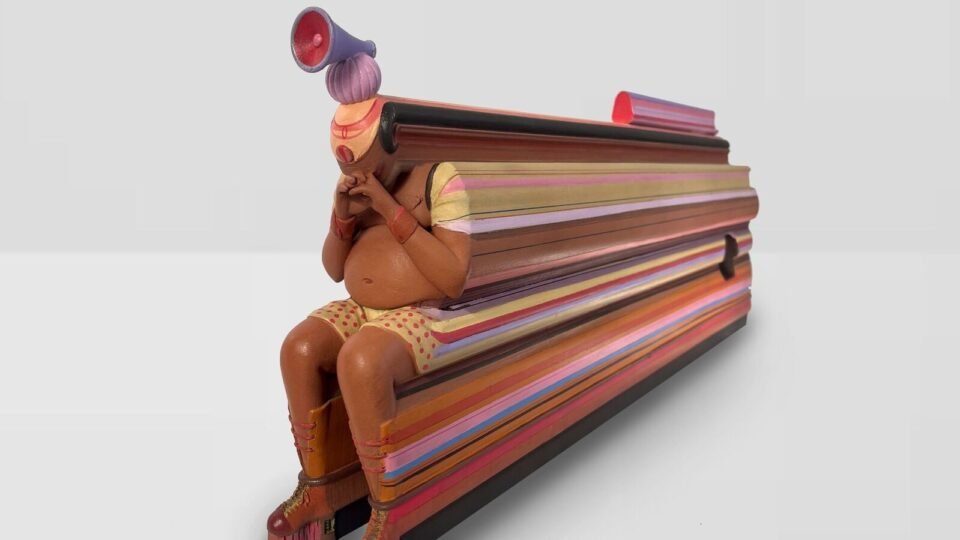
The show is part of the eighth edition of the Delhi Contemporary Art Week, a collaboration of six galleries—Latitude 28, Shrine Empire, Gallery Espace, Blueprint 12, Exhibit 320 and Vadehra Art Gallery— to spotlight shifts in South Asian contemporary art in terms of themes, materiality and mediums. The event, which is an annual fixture in the Capital’s art calendar, also includes a “Sculpture Show” in the Main Building of Bikaner House, featuring works by 15 artists, and micro exhibitions by the participating galleries at the Centre for Contemporary Art.
Taqiya Qalaam is in sync with Priyanshi’s larger practice to “make art entertaining, open up access and create innovative exhibition structures” that engage contemporary audiences. The exhibition draws from the phrase taqiya qalaam, or “word on the street” in Hindustani, which is part of everyday parlance. It explores “the effects, and affects of language, and words from different sources and contexts on our understanding of reality, and truth,” states the curatorial note.
According to the Delhi-based curator, the show has roots in the way words are often used/misused in the construction of ideas around something as basic as our identity to something as grand as our vision for an ideal society. “The concept of what a taqiya qalaam is and how it comes into being is slightly complex. Some phrases organically acquire that status. However, we have also seen examples in history that the state implants certain words in social consciousness to create taqiya qalaam,” says Priyanshi, who is also an art adviser and founder, Indian Art Market, an initiative that connects the art ecosystem with tier 2 cities and beyond.
The works by the 18 participating artists don’t just address this theme but also look at broader issues of self-censorship and the cost of expression. However, the show has not been constructed as an academic exercise, rather it looks at art as a means of conversation within spaces that we inhabit daily. Priyanshi calls this endeavour a means to create “pret art market”, in which works are ready to be purchased there and then depending on the way they speak to you. “By entering a living space, you can imagine how this work will fit into your house, complete with the practicalities and logistics of hanging it and caring for it. A lot of my clients are not collectors in the technical sense. They just like art and buy it. I want to show that you don’t need to have a certain kind of lifestyle to buy art, wherein you need an entourage of staff to take care of it,” she explains.
The works start from ₹20,000. This is also an opportunity for younger people, or those entering the world of art, to familiarise themselves with different artistic styles. None of the artworks on display carry any captions; nor does the show fea ture any wall text. As a viewer, you get to engage purely with the artwork, entering into a conversation with the visual in front of you. “For instance, not everyone might know who Sunil Gupta is (and his autobiographical interventions to re-centre subjects such as racism and alternative sexuality). However, for a lot of queer men, who grew up in India in the 1980s-90s, his photographs would resonate immediately and deeply,” elaborates Priyanshi.

View Full Image
The team led by Untitled Designs has drawn inspiration from the spirit of South East Asian homes while envisaging the spaces. From conversations with people, for instance, came the understanding that maximum thought, energy and finances in any home are devoted to spiritual spaces. “So, Amrita and Joya have created a spiritual corner, bringing in works that are transcendental in their theme and treatment. It’s interesting to note that something as ubiquitous as spirituality can take on so many dimensions,” she adds. Guha and Nandurdikar have installed design elements—big and small—in narrow corridors and spaces in which you would not typically display art. “It shows the many ways in which you can showcase art—not just on the walls. I get a lot of requests for styling bookshelves. I make use of artworks, small sculptures and small frames—elements that you move as and when you acquire more works,” says Priyanshi.
Besides Taqiya Qalaam, the micro exhibitions by the six galleries showcase perti nent themes. At Blueprint 12, for instance, technology comes together with the handmade in Tanvi Ranjan’s work. The artist embeds binary codes into textile “as a way of encoding human presence within technological systems”. Displacement, shifts and transitions are overarching themes seen across gallery showcases. For instance,Where Dust Settles by Exhibit 320 presents works by artists such as Wahida Ahmed, Deena Pindoria and Suryakanta Swain, which look at the relationship between forced displacement and bureaucratic violence. Metaphorical and literal transitions and fractures are also addressed in Latitude 28’s In-Between/Beyond, featuring the works of 17 emerging and mid-career artists.
Then there is Intimacy/Ecstacy by Vadehra Art Gallery about boundaries of the body and the mind, and how they shape our lived experiences. “These thresholds, where we begin, end, and transform, are examined through deeply personal, poetic, and philosophical lenses. The exhibition invites viewers to consider how belonging, vulnerability, and transcendence are negotiated through our ever-shifting relationship with the inner and outer worlds we inhabit,” states Roshini Vadhera, director, Vadehra Art Gallery. This season, art seems to be about get ting into the crevices of everyday experiences to create cartographies of the mind and soul.
At Bikaner House, New Delhi, 30 August to 4 September.
[ad_2]
Source link