
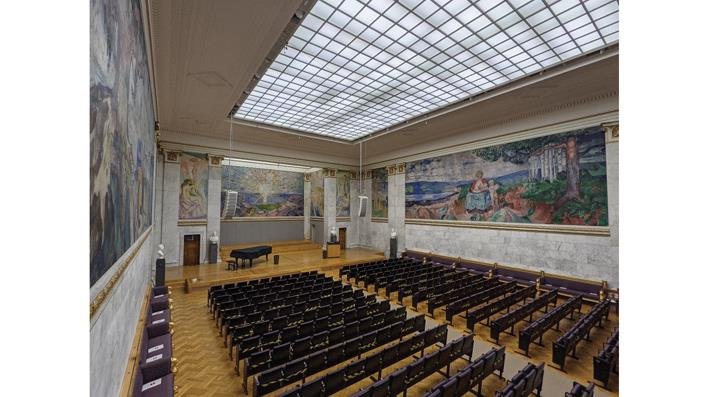
How can fragile, century-old oil paints – dulled with dirt, spread over vast areas, and exposed bare to the environment in absence of a varnish layer – be safely and consistently cleaned? And how can that cleaning process be accurately and scientifically documented as an ethical record of what has been done?
These are but a couple of questions that the conservator-restorers at the University of Oslo (UiO), charged with the care of the monumental oil paintings on canvas by Edvard Munch (1863-1944) – Norwegian father of the Expressionist movement, have been asking themselves for the past two decades. Ever since their inauguration in 1916 at the university’s festive hall – the Aula in central Oslo – these vivacious and colourful artworks have experienced myriad cycles of soiling through environmental pollution and subsequent conservation to clean their surfaces, rendering them ever more sensitive to degradation.
Those two questions were also the ones I attempted to answer during my doctoral research project, which I presented and successfully defended last June at UiO, examined tenaciously by the heads of the science departments at the Chicago Art Institute (Dr Francesca Casadio) and the Getty Conservation Institute in Los Angeles (Dr Tom Learner).
Now that some time has passed since that intense but crowning event, I can look back in hindsight and appreciate the journey that brought so much personal and professional growth, learning and reflection.
There I was, back in the autumn of 2019, arriving enthusiastically in Norway’s capital, eager to jump onto a new, challenging project, unaware of all the hard work and sacrifice ahead of me. Behind me were five years’ worth of experience working as a freelance conservator-restorer in Britain (where I had also read for my MA and MSc at University College London), in the Netherlands (where I started a conservation-restoration workshop with a friend and colleague) and also at archaeological sites in Egypt and Sudan. I had worked on monumental heritage in the context of historic interiors and the decorative arts – now it was time to apply myself to the challenges of working on monumental paintings.
The paintings in question, covering over 220m2 of surfaces over 11 artworks, were painted by Munch between 1909 and 1916, when Norway was under an international trade embargo during World War One, meaning that the artist had to get quite inventive with procuring and applying his materials. Questions on the artworks’ materiality and Munch’s technique had been predominantly researched by my PhD supervisor and principal investigator of the Munch Aula Paintings (MAP) project, Tine Frøysaker, Professor of Paintings Conservation Emerita at UiO.
The MAP project began in 2005, and throughout its course Prof. Frøysaker as well as Dr Lena Porsmo Stoveland, both paintings’ conservators involved in research, laid down the groundwork for addressing how these water-sensitive and friction-sensitive paints and exposed grounds (the ground layer is an application on canvas that is intended to receive the coloured paint – Munch’s paintings feature a significant amount of unpainted ground) can be safely cleaned.
My doctoral research project was framed within this context. Funded by one of the European Commission’s Marie Skłodowska-Curie Actions grants (no. 813789, under the innovative training network called Change – Cultural Heritage Analysis for New Generations), I was tasked with researching a new surface cleaning method that could effectively be applied on site (since the paintings are fixed on marouflage supports at height, starting at 3.5m going up to 8m from the floor) for the gentle removal of the acidic and hygroscopic dust films that were coating the degraded oil paints.
My previous experiences in dealing with environmentally sustainable treatments in conservation-restoration had familiarised me with agar gels used for surface cleaning. Agar is a thickening agent, expanded by water, composed of sugars extracted from red algae, which readers might be familiar with as a substitute for gelatine in the kitchen. The properties of agar gel render it an excellent candidate for the controlled delivery of cleaning solutions to painted surfaces. During my work, I experimented with a novel technique of applying agar gels across large surfaces – an agar spray that was first developed by the Sicilian conservator-restorer, Ambra Giordano (affiliated with the University of Palermo).
Conservation ethics dictate that cleaning trials should be first carried out on analogous mock-ups that are artificially soiled and aged so as to mimic the surfaces of the artworks being treated, and therefore a significant portion of my work revolved around the creation of paint and ground mock-ups. This process took over a year, after which the agar spray could be tested using various cleaning solutions to identify the most efficacious one that gave the most homogenous results across the painted surfaces.
For the evaluation of these cleaning tests, I drew on my background in chemistry and spectroscopy and collaborated with Change partners in order to apply an imaging technique – initially developed for satellites carrying out remote sensing in space – known as hyperspectral imaging (or reflectance imaging spectroscopy). The cameras that capture these images possess sensors that are sensitive to radiation with wavelengths ranging from 400nm to 2,500nm, meaning that they capture data in visible and infrared light. Through a series of complex data post-processing techniques called chemometrics, I tracked the effects of the cleaning process by measuring changes in the colorimetric properties of the pigments and in the molecular properties of the paint and ground binders (a paint is typically composed of a pigment in a binder, thus studying the changes in each of these components allows for a comprehensive investigation).
Furthermore, to better understand the application of the agar spray to Munch’s paintings, the materials of the paintings were also studied by hyperspectral imaging, and the environment in which they are displayed were studied by monitoring the deposition of dirt and the concentrations of pollutant gases in the Aula.
The findings from all of these branches of investigation have been published in my doctoral dissertation as well as in three Open Access articles in conservation journals, with two more articles slated for publication this year.
Overall, new insights into Munch’s materials, particularly the drying oil binders that he used, were achieved using non-contact and non-invasive methods. This was the first time that hyperspectral imaging was applied to the Aula paintings, and so the first spectrally accurate pigment maps (images which plot the presence of a particular pigment across a surface) for these artworks were published. The Aula environment was found to be much more oxidising than previously thought, and as a result a sister project to improve the climate in the room has been launched. With respect to the cleaning results, the agar spray was found to be a safe, effective and viable tool for dirt removal under specific conditions, with more work needed to fine-tune its application to the Aula paintings.
The bid to answer the questions posed at the start of this feature will thus continue onwards, given the vast and heterogenous surfaces of the paintings. The work I carried out laid down another stepping stone towards better caring for Munch’s monumental artworks, combining different streams of practice and research into an interdisciplinary framework. While the complexity of Munch’s paintings will continue to present challenges, it is this synergy of humanities, science and conservation – championed by many research consortia in addressing practical issues in the care of artworks – that promises a path forward in safeguarding this unique patrimony.
Jan Dariusz Cutajar is a conservator-restorer, trained in objects conservation (UCL) and holding a PhD in paintings conservation (UiO), with a professional specialisation in the conservation of decorative surfaces. He continues his work in Norway with current projects at the University of Oslo, the Norwegian Parliament, the Norwegian Armed Forces Museums and the Norwegian Royal Palaces. His PhD thesis, ‘Surface cleaning & spectral imaging’, will be publicly available at the Norwegian Research Information Repository late this year (copies may be requested personally until then). He is available for consultation and commissions and may be contacted at [email protected]